Nepal Lavender oil Market Size, Share & Growth Rate
The Nepal Lavender oil Market was estimated at USD 198 Million in 2025 and is projected to reach USD 275 Million by 2032, growing at a CAGR of 4.8% from 2026 to 2032. This promising trajectory is largely driven by a surge in consumer preferences for natural and organic beauty and wellness products. As awareness about the therapeutic benefits of lavender oil continues to grow, both domestically and internationally, the market is well-positioned for sustained expansion.
Nepal Lavender oil Market Year-wise Growth Rate and Key Drivers
This graph highlights how the Nepal Lavender oil Market has steadily grown over the years, supported by major growth factors.
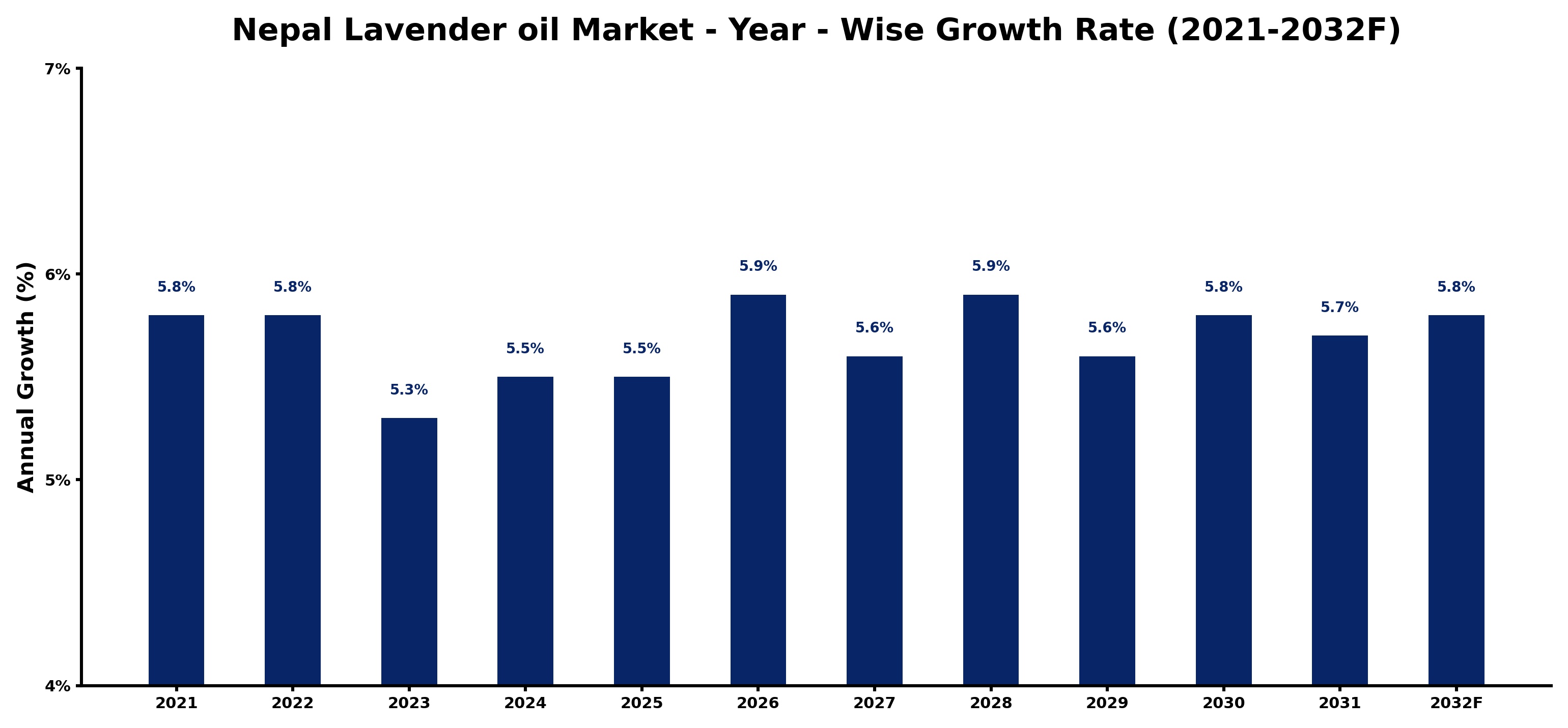
The table below presents the year‑wise growth rates along with the key drivers influencing the market
| Year | Growth Rate | Major Drivers |
| 2021 | 5.8% | Increasing industrial infrastructure investments |
| 2022 | 5.8% | Expansion of commercial construction activities |
| 2023 | 5.3% | Expansion of transportation and logistics networks |
| 2024 | 5.5% | Expansion of commercial construction activities |
| 2025 | 5.5% | Expansion of manufacturing activities |
| 2026 | 5.9% | Expansion of manufacturing activities |
| 2027 | 5.6% | Expansion of manufacturing activities |
| 2028 | 5.9% | Increasing industrial automation investments |
| 2029 | 5.6% | Government infrastructure modernization initiatives |
| 2030 | 5.8% | Growing renewable energy integration projects |
| 2031 | 5.7% | Increasing industrial infrastructure investments |
| 2032 | 5.8% | Expansion of transportation and logistics networks |
Note - Market size estimations and growth projections presented in this report are based on 6Wresearch's advanced forecasting approach, validated with industry datasets as of June 2026.
Nepal Lavender oil Market Synopsis
The recent momentum in the Nepal lavender oil market reflects a growing inclination toward natural ingredients in personal care and wellness. This trend is set against a backdrop of increasing global demand, which presents lucrative opportunities for local producers. Looking forward, the market is expected to build upon this momentum, as consumers increasingly embrace the holistic properties of lavender oil.
As sustainability and ethical sourcing gain traction, the appeal of Nepal's high-quality lavender oil only strengthens. This contrasts sharply with past periods of limited recognition and understanding of lavender's benefits, setting the stage for a robust future characterized by innovation and market growth.
Nepal Lavender oil Market Key Takeaways
- The market is benefiting from a growing global interest in natural and organic products.
- Consumers are increasingly drawn to lavender oil for its calming and therapeutic properties.
- Sustainable and ethically sourced products are becoming significant purchase drivers.
- The rise of e-commerce platforms enhances product accessibility for consumers.
- Investment opportunities are ripe for establishing lavender farms and distillation facilities.
Evaluation of Restraints in Nepal Lavender oil Market
Despite the optimism, the Nepal lavender oil market faces several restraints that could hinder its growth trajectory. Limited consumer awareness regarding the benefits and uses of lavender oil persists, which impacts demand. Additionally, inconsistencies in quality standards and a lack of a robust regulatory framework can lead to challenges surrounding product authenticity and quality control. Moreover, competition from countries with established lavender oil industries poses a significant challenge for Nepali producers who seek to carve out market share on a global scale.
Nepal Lavender oil Market Trends
Several trends are shaping the Nepal lavender oil market, notably the increasing preference for natural beauty and wellness products. Aromatherapy practices are gaining popularity, with lavender oil being a favored ingredient due to its relaxation and stress-relief benefits. Furthermore, the demand for sustainable and ethically sourced ingredients has become more prominent, prompting producers to adopt organic certifications and eco-friendly farming practices.
The digital revolution has also transformed purchasing behaviors. The rise of e-commerce platforms allows consumers to access a diverse range of lavender oil products conveniently, driving market growth. As these trends continue to evolve, the Nepal lavender oil market is likely to adapt and flourish.
Nepal Lavender oil Market Opportunities
Investment opportunities in the Nepal lavender oil market are abundant, especially considering the country's ideal climatic conditions for cultivating high-quality lavender. Investors can capitalize on growing global demand by establishing lavender farms or partnering with local farmers for raw material sourcing. The potential for setting up distillation facilities and exporting finished products to international markets also presents an attractive prospect. Additionally, the development of value-added products like lavender-infused skincare and personal care items can further enhance growth, given the market's inclination toward natural solutions.
Government Initiatives in the Nepal Lavender oil Market
While the Nepalese government does not have specific policies dedicated to the lavender oil market, its agricultural policies aim to promote the cultivation of high-value crops, including aromatic plants. Supportive measures such as subsidies, training programs, and access to credit facilities are provided to farmers. The government also emphasizes sustainable agricultural practices, ensuring that the quality and purity of essential oils produced align with growing consumer expectations for high-quality products.
Future Insights of the Nepal Lavender oil Market
The outlook for the Nepal lavender oil market from 2026 to 2032 is distinctly positive, as consumer awareness regarding the therapeutic benefits of lavender oil continues to rise. As the global shift toward natural and organic products gains momentum, Nepal stands to benefit significantly, thanks to its favorable agricultural conditions. The expanding popularity of aromatherapy and holistic wellness approaches is likely to further boost market demand. As sustainable practices become a crucial consideration for consumers, Nepal's lavender oil market appears poised for expansion and innovation.
Nepal Lavender oil Market Latest Developments (May 2025 - June 2026)
Recent developments in the Nepal lavender oil market indicate an increased focus on quality control measures and sustainable farming practices. Producers are investing in modern distillation techniques to enhance product quality, while initiatives promoting local lavender farming are gaining traction. Additionally, collaborative efforts to educate consumers about the benefits of lavender oil are being implemented, aiming to improve market awareness and stimulate demand.
Nepal Lavender oil Market - Key Attractiveness of the Report
- 10 Years of Market Numbers
- Historical Data Starting from 2022 to 2025
- Base Year: 2025
- Forecast Data until 2032
- Key Performance Indicators Impacting the Market
- Major Upcoming Developments and Projects
Key Highlights of the Report:
- Nepal Lavender oil Market Outlook
- Market Size of Nepal Lavender oil Market, 2025
- Forecast of Nepal Lavender oil Market, 2032
- Historical Data and Forecast of Nepal Lavender oil Revenues & Volume for the Period 2022-2032F
- Nepal Lavender oil Market Trend Evolution
- Nepal Lavender oil Market Drivers and Challenges
- Nepal Lavender oil Price Trends
- Nepal Lavender oil Porter's Five Forces
- Nepal Lavender oil Industry Life Cycle
- Historical Data and Forecast of Nepal Lavender oil Market Revenues & Volume By Application for the Period 2022-2032F
- Historical Data and Forecast of Nepal Lavender oil Market Revenues & Volume By Food and Beverage for the Period 2022-2032F
- Historical Data and Forecast of Nepal Lavender oil Market Revenues & Volume By Cosmetic for the Period 2022-2032F
- Historical Data and Forecast of Nepal Lavender oil Market Revenues & Volume By Pharmaceutical for the Period 2022-2032F
- Historical Data and Forecast of Nepal Lavender oil Market Revenues & Volume By Distribution Channel for the Period 2022-2032F
- Historical Data and Forecast of Nepal Lavender oil Market Revenues & Volume By Pharmacy and Drug Stores for the Period 2022-2032F
- Historical Data and Forecast of Nepal Lavender oil Market Revenues & Volume By Health and Beauty Stores for the Period 2022-2032F
- Historical Data and Forecast of Nepal Lavender oil Market Revenues & Volume By Online Retailing for the Period 2022-2032F
- Historical Data and Forecast of Nepal Lavender oil Market Revenues & Volume By Others for the Period 2022-2032F
- Nepal Lavender oil Import Export Trade Statistics
- Market Opportunity Assessment By Application
- Market Opportunity Assessment By Distribution Channel
- Nepal Lavender oil Top Companies Market Share
- Nepal Lavender oil Competitive Benchmarking By Technical and Operational Parameters
- Nepal Lavender oil Company Profiles
- Nepal Lavender oil Key Strategic Recommendations






































