Brazil Medical Imaging Equipment Market Summary
The brazil medical imaging equipment market was estimated at USD 219 Million in 2025 and is projected to reach USD 260 Million by 2032, growing at a CAGR of 2.7% from 2026 to 2032.
Brazil Medical Imaging Equipment Market Year-wise Growth Rate and Key Drivers
This graph highlights how the Brazil Medical Imaging Equipment Market has steadily grown over the past five years, supported by major growth factors.
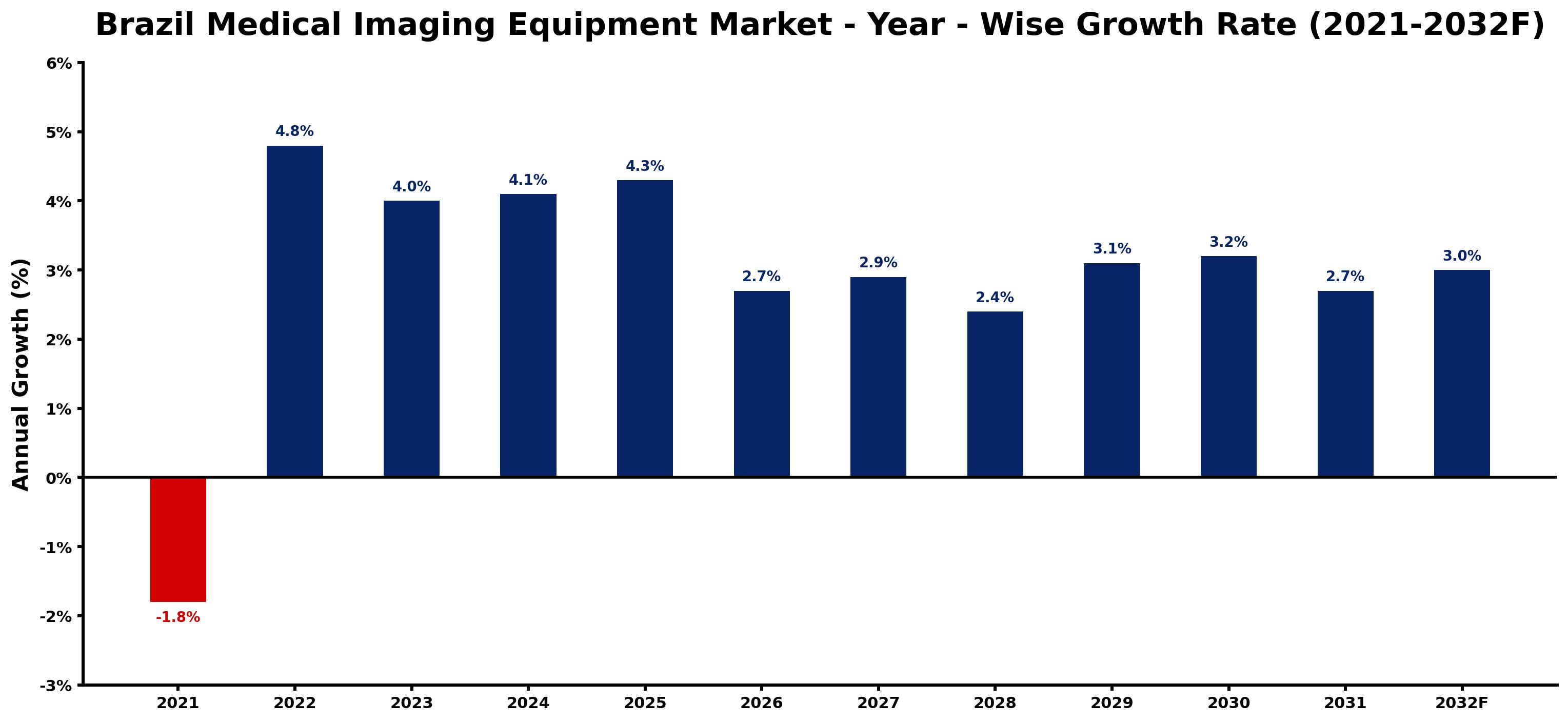
The table below presents the year wise growth rates along with the key drivers influencing the market
| Year | Growth Rate | Major Drivers |
| 2021 | -1.8% | Supply chain disruptions due to pandemic restrictions hindered equipment availability and delayed purchasing decisions. |
| 2022 | 4.8% | Investment in healthcare infrastructure accelerated, particularly in urban areas across Brazil. |
| 2023 | 4.0% | Telemedicine integration necessitated high-quality imaging for remote diagnosis and treatment. |
| 2024 | 4.1% | Aging population spurred demand for advanced imaging to manage chronic diseases effectively. |
| 2025 | 4.3% | Local manufacturers entered the market, enhancing competition and lowering equipment costs. |
| 2026 | 2.7% | Partnerships between hospitals and tech firms fostered innovative imaging solutions tailored for Brazil. |
| 2027 | 2.9% | Emerging health insurance models incentivized hospitals to upgrade imaging capabilities significantly. |
| 2028 | 2.4% | Rural healthcare initiatives expanded access to imaging technology in underserved locations. |
| 2029 | 3.1% | Government funding targeted modernization of diagnostic equipment across public health systems. |
| 2030 | 3.2% | Educational programs in radiology increased skilled professionals, supporting market growth and innovation. |
| 2031 | 2.7% | Technological advancements shifted focus toward portable and efficient imaging devices for clinics. |
| 2032 | 3.0% | Sustainability trends influenced manufacturers to produce eco-friendly imaging equipment alternatives. |
Note - Market size estimations and growth projections presented in this report are based on 6Wresearch's advanced forecasting approach, validated with industry datasets as of June 2026.
Brazil Medical Imaging Equipment Market Synopsis
The Brazil Medical Imaging Equipment Market is projected to reach 2.7% and witness significant growth during the forecast period (2026-2032). This dynamic sector is essential to the healthcare landscape in Brazil, playing a pivotal role in diagnostics and patient care. With advancements in technology that have led to the development of sophisticated imaging modalities, the market is experiencing a surge in demand, primarily driven by the increasing prevalence of chronic diseases and a rising emphasis on early detection. Healthcare providers are increasingly seeking portable and compact imaging solutions to broaden accessibility across diverse healthcare environments.
Brazil Medical Imaging Equipment Market Growth Drivers
Several critical factors are propelling growth in the Brazil Medical Imaging Equipment Market. Firstly, the continuous advancements in healthcare technology have significantly enhanced the quality and speed of medical imaging, making it easier for practitioners to diagnose conditions accurately. Secondly, the rising incidence of chronic diseases, including cardiovascular ailments and diabetes, heightens the demand for advanced imaging capabilities to support effective management and treatment protocols.
- The aging population is another major contributor to the market's expansion, as older individuals typically require more medical interventions and diagnostic testing.
- Government initiatives that focus on improving healthcare infrastructure also bolster the market by facilitating the adoption of advanced imaging systems in public and private healthcare institutions.
- The growing medical tourism sector in Brazil is increasing the demand for cutting-edge medical imaging technologies as international patients seek high-quality healthcare services.
- Moreover, an increase in healthcare expenditure, stimulated by both governmental and private sources, is further driving investments in medical imaging equipment.
Brazil Medical Imaging Equipment Market Challenges and Restraints
Despite its growth potential, the Brazil Medical Imaging Equipment Market faces several challenges. A significant concern is the high initial acquisition cost of advanced imaging equipment, which may deter healthcare institutions, particularly those in economically disadvantaged regions, from investing in the latest technology. Additionally, the ongoing maintenance costs associated with imaging devices can place a financial strain on healthcare providers.
- The rapid pace of technological advancements necessitates frequent upgrades, leading to further financial burdens on institutions that need to stay competitive.
- Regulatory compliance remains a complex issue, as healthcare providers must navigate stringent safety and operational guidelines to remain compliant.
- There is also a critical need for skilled professionals capable of operating sophisticated imaging technology, which is sometimes in short supply in Brazil.
- The uneven distribution of healthcare facilities across different regions exacerbates challenges related to access, limiting the availability of medical imaging services in remote areas.
- Economic fluctuations may impact public and private healthcare budgets, impacting investment in new imaging technologies and infrastructure.
Brazil Medical Imaging Equipment Market Government Investment and Initiatives
The Brazilian government has enacted various policies to enhance the medical imaging equipment sector, aimed at improving accessibility to advanced healthcare technologies. These initiatives include tax incentives for manufacturers of medical equipment, which encourage local production and innovation. Furthermore, the government provides subsidies to healthcare institutions that adopt state-of-the-art imaging technologies, facilitating their integration into public health frameworks.
- Regulatory frameworks are also in place to ensure that safety and efficiency standards are maintained, thereby fostering a competitive yet secure environment for medical imaging services.
- Investment in healthcare infrastructure is a priority, with plans to develop more state-of-the-art facilities that incorporate advanced imaging technologies.
- Public-private partnerships are being encouraged to stimulate investment in healthcare technologies, allowing for shared resources in research and development.
- Continued support for training programs aimed at developing a skilled workforce in the medical imaging field is essential to meet the growing demand for qualified professionals.
- Overall, these government initiatives aim to position Brazil as a leader in medical imaging, enhancing both domestic and international healthcare service offerings.
Brazil Medical Imaging Equipment Market Latest Developments (May 2025 - June 2026)
The period from May 2025 to June 2026 has seen notable developments in the Brazil Medical Imaging Equipment Market. Continuous innovations in imaging technology have emerged, including advancements in both software and hardware that enhance imaging clarity and speed. The industry is pivoting towards greater integration of artificial intelligence in diagnostic imaging, improving accuracy and reducing the time required for analysis.
- The market has experienced significant investment aimed at improving healthcare facilities, particularly in underserved areas, ensuring that advanced imaging services are available to a broader segment of the population.
- There has been a rising collaboration between healthcare providers and technology firms to develop new imaging solutions tailored to specific medical needs, highlighting a trend towards customized healthcare.
- Conferences and industry events focused on medical imaging technologies have gained momentum, serving as platforms for knowledge exchange and networking among professionals in the field.
- Regulatory bodies have introduced new standards that facilitate faster approval processes for innovative imaging technologies, thereby promoting quicker market entry.
- Healthcare providers are increasingly adopting mobile imaging units to reach patients in remote locations, expanding access to essential diagnostic services.
Brazil Medical Imaging Equipment Market - Key Attractiveness of the Report
- 10 Years of Market Numbers
- Historical Data Starting from 2022 to 2025
- Base Year: 2025
- Forecast Data until 2032
- Key Performance Indicators Impacting the Market
- Major Upcoming Developments and Projects
Key Highlights of the Report:
- Brazil Medical Imaging Equipment Market Outlook
- Market Size of Brazil Medical Imaging Equipment Market, 2025
- Forecast of Brazil Medical Imaging Equipment Market, 2032
- Historical Data and Forecast of Brazil Medical Imaging Equipment Revenues & Volume for the Period 2022-2032F
- Brazil Medical Imaging Equipment Market Trend Evolution
- Brazil Medical Imaging Equipment Market Drivers and Challenges
- Brazil Medical Imaging Equipment Price Trends
- Brazil Medical Imaging Equipment Porter's Five Forces
- Brazil Medical Imaging Equipment Industry Life Cycle
- Historical Data and Forecast of Brazil Medical Imaging Equipment Market Revenues & Volume By Product Type for the Period 2022-2032F
- Historical Data and Forecast of Brazil Medical Imaging Equipment Market Revenues & Volume By Magnetic resonance imaging equipment for the Period 2022-2032F
- Historical Data and Forecast of Brazil Medical Imaging Equipment Market Revenues & Volume By Compound tomography equipment for the Period 2022-2032F
- Historical Data and Forecast of Brazil Medical Imaging Equipment Market Revenues & Volume By X-ray equipment for the Period 2022-2032F
- Historical Data and Forecast of Brazil Medical Imaging Equipment Market Revenues & Volume By Ultrasound equipment for the Period 2022-2032F
- Historical Data and Forecast of Brazil Medical Imaging Equipment Market Revenues & Volume By Molecular equipment for the Period 2022-2032F
- Historical Data and Forecast of Brazil Medical Imaging Equipment Market Revenues & Volume By Application for the Period 2022-2032F
- Historical Data and Forecast of Brazil Medical Imaging Equipment Market Revenues & Volume By Cardiology for the Period 2022-2032F
- Historical Data and Forecast of Brazil Medical Imaging Equipment Market Revenues & Volume By Neurology for the Period 2022-2032F
- Historical Data and Forecast of Brazil Medical Imaging Equipment Market Revenues & Volume By Orthopedics for the Period 2022-2032F
- Historical Data and Forecast of Brazil Medical Imaging Equipment Market Revenues & Volume By Gynecology for the Period 2022-2032F
- Historical Data and Forecast of Brazil Medical Imaging Equipment Market Revenues & Volume By Oncology for the Period 2022-2032F
- Historical Data and Forecast of Brazil Medical Imaging Equipment Market Revenues & Volume By Others for the Period 2022-2032F
- Historical Data and Forecast of Brazil Medical Imaging Equipment Market Revenues & Volume By End user for the Period 2022-2032F
- Historical Data and Forecast of Brazil Medical Imaging Equipment Market Revenues & Volume By Hospitals for the Period 2022-2032F
- Historical Data and Forecast of Brazil Medical Imaging Equipment Market Revenues & Volume By Specialty clinics for the Period 2022-2032F
- Historical Data and Forecast of Brazil Medical Imaging Equipment Market Revenues & Volume By Diagnostic imaging centers for the Period 2022-2032F
- Historical Data and Forecast of Brazil Medical Imaging Equipment Market Revenues & Volume By Others for the Period 2022-2032F
- Brazil Medical Imaging Equipment Import Export Trade Statistics
- Market Opportunity Assessment By Product Type
- Market Opportunity Assessment By Application
- Market Opportunity Assessment By End user
- Brazil Medical Imaging Equipment Top Companies Market Share
- Brazil Medical Imaging Equipment Competitive Benchmarking By Technical and Operational Parameters
- Brazil Medical Imaging Equipment Company Profiles
- Brazil Medical Imaging Equipment Key Strategic Recommendations






































