Brazil Metal Fabrication Market Size, Share & Growth Rate
The Brazil Metal Fabrication Market was estimated at USD 80 Million in 2025 and is projected to reach USD 95 Million by 2032, growing at a CAGR of 2.5% from 2026 to 2032. This growth trajectory is primarily driven by increasing demand from key industries such as automotive and aerospace, where the need for precision and quality in fabricated metal products is paramount. Moreover, advancements in manufacturing technologies and the government's push for industrial diversification are anticipated to further fuel the market's expansion.
Brazil Metal Fabrication Market Year-wise Growth Rate and Key Drivers
This graph highlights how the Brazil Metal Fabrication Market has steadily grown over the years, supported by major growth factors.
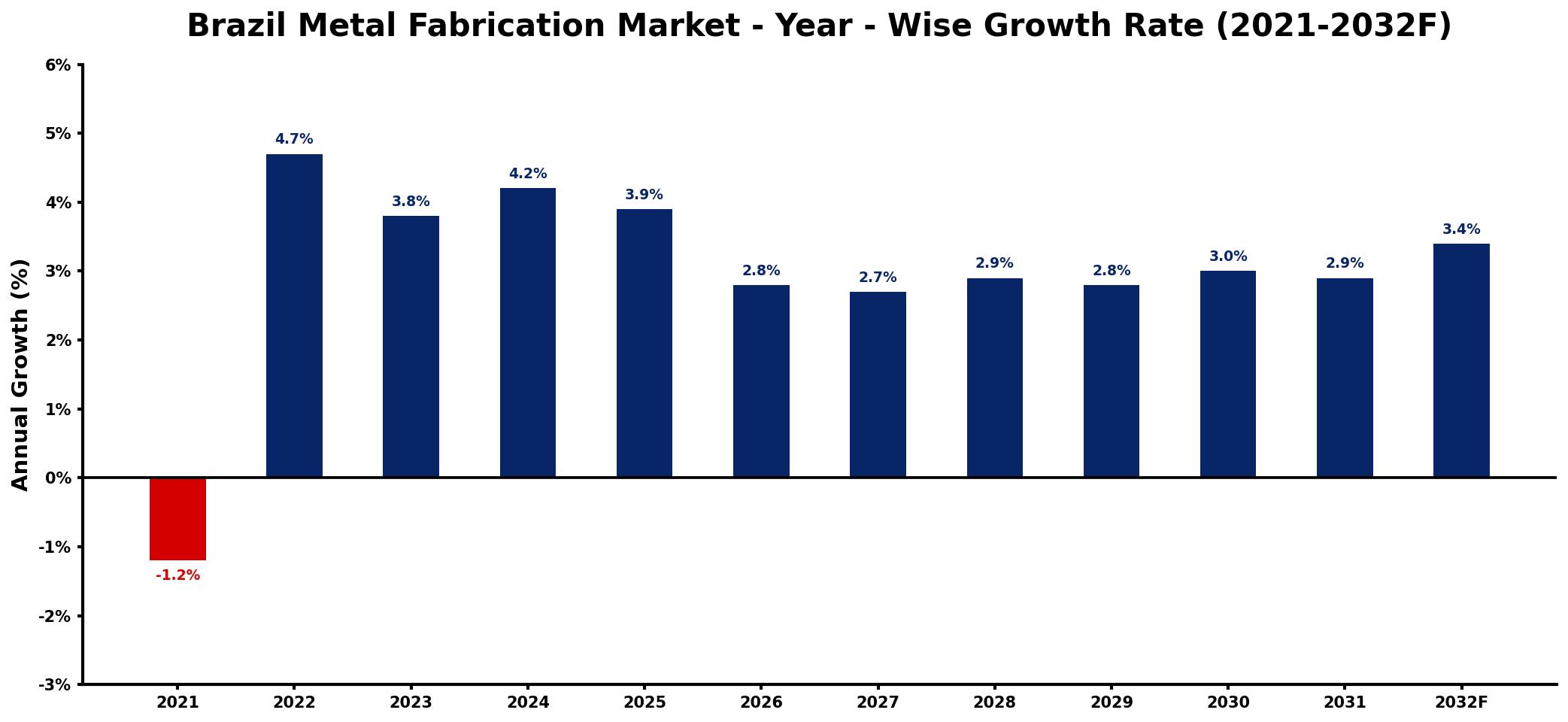
The table below presents the year‑wise growth rates along with the key drivers influencing the market
| Year | Growth Rate | Major Drivers |
| 2021 | -1.2% | decreased industrial construction activities |
| 2022 | 4.7% | increased infrastructure project investments |
| 2023 | 3.8% | growing automotive sector demands |
| 2024 | 4.2% | expansion in renewable energy projects |
| 2025 | 3.9% | rising consumer electronics production |
| 2026 | 2.8% | enhanced building renovation initiatives |
| 2027 | 2.7% | increased aerospace manufacturing needs |
| 2028 | 2.9% | growth in transportation infrastructure |
| 2029 | 2.8% | surge in machinery production demand |
| 2030 | 3.0% | expansion of defense sector investments |
| 2031 | 2.9% | rising demand for automation solutions |
| 2032 | 3.4% | growing focus on sustainability initiatives |
Note: Market size estimations and growth projections presented in this report are based on 6Wresearch's proprietary forecasting methodology, utilizing the latest available industry data, government publications, and primary research inputs.
Brazil Metal Fabrication Market Synopsis
In recent years, the Brazil metal fabrication market has experienced robust growth, buoyed by a surge in industrial activities and investment in infrastructure. However, as the market transitions towards more advanced manufacturing processes, future growth may hinge on addressing evolving consumer demands and leveraging new technologies.
Looking ahead, the market faces a combination of challenges and opportunities. While production costs and supply chain issues present hurdles, innovations in automation and digitization offer promising avenues for efficiency and enhanced output. The overall sentiment is one of cautious optimism, underpinned by ongoing governmental support and a clear focus on enhancing competitiveness.
Brazil Metal Fabrication Market Key Takeaways
- Strong market growth anticipated, with a CAGR of 2.5% from 2026 to 2032.
- Key drivers include demand from automotive and aerospace sectors, as well as government initiatives.
- Investment in technological advancements is essential for maintaining competitiveness.
- Challenges such as rising production costs and supply chain disruptions need addressing.
- Skill development programs are vital to meet the labor needs of the evolving market.
Evaluation of Restraints in Brazil Metal Fabrication Market
The Brazil metal fabrication market grapples with several critical restraints that may inhibit its growth. Rising production costs driven by inflation and fluctuating raw material prices remain a significant concern for manufacturers. Additionally, disruptions in supply chains, exacerbated by global events, contribute to delays and increased operational expenses. The need for skilled labor presents a further challenge, as firms must invest in training programs to align their workforce with modern manufacturing demands. To remain competitive, players must navigate these obstacles while adapting to rapidly changing market dynamics.
Brazil Metal Fabrication Market Trends
A number of current and emerging trends are shaping the Brazil metal fabrication market. The integration of automation and advanced robotics into fabrication processes is revolutionizing efficiency and precision. Additionally, sustainability is becoming a focal point, with companies increasingly adopting eco-friendly practices and materials in response to consumer preferences. Digital technologies, including additive manufacturing and the Internet of Things (IoT), are also gaining traction, promising to enhance customization and operational transparency across the industry.
Brazil Metal Fabrication Market Opportunities
Significant growth and investment opportunities are present in the Brazil metal fabrication market, particularly in sectors such as renewable energy and electric vehicles. As Brazil aims to bolster its green economy, demand for fabricated components in sustainable technologies will likely surge. Furthermore, the modernization of infrastructure across the country opens doors for manufacturers to engage in large-scale projects that require high-quality metal fabrication. These areas, combined with government incentives for technological innovation, provide fertile ground for investment.
Government Initiatives in the Brazil Metal Fabrication Market
The Brazilian government has implemented several initiatives to enhance the metal fabrication market, focusing on industrial diversification and productivity. Public spending is directed toward skills training programs designed to cultivate a skilled workforce capable of meeting modern manufacturing challenges. Additionally, regulatory reforms aim to streamline processes and improve access to financing for small and medium enterprises. These initiatives foster an environment conducive to growth, innovation, and competitiveness within the sector.
Future Insights of the Brazil Metal Fabrication Market
From 2026 to 2032, the Brazil metal fabrication market is poised for gradual yet steady growth, driven by technological advancements and a strong push for sustainability. As industries evolve and the demand for customized solutions increases, fabricators that adapt to these trends will find themselves well-positioned for success. The ongoing commitment from the government to support industrial growth, coupled with the industrys responsiveness to market changes, will likely shape a promising future for metal fabrication in Brazil.
Brazil Metal Fabrication Market Latest Developments (2025 - 2026)
Recent developments in the Brazil metal fabrication market indicate a strong shift toward innovative practices and technologies. Companies are increasingly focusing on automation and the integration of digital tools in their fabrication processes. Additionally, there is a heightened emphasis on sustainability initiatives, with many firms exploring eco-friendly materials and manufacturing processes. These trends suggest a proactive response to market demands, positioning the sector for continued evolution and growth.
Brazil Metal Fabrication Market - Key Attractiveness of the Report
- 10 Years of Market Numbers
- Historical Data Starting from 2022 to 2025
- Base Year: 2025
- Forecast Data until 2032
- Key Performance Indicators Impacting the Market
- Major Upcoming Developments and Projects
Key Highlights of the Report:
- Brazil Metal Fabrication Market Outlook
- Market Size of Brazil Metal Fabrication Market, 2025
- Forecast of Brazil Metal Fabrication Market, 2032
- Historical Data and Forecast of Brazil Metal Fabrication Revenues & Volume for the Period 2022-2032F
- Brazil Metal Fabrication Market Trend Evolution
- Brazil Metal Fabrication Market Drivers and Challenges
- Brazil Metal Fabrication Price Trends
- Brazil Metal Fabrication Porter's Five Forces
- Brazil Metal Fabrication Industry Life Cycle
- Historical Data and Forecast of Brazil Metal Fabrication Market Revenues & Volume By End-user Industry for the Period 2022-2032F
- Historical Data and Forecast of Brazil Metal Fabrication Market Revenues & Volume By Manufacturing for the Period 2022-2032F
- Historical Data and Forecast of Brazil Metal Fabrication Market Revenues & Volume By Power and Utilities for the Period 2022-2032F
- Historical Data and Forecast of Brazil Metal Fabrication Market Revenues & Volume By Construction for the Period 2022-2032F
- Historical Data and Forecast of Brazil Metal Fabrication Market Revenues & Volume By Oil and Gas for the Period 2022-2032F
- Historical Data and Forecast of Brazil Metal Fabrication Market Revenues & Volume By Other End-user Industries for the Period 2022-2032F
- Historical Data and Forecast of Brazil Metal Fabrication Market Revenues & Volume By Metal Folding for the Period 2022-2032F
- Historical Data and Forecast of Brazil Metal Fabrication Market Revenues & Volume By Product category for the Period 2022-2032F
- Historical Data and Forecast of Brazil Metal Fabrication Market Revenues & Volume By Structural steel fabrication for the Period 2022-2032F
- Historical Data and Forecast of Brazil Metal Fabrication Market Revenues & Volume By Process Equipment Fabrication for the Period 2022-2032F
- Brazil Metal Fabrication Import Export Trade Statistics
- Market Opportunity Assessment By End-user Industry
- Market Opportunity Assessment By Product category
- Brazil Metal Fabrication Top Companies Market Share
- Brazil Metal Fabrication Competitive Benchmarking By Technical and Operational Parameters
- Brazil Metal Fabrication Company Profiles
- Brazil Metal Fabrication Key Strategic Recommendations






































