Brazil Microlearning Market Size & Growth Rate (2026-2032)
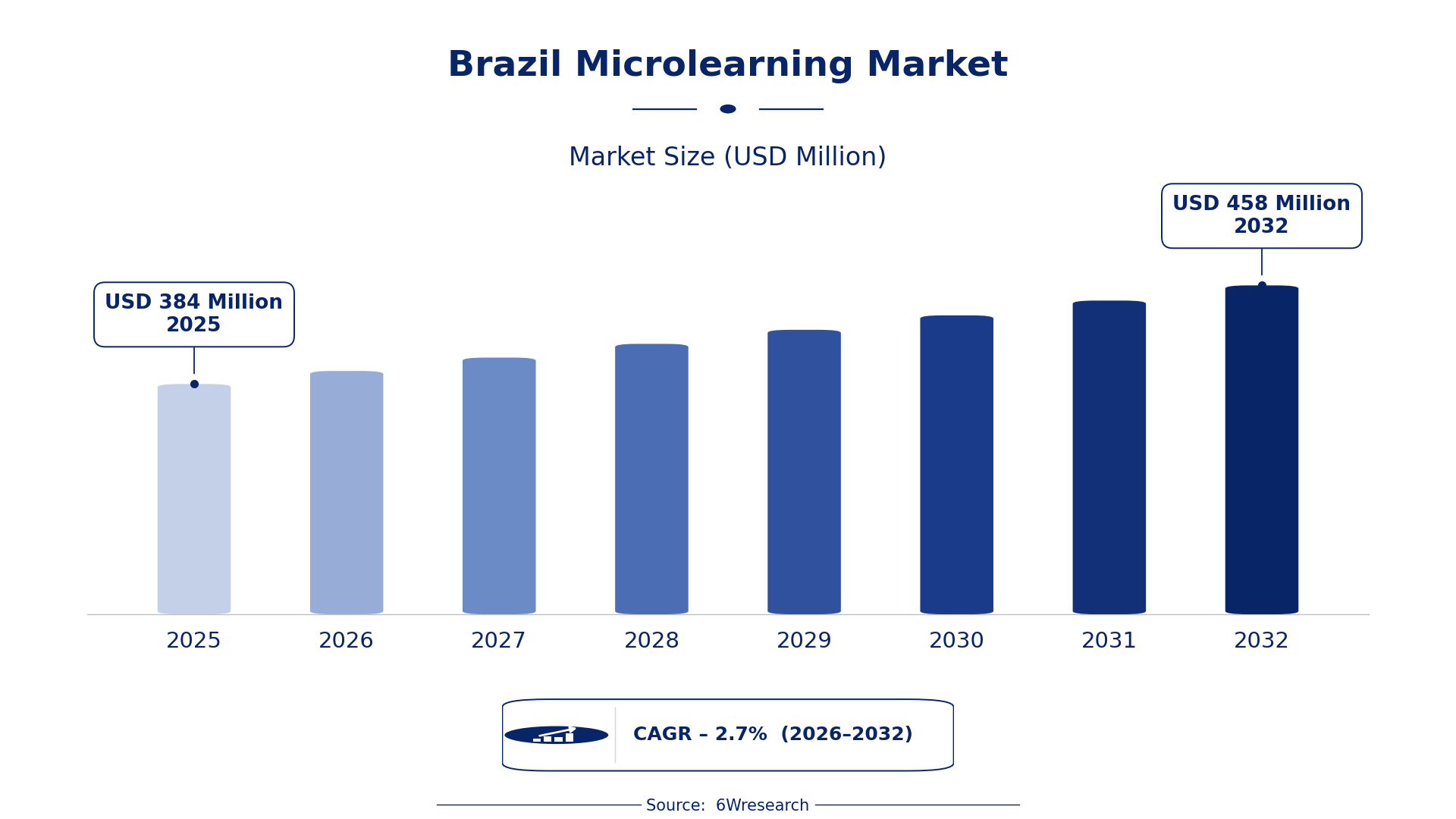
The Brazil Microlearning Market was estimated at USD 384 Million in 2025 and is projected to reach USD 458 Million by 2032, growing at a CAGR of 2.7% from 2026 to 2032.
Brazil Microlearning Market Synopsis
The Brazilian market for microlearning is rapidly expanding as organizations seek efficient ways to train employees in a fast-paced environment. Tailored bite-sized content resonates with the learning preferences of a diverse workforce, making it a favored choice across sectors.
With advancements in technology, particularly artificial intelligence, the ability to deliver personalized learning experiences has never been more feasible. Businesses are increasingly recognizing that microlearning can effectively bridge skill gaps and enhance overall productivity.
Brazil Microlearning Market Year-wise Growth Rate and Key Drivers
This graph illustrates the annual growth rates of the Brazil Microlearning Market from 2021 to 2032, highlighting a steady upward trajectory and projected expansion over the forecast period.

The table below presents the year‑wise growth rates along with the key drivers influencing the market
| Year | Growth Rate | Major Drivers |
| 2021 | -1.4% | Shift to live online training formats by companies. |
| 2022 | 5.4% | Government digital literacy initiatives boosting online education |
| 2023 | 4.0% | Increased smartphone penetration enhancing access to microlearning |
| 2024 | 4.3% | Corporate training budgets reallocating towards bite-sized content |
| 2025 | 4.1% | Higher demand for upskilling in tech-driven job market |
| 2026 | 3.1% | Rising online course registrations among Brazilian professionals |
| 2027 | 2.2% | Adoption of mobile learning tools in Brazilian universities |
| 2028 | 2.4% | Increased participation in online workshops and webinars |
| 2029 | 2.9% | Employers prioritizing skill development in remote work adaptability |
| 2030 | 3.1% | Surge in freelance economy boosting microlearning popularity |
| 2031 | 3.4% | Educational policies promoting microlearning integration in curricula |
| 2032 | 2.7% | Enhanced internet connectivity facilitating access to learning platforms |
Note: Market size estimations and growth projections presented in this report are based on 6Wresearch's proprietary forecasting methodology, utilizing the latest available industry data, government publications, and primary research inputs.
Brazil Microlearning Market Key Takeaways
Below are some of the specific key takeaways from the market, including:
- The market is projected to grow from USD 384 Million in 2025 to USD 458 Million by 2032.
- Integration of AI technologies is enhancing the personalization of learning experiences.
- Corporate training programs are increasingly adopting microlearning methodologies.
- Government initiatives are supporting the growth of skill development programs across various sectors.
- Resistance to traditional training methods is a notable barrier to widespread adoption.
Evaluation of Restraints in Brazil Microlearning Market
Despite the notable growth, the Brazil Microlearning Market faces several restraints that inhibit its potential. One primary challenge is the entrenched nature of traditional training methods within many organizations. This resistance not only complicates the transition to microlearning but also necessitates clear demonstrations of effectiveness to stakeholders who may be skeptical. Additionally, the need for accessibility across varied demographic groups adds another layer of complexity, as tailored solutions must be developed to accommodate diverse learning styles and technological access.
Brazil Microlearning Market Trends
Current trends indicate a shift towards mobile-friendly learning solutions, reflecting the demand for flexibility in training. As remote work becomes commonplace, organizations are prioritizing microlearning modules that can be accessed anytime, anywhere. on top of that, gamification is emerging as a popular technique to engage learners and improve retention rates, blending fun with educational content.
Brazil Microlearning Market Opportunities
Opportunities abound for businesses willing to invest in microlearning solutions. The growing emphasis on lifelong learning presents a ripe landscape for developing tailored content that addresses specific skill gaps. Additionally, sectors such as healthcare and technology are particularly well-positioned to benefit from targeted microlearning initiatives, allowing for rapid upskilling in response to industry demands.
Government Initiatives in the Brazil Microlearning Market
Government policies in Brazil are increasingly aligning with the need for enhanced skill development, creating a supportive environment for the microlearning market. The focus on education reform and workforce training is evident as public entities prioritize continuous learning initiatives that resonate with the microlearning approach.
- A recently completed initiative aimed at enhancing digital literacy among educators has laid the groundwork for integrating microlearning into traditional curricula.
- Current efforts include a nationwide program focused on skill development for young professionals, emphasizing the role of microlearning in bridging the skill gap.
- A planned public-private initiative expected to roll out by 2026 will seek to foster collaboration between educational institutions and businesses to develop customized microlearning solutions.
- The government has introduced a regulatory framework aimed at promoting the use of technology in educational settings, enhancing the appeal of microlearning.
- Ongoing support for vocational training programs is expanding, which directly aligns with the principles of microlearning.
Future Insights of the Brazil Microlearning Market
Looking ahead to 2026-2032, the Brazil Microlearning Market is set for continued expansion. The increasing integration of technology in learning, alongside a growing recognition of the need for agility in workforce training, will drive demand for microlearning solutions. As businesses prioritize employee development, the market's evolution will likely see enhanced collaboration between educational institutions and private sector companies, fostering innovation and tailored content delivery.
Brazil Microlearning Market Latest Developments
Recent activity in the Brazil Microlearning Market highlights a dynamic shift toward more innovative training solutions. Over the past year, various initiatives have been launched, reflecting a commitment to enhancing learning experiences across sectors.
- A major technology vendor rolled out a new microlearning platform in early 2025, aimed at corporate clients seeking to enhance employee engagement through gamified content.
- In mid-2025, an ongoing initiative was introduced that focuses on developing mobile-friendly microlearning modules for healthcare professionals, addressing critical skill shortages.
- A partnership between educational institutions and tech companies is currently underway, aimed at creating customized microlearning content tailored to industry needs.
- By late 2026, a planned initiative will establish a national framework for integrating microlearning in higher education, with the goal of modernizing curricula.
- A recent study published in early 2025 highlighted the effectiveness of microlearning in corporate settings, prompting increased interest from various industries.
Brazil Microlearning Market - Key Attractiveness of the Report
- 10 Years of Market Numbers
- Historical Data Starting from 2022 to 2025
- Base Year: 2025
- Forecast Data until 2032
- Key Performance Indicators Impacting the Market
- Major Upcoming Developments and Projects
Key Highlights of the Report:
- Brazil Microlearning Market Outlook
- Market Size of Brazil Microlearning Market, 2025
- Forecast of Brazil Microlearning Market, 2032
- Historical Data and Forecast of Brazil Microlearning Revenues & Volume for the Period 2022-2032F
- Brazil Microlearning Market Trend Evolution
- Brazil Microlearning Market Drivers and Challenges
- Brazil Microlearning Price Trends
- Brazil Microlearning Porter's Five Forces
- Brazil Microlearning Industry Life Cycle
- Historical Data and Forecast of Brazil Microlearning Market Revenues & Volume By Component for the Period 2022-2032F
- Historical Data and Forecast of Brazil Microlearning Market Revenues & Volume By Solution for the Period 2022-2032F
- Historical Data and Forecast of Brazil Microlearning Market Revenues & Volume By Services for the Period 2022-2032F
- Historical Data and Forecast of Brazil Microlearning Market Revenues & Volume By Industry for the Period 2022-2032F
- Historical Data and Forecast of Brazil Microlearning Market Revenues & Volume By Retail for the Period 2022-2032F
- Historical Data and Forecast of Brazil Microlearning Market Revenues & Volume By Manufacturing for the Period 2022-2032F
- Historical Data and Forecast of Brazil Microlearning Market Revenues & Volume By Logistics for the Period 2022-2032F
- Historical Data and Forecast of Brazil Microlearning Market Revenues & Volume By BFSI for the Period 2022-2032F
- Historical Data and Forecast of Brazil Microlearning Market Revenues & Volume By Telecom for the Period 2022-2032F
- Historical Data and Forecast of Brazil Microlearning Market Revenues & Volume By IT for the Period 2022-2032F
- Historical Data and Forecast of Brazil Microlearning Market Revenues & Volume By Healthcare for the Period 2022-2032F
- Historical Data and Forecast of Brazil Microlearning Market Revenues & Volume By Life Sciences for the Period 2022-2032F
- Historical Data and Forecast of Brazil Microlearning Market Revenues & Volume By Deployment Type for the Period 2022-2032F
- Historical Data and Forecast of Brazil Microlearning Market Revenues & Volume By On-Premises for the Period 2022-2032F
- Historical Data and Forecast of Brazil Microlearning Market Revenues & Volume By Cloud for the Period 2022-2032F
- Historical Data and Forecast of Brazil Microlearning Market Revenues & Volume By Organization Size for the Period 2022-2032F
- Historical Data and Forecast of Brazil Microlearning Market Revenues & Volume By SMEs for the Period 2022-2032F
- Historical Data and Forecast of Brazil Microlearning Market Revenues & Volume By Large Enterprises for the Period 2022-2032F
- Brazil Microlearning Import Export Trade Statistics
- Market Opportunity Assessment By Component
- Market Opportunity Assessment By Industry
- Market Opportunity Assessment By Deployment Type
- Market Opportunity Assessment By Organization Size
- Brazil Microlearning Top Companies Market Share
- Brazil Microlearning Competitive Benchmarking By Technical and Operational Parameters
- Brazil Microlearning Company Profiles
- Brazil Microlearning Key Strategic Recommendations






































