Brazil Network as a Service Market Size & Growth Rate (2026-2032)
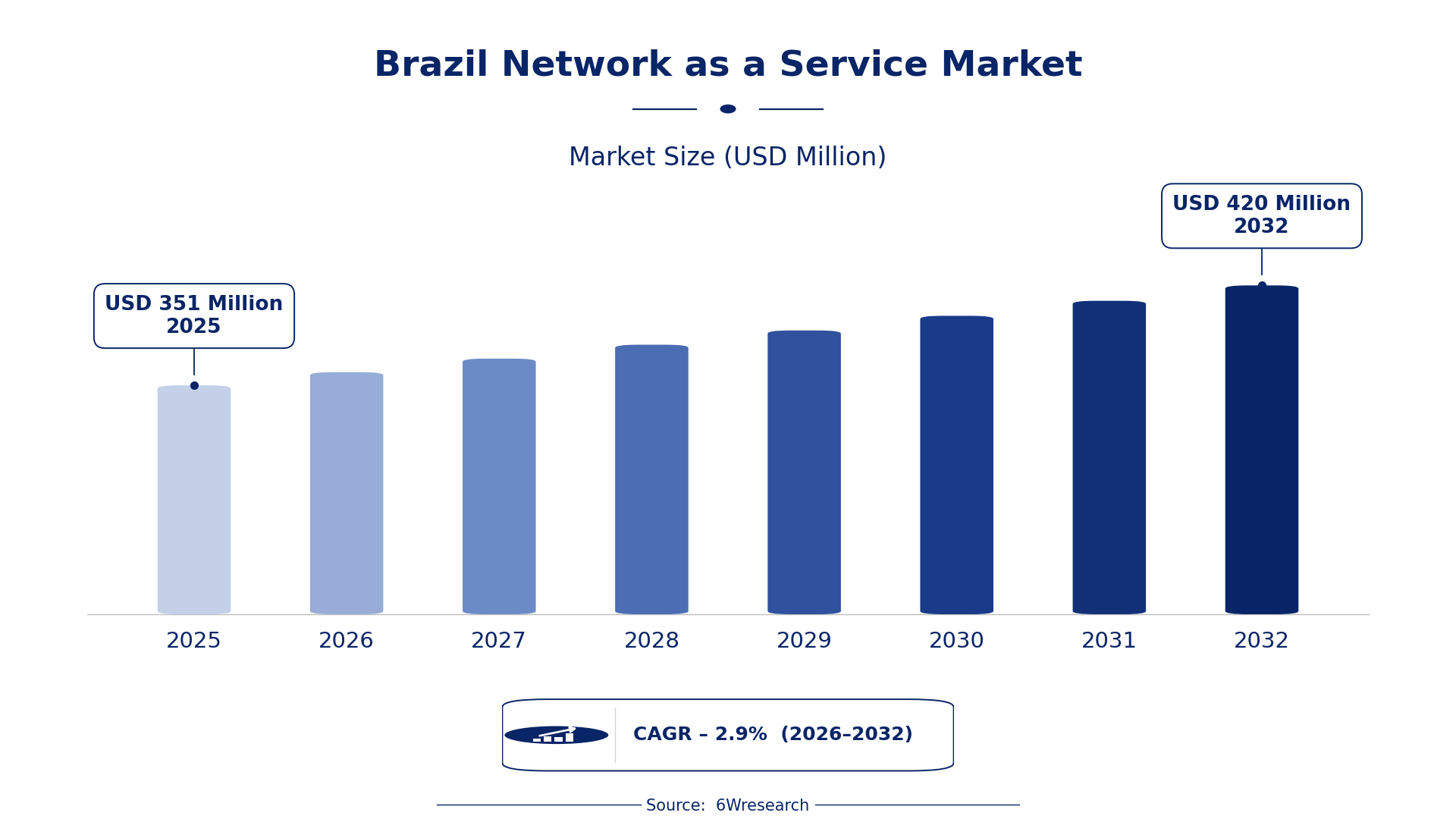
The Brazil Network as a Service Market was estimated at USD 351 Million in 2025 and is projected to reach USD 420 Million by 2032, growing at a CAGR of 2.9% from 2026 to 2032.
Brazil Network as a Service Market Synopsis
Brazil's Network as a Service (NaaS) market is currently experiencing a surge in demand as organizations seek greater flexibility in network management. This momentum is driven by a growing inclination toward subscription-based models that allow businesses to scale their network services according to evolving needs.
Looking ahead, the NaaS market is set to transform, with enterprises prioritizing operational efficiency and cost-effectiveness. The shift toward digitalization and cloud-based solutions will further propel the adoption of NaaS, as companies recognize the potential for optimizing resource utilization without compromising security.
Brazil Network as a Service Market Year-wise Growth Rate and Key Drivers
This graph illustrates the annual growth rates of the Brazil Network as a Service Market from 2021 to 2032, highlighting a steady upward trajectory and projected expansion over the forecast period.
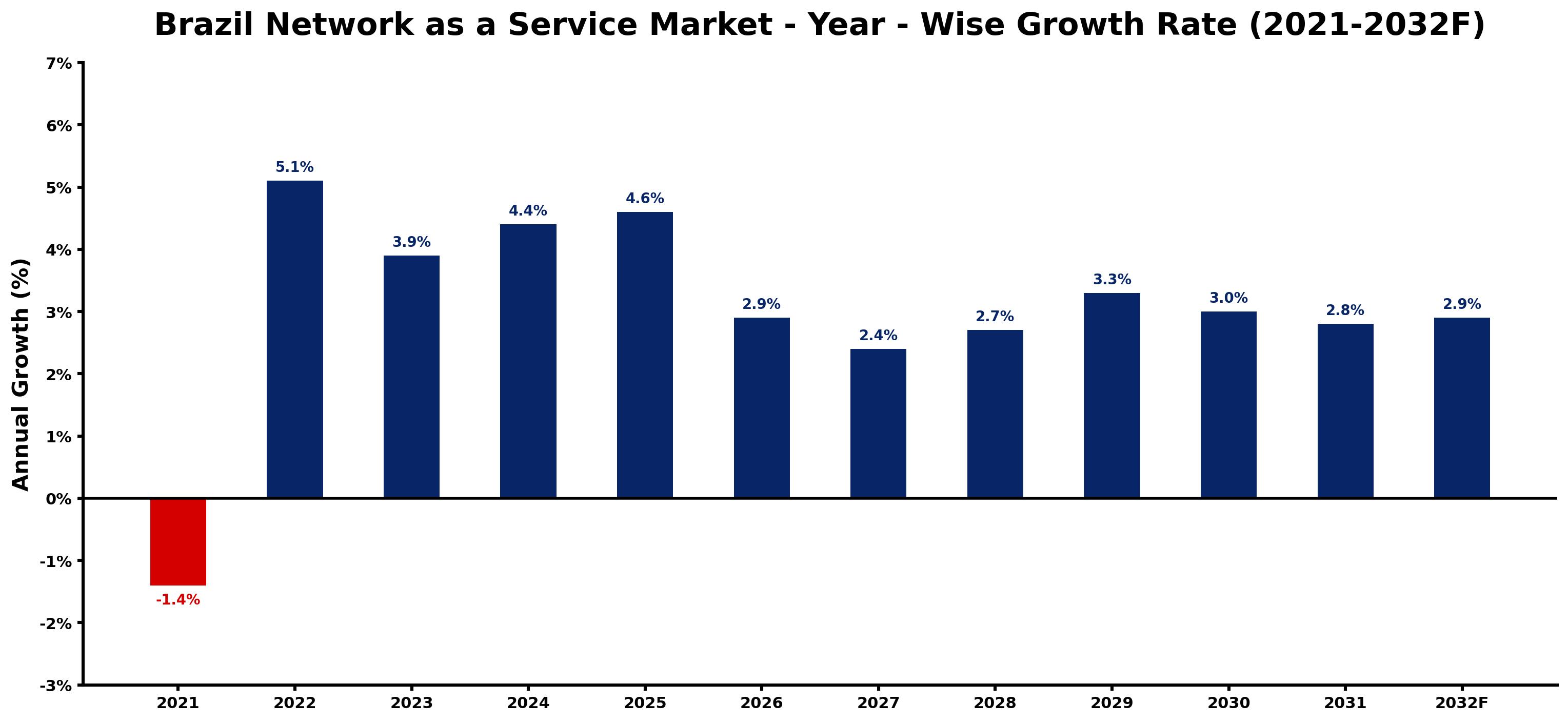
The table below presents the year‑wise growth rates along with the key drivers influencing the market
| Year | Growth Rate | Major Drivers |
| 2021 | -1.4% | Regulatory changes by ANATEL limiting foreign investment. |
| 2022 | 5.1% | Increase in e-commerce driving network service demand. |
| 2023 | 3.9% | Telecom regulation reforms enhancing NaaS market growth. |
| 2024 | 4.4% | Government focus on expanding broadband internet access. |
| 2025 | 4.6% | Local startups boosting demand for scalable network solutions. |
| 2026 | 2.9% | Adoption of smart city initiatives driving connectivity needs. |
| 2027 | 2.4% | Growing cloud service adoption among SMEs in Brazil. |
| 2028 | 2.7% | Investment in network security services for enterprises. |
| 2029 | 3.3% | Major sporting events increasing temporary network infrastructure. |
| 2030 | 3.0% | Rising need for enhanced cybersecurity solutions in businesses. |
| 2031 | 2.8% | Development of AI-driven network management tools in Brazil. |
| 2032 | 2.9% | Increased usage of mobile applications requiring network reliability. |
Note: Market size estimations and growth projections presented in this report are based on 6Wresearch's proprietary forecasting methodology, utilizing the latest available industry data, government publications, and primary research inputs.
Brazil Network as a Service Market Key Takeaways
Below are some of the specific key takeaways from the market, including:
- The shift to subscription-based network services is accelerating among Brazilian enterprises.
- Cost control and resource optimization are primary drivers for adopting NaaS solutions.
- Security and data privacy concerns remain pivotal issues that need addressing for market growth.
- Government initiatives are increasingly favoring the development of NaaS infrastructure.
- The market is expected to expand significantly as businesses seek agile solutions tailored to their needs.
Evaluation of Restraints in Brazil Network as a Service Market
Despite the positive momentum, several factors hinder the growth of the NaaS market in Brazil. Data privacy and security issues present significant challenges, as organizations are often hesitant to adopt third-party network services due to concerns over potential breaches. Additionally, the market grapples with the lack of standardized service-level agreements, making it difficult for businesses to ensure compliance with regulations and achieve satisfactory service delivery. These concerns can delay decision-making processes and inhibit broader adoption of NaaS solutions.
Brazil Network as a Service Market Trends
The Brazil NaaS market is currently witnessing trends that emphasize agility and cost-efficiency. Businesses are increasingly looking for on-demand network services that allow them to scale up or down based on their operational needs. Cloud integration is becoming a focal point, as organizations seek seamless connectivity between their applications and networks. on top of that, the push towards automation in network management is gaining traction, with companies adopting intelligent solutions that enhance performance and reduce downtime.
Brazil Network as a Service Market Opportunities
Significant growth opportunities lie in the integration of advanced technologies such as Artificial Intelligence and Machine Learning into NaaS offerings. Companies that can provide innovative solutions that enhance network efficiency and security will find themselves at a competitive advantage. Additionally, small and medium enterprises (SMEs) represent an untapped market segment, as many are still reliant on traditional network management models. Tailoring NaaS solutions specifically for this demographic could open new revenue streams and drive wider adoption.
Government Initiatives in the Brazil Network as a Service Market
Government policies in Brazil are increasingly aimed at fostering a conducive environment for NaaS adoption. The focus is on improving the efficiency of network infrastructure and ensuring fair competition among service providers. Current initiatives are paving the way for enhanced service delivery and increased investment in digital transformation.
- A national digital infrastructure upgrade programme now in its rollout phase aims to enhance connectivity across underserved regions.
- Ongoing regulatory frameworks are being established to ensure transparency in billing practices for NaaS providers.
- Recent initiatives have introduced incentives for companies adopting cloud-based network solutions to stimulate market growth.
- Upcoming policies are expected to focus on data privacy regulations that will shape the compliance landscape for NaaS providers.
Future Insights of the Brazil Network as a Service Market
As we approach 2032, the Brazil NaaS market is likely to witness transformative growth driven by technological advancements and changing business needs. Companies will increasingly rely on flexible network solutions to maintain competitiveness. The integration of IoT devices and smart technologies will further enhance the relevance of NaaS offerings, catering to the demands of a more connected economy. Expect a competitive environment where agility and innovation will dictate market leaders.
Brazil Network as a Service Market Latest Developments
In the past year, the Brazil Network as a Service market has been characterized by a flurry of activity as organizations adapt to digital transformations. Companies are prioritizing network solutions that offer agility and cost efficiency, responding to the growing demand for flexible service models.
- A major technology vendor launched a comprehensive NaaS platform in early 2025, aimed at small businesses seeking to streamline their network management.
- Currently ongoing is a collaborative initiative between local governments and private sectors to enhance digital infrastructure in urban areas.
- Recently completed is a pilot program for NaaS services in remote regions, successfully demonstrating improved connectivity and resource management.
- An upcoming rollout expected to begin in late 2026 aims to introduce automated network management solutions across various sectors.
Brazil Network as a Service Market - Key Attractiveness of the Report
- 10 Years of Market Numbers
- Historical Data Starting from 2022 to 2025
- Base Year: 2025
- Forecast Data until 2032
- Key Performance Indicators Impacting the Market
- Major Upcoming Developments and Projects
Key Highlights of the Report:
- Brazil Network as a Service Market Outlook
- Market Size of Brazil Network as a Service Market, 2025
- Forecast of Brazil Network as a Service Market, 2032
- Historical Data and Forecast of Brazil Network as a Service Revenues & Volume for the Period 2022-2032F
- Brazil Network as a Service Market Trend Evolution
- Brazil Network as a Service Market Drivers and Challenges
- Brazil Network as a Service Price Trends
- Brazil Network as a Service Porter's Five Forces
- Brazil Network as a Service Industry Life Cycle
- Historical Data and Forecast of Brazil Network as a Service Market Revenues & Volume By Type for the Period 2022-2032F
- Historical Data and Forecast of Brazil Network as a Service Market Revenues & Volume By Local Area Network and Wireless Local Area Network for the Period 2022-2032F
- Historical Data and Forecast of Brazil Network as a Service Market Revenues & Volume By Wire Area Network for the Period 2022-2032F
- Historical Data and Forecast of Brazil Network as a Service Market Revenues & Volume By Communication and Collaboration for the Period 2022-2032F
- Historical Data and Forecast of Brazil Network as a Service Market Revenues & Volume By Network Security for the Period 2022-2032F
- Historical Data and Forecast of Brazil Network as a Service Market Revenues & Volume By End User for the Period 2022-2032F
- Historical Data and Forecast of Brazil Network as a Service Market Revenues & Volume By Banking, Financial, Services, and Insurance for the Period 2022-2032F
- Historical Data and Forecast of Brazil Network as a Service Market Revenues & Volume By Manufacturing for the Period 2022-2032F
- Historical Data and Forecast of Brazil Network as a Service Market Revenues & Volume By Retail and eCommerce for the Period 2022-2032F
- Historical Data and Forecast of Brazil Network as a Service Market Revenues & Volume By Software and Technology for the Period 2022-2032F
- Historical Data and Forecast of Brazil Network as a Service Market Revenues & Volume By Media and Entertainment for the Period 2022-2032F
- Historical Data and Forecast of Brazil Network as a Service Market Revenues & Volume By Healthcare for the Period 2022-2032F
- Historical Data and Forecast of Brazil Network as a Service Market Revenues & Volume By Education for the Period 2022-2032F
- Historical Data and Forecast of Brazil Network as a Service Market Revenues & Volume By Government for the Period 2022-2032F
- Historical Data and Forecast of Brazil Network as a Service Market Revenues & Volume By Organization Size for the Period 2022-2032F
- Historical Data and Forecast of Brazil Network as a Service Market Revenues & Volume By Large Enterprises for the Period 2022-2032F
- Historical Data and Forecast of Brazil Network as a Service Market Revenues & Volume By SMEs for the Period 2022-2032F
- Historical Data and Forecast of Brazil Network as a Service Market Revenues & Volume By Application for the Period 2022-2032F
- Historical Data and Forecast of Brazil Network as a Service Market Revenues & Volume By UCaaS/Video Conferencing for the Period 2022-2032F
- Historical Data and Forecast of Brazil Network as a Service Market Revenues & Volume By Virtual Private Network for the Period 2022-2032F
- Historical Data and Forecast of Brazil Network as a Service Market Revenues & Volume By Cloud and SaaS Connectivity for the Period 2022-2032F
- Historical Data and Forecast of Brazil Network as a Service Market Revenues & Volume By Bandwidth on Demand for the Period 2022-2032F
- Historical Data and Forecast of Brazil Network as a Service Market Revenues & Volume By Multi-Branch Connectivity for the Period 2022-2032F
- Historical Data and Forecast of Brazil Network as a Service Market Revenues & Volume By WAN Optimization for the Period 2022-2032F
- Historical Data and Forecast of Brazil Network as a Service Market Revenues & Volume By Secure Web Gateway for the Period 2022-2032F
- Brazil Network as a Service Import Export Trade Statistics
- Market Opportunity Assessment By Type
- Market Opportunity Assessment By End User
- Market Opportunity Assessment By Organization Size
- Market Opportunity Assessment By Application
- Brazil Network as a Service Top Companies Market Share
- Brazil Network as a Service Competitive Benchmarking By Technical and Operational Parameters
- Brazil Network as a Service Company Profiles
- Brazil Network as a Service Key Strategic Recommendations






































