Brazil Nickel Mining Market Size, Share & Growth Rate
The Brazil Nickel Mining Market was estimated at USD 98 Million in 2025 and is projected to reach USD 116 Million by 2032, growing at a CAGR of 2.4% from 2026 to 2032. This growth trajectory is largely driven by an escalating demand for nickel in the production of batteries and stainless steel, which are critical for electric vehicles and various sustainable energy technologies. Brazils substantial nickel reserves not only position it as a vital player in the global nickel market but also support the ongoing transition toward more sustainable industrial practices.
Brazil Nickel Mining Market Year-wise Growth Rate and Key Drivers
This graph highlights how the Brazil Nickel Mining Market has steadily grown over the years, supported by major growth factors.
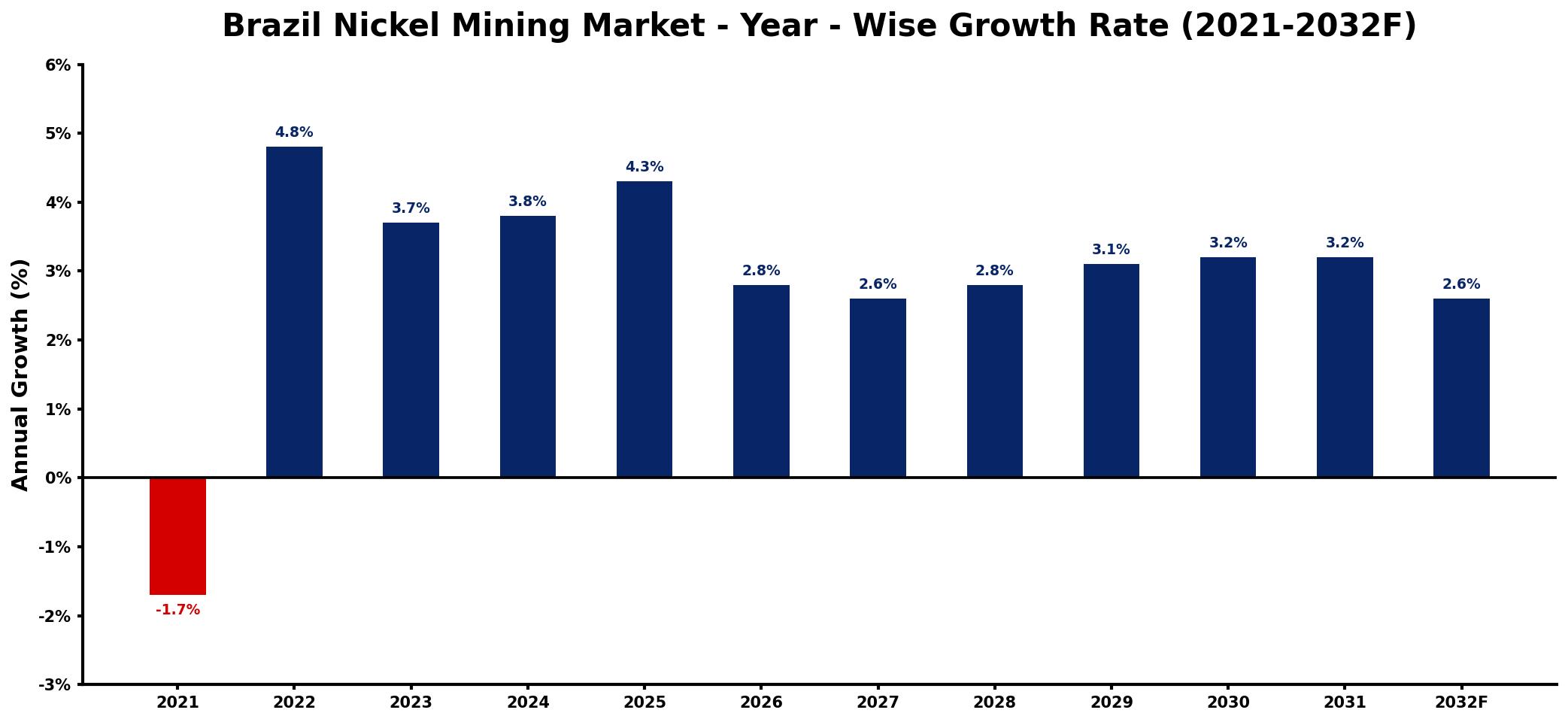
The table below presents the year‑wise growth rates along with the key drivers influencing the market
| Year | Growth Rate | Major Drivers |
| 2021 | -1.7% | Global market demand decreased significantly |
| 2022 | 4.8% | Renewable energy investments increased sharply |
| 2023 | 3.7% | Electric vehicle production expanded rapidly |
| 2024 | 3.8% | Technological advancements enhanced efficiency |
| 2025 | 4.3% | Infrastructure projects spurred resource needs |
| 2026 | 2.8% | Sustainable practices gained wider adoption |
| 2027 | 2.6% | Green technology initiatives drove investments |
| 2028 | 2.8% | Supply chain improvements enabled growth |
| 2029 | 3.1% | Consumer electronics market thrived significantly |
| 2030 | 3.2% | Government policies encouraged resource exploration |
| 2031 | 3.2% | International trade agreements facilitated access |
| 2032 | 2.6% | Urbanization trends increased industrial demand |
Note: Market size estimations and growth projections presented in this report are based on 6Wresearch's proprietary forecasting methodology, utilizing the latest available industry data, government publications, and primary research inputs.
Brazil Nickel Mining Market Synopsis
Brazil's nickel mining sector is uniquely characterized by its rich geological formations, which house some of the world's largest deposits of nickel. This inherent abundance, coupled with a strategic focus on sustainable mining practices, places Brazil at the forefront of the global nickel supply chain.
In addition to catering to traditional markets, Brazil's nickel is increasingly sought after for its application in the burgeoning electric vehicle sector. As automotive manufacturers pivot towards electric models, the demand for high-quality nickel for battery production is expected to surge, reinforcing Brazil's significance in the global energy transition.
Brazil Nickel Mining Market Key Takeaways
- The Brazil Nickel Mining Market is a critical player in the global supply chain, supported by significant reserves and increasing demand for battery production.
- Government policies focusing on sustainable mining practices and environmental stewardship are shaping industry operations.
- Political stability and technological advancements will play crucial roles in shaping market dynamics going forward.
- Electric vehicles' expansion is driving a substantial increase in nickel demand, thus enhancing Brazil's strategic importance.
- Ongoing collaboration between government and industry stakeholders aims to ensure responsible mining practices and community engagement.
Evaluation of Restraints in Brazil Nickel Mining Market
Despite its advantages, the Brazil Nickel Mining Market is not without its challenges. Geopolitical factors, such as political instability and international trade tensions, pose significant risks to mining operations. Moreover, the market must navigate the complexities of investing in advanced extraction technologies, which are essential for improving operational efficiency while simultaneously minimizing environmental impacts. As companies strive to modernize their practices, the balance between technological adoption and sustainability remains a critical focal point.
Brazil Nickel Mining Market Trends
Current trends in the Brazil Nickel Mining Market are strongly influenced by a global shift towards electric vehicles and renewable energy sources. As more companies look to reduce their carbon footprints, the demand for sustainably sourced nickel continues to grow. Additionally, advancements in mining technologies aimed at increasing efficiency and lowering environmental impacts are reshaping operational paradigms. Moreover, the rise of battery recycling initiatives is also contributing to changes in market dynamics, prompting a reevaluation of nickel sourcing strategies.
Brazil Nickel Mining Market Opportunities
Investment opportunities within the Brazil Nickel Mining Market are largely tied to the expansion of the electric vehicle sector and renewable energy initiatives. The growing need for advanced batteries, particularly lithium-ion, creates a lucrative market for nickel producers. Furthermore, as Brazil enhances its infrastructure for sustainable mining, opportunities for companies that innovate in the areas of environmental conservation and community engagement are also on the rise. Collaborative projects that focus on research and development can facilitate significant advancements in mining efficiency and sustainability.
Government Initiatives in the Brazil Nickel Mining Market
The Brazilian government plays a pivotal role in the nickel mining sector through the implementation of policies that promote environmental responsibility and occupational health and safety. Regulations mandating environmental impact assessments and rehabilitation plans are in place to ensure that mining activities do not adversely affect local ecosystems. Additionally, the government is working closely with industry stakeholders to promote community development initiatives that foster socio-economic growth in mining regions. These efforts are aimed at building a sustainable mining landscape while enhancing local livelihoods.
Future Insights of the Brazil Nickel Mining Market
Looking ahead to 2026-2032, the Brazil Nickel Mining Market is poised for transformative growth, driven by the accelerating demand for electric vehicles and renewable energy technologies. As Brazil continues to leverage its vast nickel reserves, the market is expected to align closely with global sustainability initiatives. The integration of innovative extraction technologies and a focus on responsible mining practices will likely define competitive advantages in this evolving landscape. By capitalizing on these trends, Brazil can solidify its position as a leading supplier of nickel for the world.
Brazil Nickel Mining Market Latest Developments (2025 - 2026)
Recent developments in the Brazil Nickel Mining Market highlight a renewed emphasis on sustainable practices and technological integration. Companies are increasingly exploring advanced mining techniques that aim to enhance efficiency while reducing environmental footprints. Additionally, collaborative ventures between government entities and private sector players are emerging, focusing on research to drive innovation in sustainable mining practices. Such initiatives signal a proactive approach to addressing environmental concerns while maintaining production efficiency.
Brazil Nickel Mining Market - Key Attractiveness of the Report
- 10 Years of Market Numbers
- Historical Data Starting from 2022 to 2025
- Base Year: 2025
- Forecast Data until 2032
- Key Performance Indicators Impacting the Market
- Major Upcoming Developments and Projects
Key Highlights of the Report:
- Brazil Nickel Mining Market Outlook
- Market Size of Brazil Nickel Mining Market, 2025
- Forecast of Brazil Nickel Mining Market, 2032
- Historical Data and Forecast of Brazil Nickel Mining Revenues & Volume for the Period 2022-2032F
- Brazil Nickel Mining Market Trend Evolution
- Brazil Nickel Mining Market Drivers and Challenges
- Brazil Nickel Mining Price Trends
- Brazil Nickel Mining Porter's Five Forces
- Brazil Nickel Mining Industry Life Cycle
- Historical Data and Forecast of Brazil Nickel Mining Market Revenues & Volume By Type for the Period 2022-2032F
- Historical Data and Forecast of Brazil Nickel Mining Market Revenues & Volume By Pentlandite (Sulfide Ore) for the Period 2022-2032F
- Historical Data and Forecast of Brazil Nickel Mining Market Revenues & Volume By Laterite for the Period 2022-2032F
- Brazil Nickel Mining Import Export Trade Statistics
- Market Opportunity Assessment By Type
- Brazil Nickel Mining Top Companies Market Share
- Brazil Nickel Mining Competitive Benchmarking By Technical and Operational Parameters
- Brazil Nickel Mining Company Profiles
- Brazil Nickel Mining Key Strategic Recommendations






































