Brazil Oil Burner Market Size, Share & Growth Rate
The Brazil Oil Burner Market was estimated at USD 380 Million in 2025 and is projected to reach USD 453 Million by 2032, growing at a CAGR of 2.5% from 2026 to 2032. This growth is primarily driven by an increasing demand for efficient heating solutions across residential and industrial sectors, particularly in light of Brazil's diverse climate and energy requirements. As industries evolve and consumers become more environmentally conscious, the shift towards advanced oil burner technologies that emphasize fuel efficiency and lower emissions is pivotal to this market trajectory.
Brazil Oil Burner Market Year-wise Growth Rate and Key Drivers
This graph highlights how the Brazil Oil Burner Market has steadily grown over the years, supported by major growth factors.
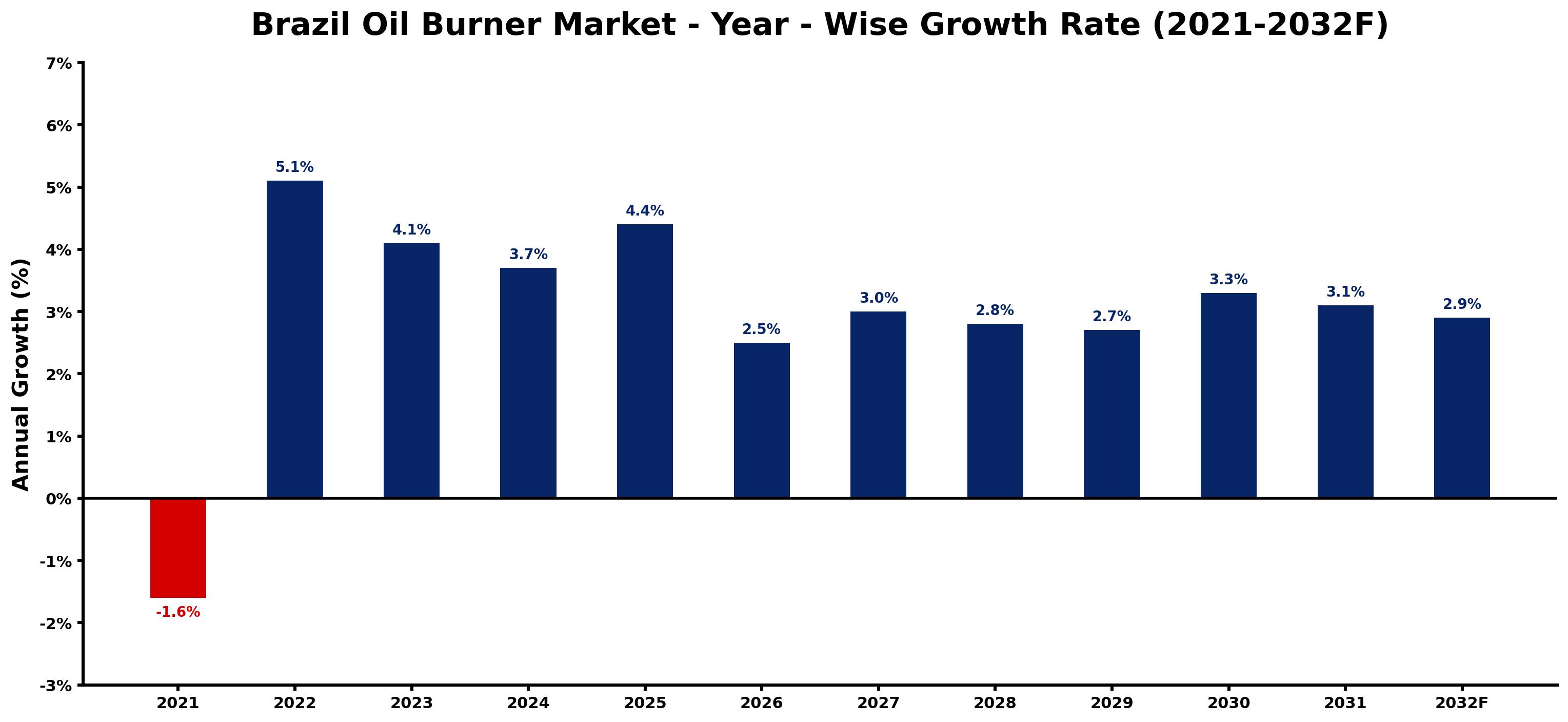
The table below presents the year‑wise growth rates along with the key drivers influencing the market
| Year | Growth Rate | Major Drivers |
| 2021 | -1.6% | Increasing industrial automation investments |
| 2022 | 5.1% | Expansion of commercial construction activities |
| 2023 | 4.1% | Expansion of transportation and logistics networks |
| 2024 | 3.7% | Rising electricity demand across industries |
| 2025 | 4.4% | Increasing smart city development projects |
| 2026 | 2.5% | Increasing adoption of advanced technologies |
| 2027 | 3.0% | Expansion of commercial construction activities |
| 2028 | 2.8% | Rising electricity demand across industries |
| 2029 | 2.7% | Increasing adoption of advanced technologies |
| 2030 | 3.3% | Increasing adoption of advanced technologies |
| 2031 | 3.1% | Government infrastructure modernization initiatives |
| 2032 | 2.9% | Expansion of transportation and logistics networks |
Note - Market size estimations and growth projections presented in this report are based on 6Wresearch's advanced forecasting approach, validated with industry datasets as of June 2026.
Brazil Oil Burner Market Synopsis
The strongest force shaping the Brazil Oil Burner Market today is the ongoing demand for sustainable and efficient heating systems. With the increasing regulations surrounding emissions and energy consumption, stakeholders are keenly aware of the need to adopt innovative technologies that comply with these standards while enhancing operational efficiency.
Additionally, the market is influenced by fluctuating crude oil prices and the rising competition from alternative energy sources, such as natural gas and renewable solutions. This competitive landscape compels manufacturers and consumers to re-evaluate their heating choices, further driving technological advancements in oil burner design.
Brazil Oil Burner Market Key Takeaways
- The market is anticipated to grow steadily, reflecting a shift towards energy-efficient technologies.
- Government policies encourage the adoption of cleaner, advanced oil burner systems.
- Environmental regulations are prompting the development of more efficient and less polluting heating technologies.
- Fluctuating oil prices and competition from renewables challenge traditional oil burner market dynamics.
- Residential and industrial sectors are key contributors to market growth due to their distinct heating needs.
Evaluation of Restraints in Brazil Oil Burner Market
Despite the promising growth of the Brazil Oil Burner Market, several restraints continue to hinder its expansion. Stringent environmental regulations compel manufacturers to invest in cleaner technologies, which may initially raise costs. Additionally, the volatility of crude oil prices impacts both production and consumer pricing, creating uncertainty for end-users. Furthermore, the increasing shift towards alternative energy sources, such as solar and natural gas, poses a competitive threat to traditional oil-based heating solutions. Manufacturers face the challenge of innovating while ensuring affordability to maintain market share in an evolving energy landscape.
Brazil Oil Burner Market Trends
Current trends in the Brazil Oil Burner Market include the advancement of smart burner technologies that integrate IoT capabilities. These systems allow for real-time monitoring and optimization of fuel consumption, which enhances efficiency and minimizes waste. Additionally, there is a growing emphasis on hybrid solutions that combine oil burners with alternative energy sources, promoting energy resilience and sustainability. Consumers are increasingly leaning towards products that not only meet their heating needs but also align with their ecological values.
Brazil Oil Burner Market Opportunities
The ongoing transition towards energy-efficient heating presents substantial opportunities for growth and investment within the Brazil Oil Burner Market. Innovations in combustion technology and fuel efficiency offer manufacturers avenues for product differentiation. Moreover, government incentives aimed at promoting high-efficiency systems can bolster market attractiveness. With consumers eager for solutions that minimize their carbon footprint, there is potential for tailored products that meet specific regional needs, particularly in colder areas where reliable heating is crucial.
Government Initiatives in the Brazil Oil Burner Market
Government initiatives play a crucial role in shaping the Brazil Oil Burner Market by emphasizing energy efficiency and environmental protection. Policies are increasingly focused on regulating oil burner performance standards to reduce emissions and improve overall energy consumption. Financial incentives may be offered to encourage the adoption of modern, high-efficiency burners and alternative heating solutions. Furthermore, government oversight ensures that installation and maintenance practices uphold safety and environmental standards, thereby fostering a more responsible approach to heating in both residential and industrial settings.
Future Insights of the Brazil Oil Burner Market
Looking ahead to 2026-2032, the Brazil Oil Burner Market is poised for steady growth, driven by technological advancements and regulatory pressures. The industry's focus will increasingly be on integrating smart technologies that enhance efficiency and user experience. As environmental awareness continues to rise, the development of cleaner burner technologies will become paramount. The interplay between traditional oil burners and alternative heating solutions will shape market dynamics, requiring manufacturers to remain agile in their approach to product development and market strategies.
Brazil Oil Burner Market Latest Developments (May 2025 - June 2026)
In recent months, the Brazil Oil Burner Market has seen several notable developments as manufacturers explore innovative solutions to enhance efficiency and compliance with evolving regulations. The introduction of hybrid heating systems combining oil burners with renewable energy sources is gaining traction. Additionally, more companies are investing in research and development efforts aimed at producing ultra-low emission burners, showcasing a commitment to sustainability. Collaborations between industry stakeholders and government bodies are becoming more prevalent, focusing on establishing standards and incentives to advance the market.
Brazil Oil Burner Market - Key Attractiveness of the Report
- 10 Years of Market Numbers
- Historical Data Starting from 2022 to 2025
- Base Year: 2025
- Forecast Data until 2032
- Key Performance Indicators Impacting the Market
- Major Upcoming Developments and Projects
Key Highlights of the Report:
- Brazil Oil Burner Market Outlook
- Market Size of Brazil Oil Burner Market, 2025
- Forecast of Brazil Oil Burner Market, 2032
- Historical Data and Forecast of Brazil Oil Burner Revenues & Volume for the Period 2022-2032F
- Brazil Oil Burner Market Trend Evolution
- Brazil Oil Burner Market Drivers and Challenges
- Brazil Oil Burner Price Trends
- Brazil Oil Burner Porter's Five Forces
- Brazil Oil Burner Industry Life Cycle
- Historical Data and Forecast of Brazil Oil Burner Market Revenues & Volume By Type for the Period 2022-2032F
- Historical Data and Forecast of Brazil Oil Burner Market Revenues & Volume By Pot Types for the Period 2022-2032F
- Historical Data and Forecast of Brazil Oil Burner Market Revenues & Volume By Gun Types for the Period 2022-2032F
- Historical Data and Forecast of Brazil Oil Burner Market Revenues & Volume By Rotary Types for the Period 2022-2032F
- Historical Data and Forecast of Brazil Oil Burner Market Revenues & Volume By Others for the Period 2022-2032F
- Historical Data and Forecast of Brazil Oil Burner Market Revenues & Volume By Applications for the Period 2022-2032F
- Historical Data and Forecast of Brazil Oil Burner Market Revenues & Volume By Residential Heaters for the Period 2022-2032F
- Historical Data and Forecast of Brazil Oil Burner Market Revenues & Volume By Industrial Heating for the Period 2022-2032F
- Historical Data and Forecast of Brazil Oil Burner Market Revenues & Volume By Other for the Period 2022-2032F
- Brazil Oil Burner Import Export Trade Statistics
- Market Opportunity Assessment By Type
- Market Opportunity Assessment By Applications
- Brazil Oil Burner Top Companies Market Share
- Brazil Oil Burner Competitive Benchmarking By Technical and Operational Parameters
- Brazil Oil Burner Company Profiles
- Brazil Oil Burner Key Strategic Recommendations






































