Brazil Oilfield Air Drilling Market Size, Share & Growth Rate
The Brazil Oilfield Air Drilling Market was estimated at USD 456 Million in 2025 and is projected to reach USD 632 Million by 2032, growing at a CAGR of 4.8% from 2026 to 2032. This upward trajectory is primarily driven by the need for improved drilling efficiencies as operators look to exploit deeper reservoirs. The focus on enhancing operational efficiency and mitigating environmental impact are also significant factors propelling the adoption of air drilling technologies across Brazil's oilfields.
Brazil Oilfield Air Drilling Market Year-wise Growth Rate and Key Drivers
This graph highlights how the Brazil Oilfield Air Drilling Market has steadily grown over the years, supported by major growth factors.
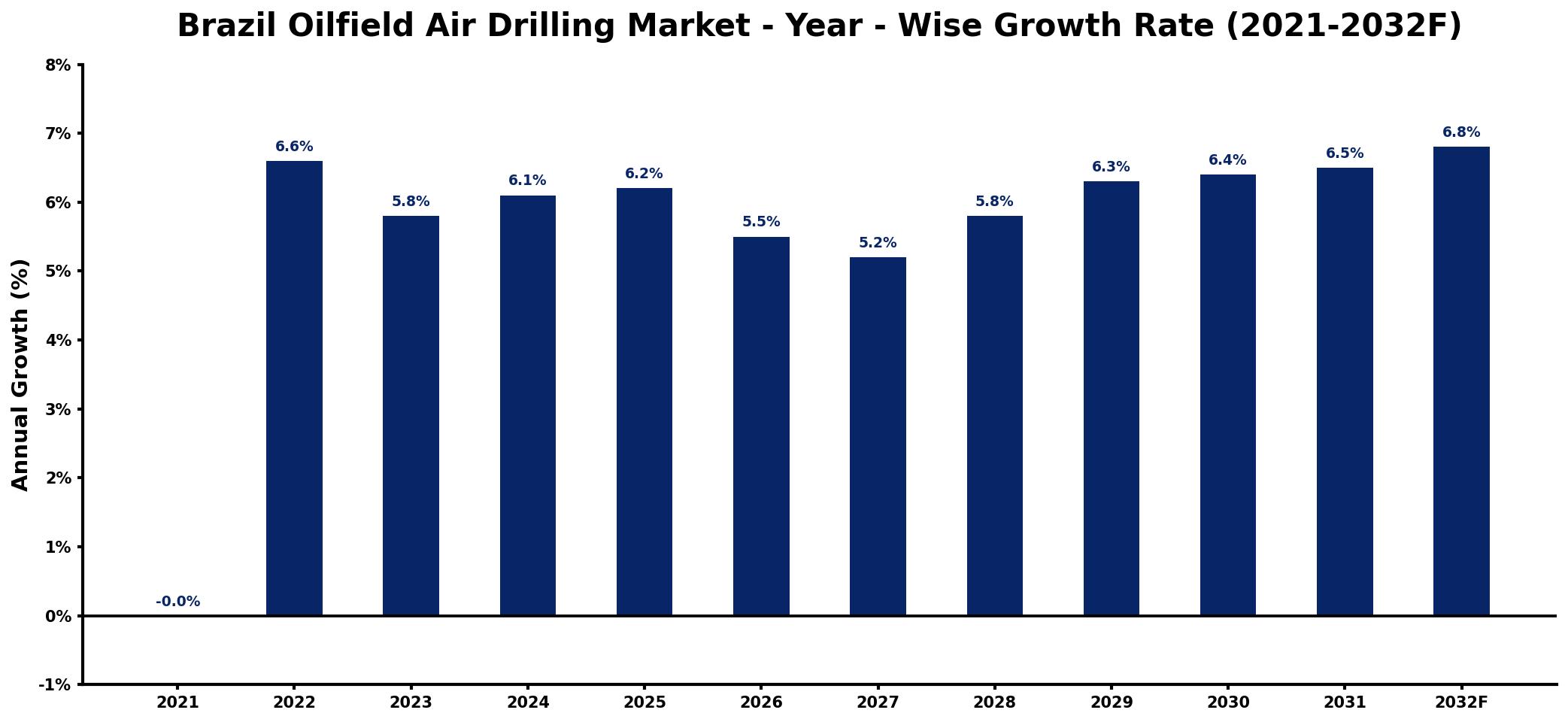
The table below presents the year‑wise growth rates along with the key drivers influencing the market
| Year | Growth Rate | Major Drivers |
| 2021 | -0.0% | Emerging technologies enhancing efficiency |
| 2022 | 6.6% | Increased investment in infrastructure |
| 2023 | 5.8% | Rising demand for energy solutions |
| 2024 | 6.1% | Expansion of renewable energy initiatives |
| 2025 | 6.2% | Growth in global energy consumption |
| 2026 | 5.5% | Technological advancements in extraction |
| 2027 | 5.2% | Increase in foreign direct investments |
| 2028 | 5.8% | Government support for energy projects |
| 2029 | 6.3% | Surge in energy sector collaborations |
| 2030 | 6.4% | Development of sustainable energy practices |
| 2031 | 6.5% | Rising consumer energy needs globally |
| 2032 | 6.8% | Strategic partnerships driving innovation |
Note: Market size estimations and growth projections presented in this report are based on 6Wresearch's proprietary forecasting methodology, utilizing the latest available industry data, government publications, and primary research inputs.
Brazil Oilfield Air Drilling Market Synopsis
As Brazil's oil exploration activities continue to evolve, the demand for air drilling technologies is surging. This method is particularly favored for its ability to maintain wellbore stability while minimizing formation damage, offering a distinct advantage in challenging drilling environments.
Moreover, with Brazil's increasing ventures into unconventional hydrocarbon reserves, air drilling is increasingly seen as a vital tool. The recent advancements in drilling equipment have further contributed to making these technologies more cost-effective and accessible for both offshore and onshore operations.
Brazil Oilfield Air Drilling Market Key Takeaways
- The market is poised for steady growth driven by advancements in drilling technologies.
- Air drilling methods offer improved efficiency and reduced environmental impact.
- Regulatory bodies play a crucial role in ensuring safe and compliant drilling operations.
- There is increasing interest in sustainable practices within the oilfield air drilling sector.
- Operators are focusing on innovative techniques to tap into deepwater and ultra-deepwater reserves.
Evaluation of Restraints in Brazil Oilfield Air Drilling Market
The Brazil Oilfield Air Drilling Market faces a range of restraints that can hinder its growth potential. Environmental concerns remain paramount, as regulatory compliance must be balanced with operational efficiency. Furthermore, technological limitations may pose challenges for certain deep drilling operations. Market volatility, influenced by geopolitical factors and fluctuations in global oil prices, also adds a layer of unpredictability. To overcome these obstacles, investment in innovative and sustainable drilling technologies is essential.
Brazil Oilfield Air Drilling Market Trends
Emerging trends in the Brazil Oilfield Air Drilling Market highlight a shift toward enhanced automation and real-time monitoring technologies. These advancements are enabling operators to optimize drilling performance and reduce downtime significantly. Additionally, there is a noticeable increase in partnerships focused on research and development to foster innovation in air drilling techniques.
Brazil Oilfield Air Drilling Market Opportunities
Genuine growth opportunities lie in the expanding deepwater and ultra-deepwater drilling segments. Operators are increasingly looking to air drilling as a solution to the complexities involved in these challenging environments. Additionally, as Brazil embraces greener practices, the push for environmentally friendly drilling technologies presents a unique investment opportunity for stakeholders.
Government Initiatives in the Brazil Oilfield Air Drilling Market
Brazilian regulatory bodies, such as ANP, have established a framework that governs oilfield operations, including air drilling methods. These policies are aimed at promoting exploration while ensuring environmental sustainability and adherence to safety standards. Continued government support for technological advancements and infrastructure development further underscores the commitment to fostering a robust oilfield air drilling market.
Future Insights of the Brazil Oilfield Air Drilling Market
Looking ahead to 2026-2032, the Brazil Oilfield Air Drilling Market is expected to capitalize on the growing demand for efficient and environmentally responsible drilling solutions. The exploration of unconventional reserves will likely intensify, resulting in further investments in air drilling technologies. As regulatory frameworks evolve to promote innovation, Brazil's oilfield sector will be positioned for significant advancements and improvements in drilling efficiency.
Brazil Oilfield Air Drilling Market Latest Developments (2025 - 2026)
Recent developments in the Brazil Oilfield Air Drilling Market indicate a strong focus on enhancing drilling capabilities through advanced technologies. The sector is witnessing increased collaboration among stakeholders to improve safety protocols and operational efficiencies. Additionally, the emphasis on environmental sustainability is driving new initiatives aimed at reducing carbon footprints in drilling operations.
Brazil Oilfield Air Drilling Market - Key Attractiveness of the Report
- 10 Years of Market Numbers
- Historical Data Starting from 2022 to 2025
- Base Year: 2025
- Forecast Data until 2032
- Key Performance Indicators Impacting the Market
- Major Upcoming Developments and Projects
Key Highlights of the Report:
- Brazil Oilfield Air Drilling Market Outlook
- Market Size of Brazil Oilfield Air Drilling Market, 2025
- Forecast of Brazil Oilfield Air Drilling Market, 2032
- Historical Data and Forecast of Brazil Oilfield Air Drilling Revenues & Volume for the Period 2022-2032F
- Brazil Oilfield Air Drilling Market Trend Evolution
- Brazil Oilfield Air Drilling Market Drivers and Challenges
- Brazil Oilfield Air Drilling Price Trends
- Brazil Oilfield Air Drilling Porter's Five Forces
- Brazil Oilfield Air Drilling Industry Life Cycle
- Historical Data and Forecast of Brazil Oilfield Air Drilling Market Revenues & Volume By Type for the Period 2022-2032F
- Historical Data and Forecast of Brazil Oilfield Air Drilling Market Revenues & Volume By Dust for the Period 2022-2032F
- Historical Data and Forecast of Brazil Oilfield Air Drilling Market Revenues & Volume By Aerated fluid for the Period 2022-2032F
- Historical Data and Forecast of Brazil Oilfield Air Drilling Market Revenues & Volume By Foam for the Period 2022-2032F
- Historical Data and Forecast of Brazil Oilfield Air Drilling Market Revenues & Volume By Mist for the Period 2022-2032F
- Historical Data and Forecast of Brazil Oilfield Air Drilling Market Revenues & Volume By Nitrogen membrane for the Period 2022-2032F
- Brazil Oilfield Air Drilling Import Export Trade Statistics
- Market Opportunity Assessment By Type
- Brazil Oilfield Air Drilling Top Companies Market Share
- Brazil Oilfield Air Drilling Competitive Benchmarking By Technical and Operational Parameters
- Brazil Oilfield Air Drilling Company Profiles
- Brazil Oilfield Air Drilling Key Strategic Recommendations






































