Brazil Packaging Trays Market Summary
The brazil packaging trays market was estimated at USD 421 Million in 2025 and is projected to reach USD 502 Million by 2032, growing at a CAGR of 3.2% from 2026 to 2032.
Brazil Packaging Trays Market Year-wise Growth Rate and Key Drivers
This graph highlights how the Brazil Packaging Trays Market has steadily grown over the past five years, supported by major growth factors.
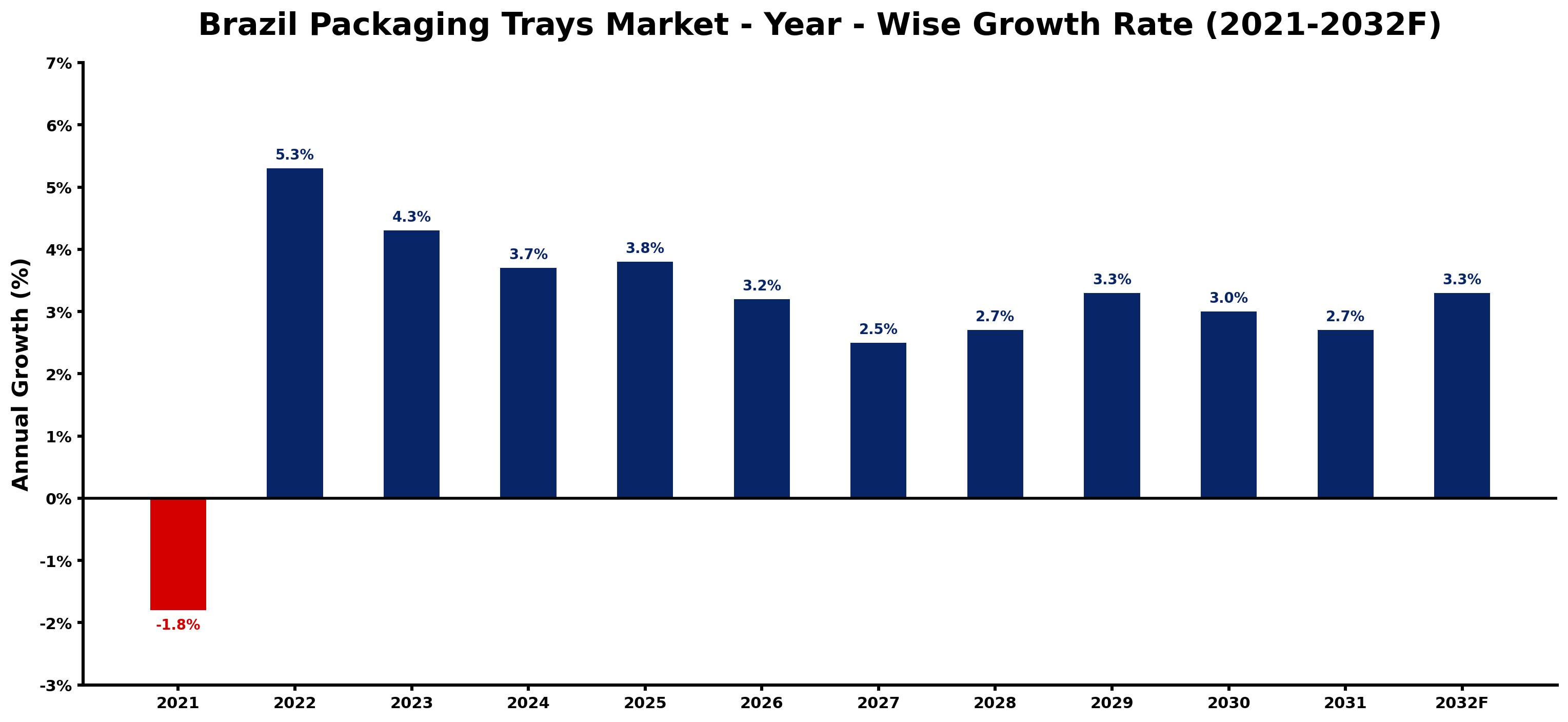
The table below presents the year wise growth rates along with the key drivers influencing the market
| Year | Growth Rate | Major Drivers |
| 2021 | -1.8% | Supply chain disruptions led to increased costs and limited availability of packaging trays, impacting overall market performance. |
| 2022 | 5.3% | E-commerce expansion demanded innovative packaging options for efficient product delivery. |
| 2023 | 4.3% | Food industry trends emphasized biodegradable trays for fresh produce and takeout meals. |
| 2024 | 3.7% | Retailers focused on reducing plastic use, prompting shifts toward eco-friendly materials. |
| 2025 | 3.8% | Urbanization and demographic changes fueled demand for convenience packaging in cities. |
| 2026 | 3.2% | Technological improvements in manufacturing drove down costs for biodegradable packaging options. |
| 2027 | 2.5% | Corporate sustainability initiatives highlighted the importance of eco-conscious packaging materials. |
| 2028 | 2.7% | Increased consumer awareness about environmental impact shifted preferences to recyclable trays. |
| 2029 | 3.3% | Partnerships between brands and green startups fostered innovation in packaging designs. |
| 2030 | 3.0% | Investment in recycling infrastructure enhanced the lifecycle of packaging materials significantly. |
| 2031 | 2.7% | Rising competition in the food sector encouraged differentiation through unique packaging formats. |
| 2032 | 3.3% | Supply chain advancements reduced costs, bolstering the market for innovative packaging solutions. |
Note - Market size estimations and growth projections presented in this report are based on 6Wresearch's advanced forecasting approach, validated with industry datasets as of June 2026.
Brazil Packaging Trays Market Synopsis
The Brazil Packaging Trays Market is projected to reach 3.2% and witness significant growth during the forecast period (2026-2032). This market is crucial in supporting various industries, primarily food and beverage, while adapting to contemporary consumer preferences for sustainable and attractive packaging options. The ongoing evolution of design, materials, and functionality within the packaging sector plays an integral role in enhancing product presentation and ensuring safety.
Brazil Packaging Trays Market Growth Drivers
The growth of the Brazil Packaging Trays Market is significantly influenced by several key drivers:
- One of the primary drivers is the escalating demand from the food and beverage industry for packaging solutions that are not only functional but also visually appealing, enhancing brand image.
- Increased consumer awareness surrounding hygiene and product freshness has led to wider adoption of packaging trays, as they provide optimal protection and an aesthetic presentation.
- Technological advancements in manufacturing processes, such as automation and the use of innovative materials, have improved the efficiency and quality of packaging trays, thus driving market growth.
- The ongoing trend of convenience in food consumption, particularly with the rise of ready-to-eat meals, further bolsters demand for packaging trays that are easy to handle and dispose of.
- As consumers become more health-conscious, packaging that facilitates cleanliness and reduces contamination risk has become increasingly important, propelling the growth of the market.
Brazil Packaging Trays Market Challenges and Restraints
Despite its robust growth, the Brazil Packaging Trays Market faces several notable challenges:
- The shift towards eco-friendly and biodegradable packaging solutions poses a significant challenge, as companies must adapt to stringent regulations and consumer expectations for sustainability.
- Navigating the complexities of environmental regulations requires investment in sustainable practices, which can strain financial resources, especially for smaller firms.
- The constant evolution of packaging technologies and materials necessitates ongoing innovation, where failure to keep up can lead to diminished market competitiveness.
- Consumer preferences are continually shifting, making it essential for companies to remain agile in their product offerings to meet changing demands effectively.
- The higher cost associated with sustainable materials compared to traditional options can also be a deterrent for many suppliers, impacting market growth.
Brazil Packaging Trays Market Government Investment and Initiatives
The Brazilian government has implemented various policies and initiatives aimed at promoting the growth of the packaging industry, specifically targeting the packing trays sector:
- Government initiatives are focusing on encouraging the development of lightweight, recyclable materials in packaging, aiming to minimize environmental impact.
- Policies promoting waste reduction are in place, driving the packaging sector towards more sustainable production practices.
- Investment in research and development for sustainable packaging technologies is being promoted to address increasing environmental concerns.
- Public spending is being directed towards innovation in packaging solutions, ensuring businesses can adapt to new regulations and consumer demands.
- Incentives for companies adopting eco-friendly practices are being established, in an effort to facilitate the transition to more sustainable packaging options.
Brazil Packaging Trays Market Latest Developments (May 2025 - June 2026)
Recent developments in the Brazil Packaging Trays Market highlight a significant commitment to innovation and sustainability. Trends indicate a growing focus on eco-friendly materials, with industry participants increasingly investing in research to develop biodegradable and recyclable packaging solutions. Collaborations among manufacturers and environmental organizations are emerging as a strategy to enhance sustainability practices. Furthermore, the integration of smart technologies into packaging design is gaining traction, allowing for improved tracking and consumer engagement. As regulations evolve, the industry is adapting by implementing new standards for sustainable production methods.
Brazil Packaging Trays Market - Key Attractiveness of the Report
- 10 Years of Market Numbers
- Historical Data Starting from 2022 to 2025
- Base Year: 2025
- Forecast Data until 2032
- Key Performance Indicators Impacting the Market
- Major Upcoming Developments and Projects
Key Highlights of the Report:
- Brazil Packaging Trays Market Outlook
- Market Size of Brazil Packaging Trays Market, 2025
- Forecast of Brazil Packaging Trays Market, 2032
- Historical Data and Forecast of Brazil Packaging Trays Revenues & Volume for the Period 2022-2032F
- Brazil Packaging Trays Market Trend Evolution
- Brazil Packaging Trays Market Drivers and Challenges
- Brazil Packaging Trays Price Trends
- Brazil Packaging Trays Porter's Five Forces
- Brazil Packaging Trays Industry Life Cycle
- Historical Data and Forecast of Brazil Packaging Trays Market Revenues & Volume By Material Types for the Period 2022-2032F
- Historical Data and Forecast of Brazil Packaging Trays Market Revenues & Volume By PET for the Period 2022-2032F
- Historical Data and Forecast of Brazil Packaging Trays Market Revenues & Volume By PVC for the Period 2022-2032F
- Historical Data and Forecast of Brazil Packaging Trays Market Revenues & Volume By Polypropylene for the Period 2022-2032F
- Historical Data and Forecast of Brazil Packaging Trays Market Revenues & Volume By Others for the Period 2022-2032F
- Historical Data and Forecast of Brazil Packaging Trays Market Revenues & Volume By Forms for the Period 2022-2032F
- Historical Data and Forecast of Brazil Packaging Trays Market Revenues & Volume By Flexible for the Period 2022-2032F
- Historical Data and Forecast of Brazil Packaging Trays Market Revenues & Volume By Semi-Flexible for the Period 2022-2032F
- Historical Data and Forecast of Brazil Packaging Trays Market Revenues & Volume By End-users for the Period 2022-2032F
- Historical Data and Forecast of Brazil Packaging Trays Market Revenues & Volume By Industrial for the Period 2022-2032F
- Historical Data and Forecast of Brazil Packaging Trays Market Revenues & Volume By Food & Beverages for the Period 2022-2032F
- Historical Data and Forecast of Brazil Packaging Trays Market Revenues & Volume By Retail for the Period 2022-2032F
- Historical Data and Forecast of Brazil Packaging Trays Market Revenues & Volume By Cosmetic & Personal Care for the Period 2022-2032F
- Historical Data and Forecast of Brazil Packaging Trays Market Revenues & Volume By Others for the Period 2022-2032F
- Brazil Packaging Trays Import Export Trade Statistics
- Market Opportunity Assessment By Material Types
- Market Opportunity Assessment By Forms
- Market Opportunity Assessment By End-users
- Brazil Packaging Trays Top Companies Market Share
- Brazil Packaging Trays Competitive Benchmarking By Technical and Operational Parameters
- Brazil Packaging Trays Company Profiles
- Brazil Packaging Trays Key Strategic Recommendations






































