Brazil Peat Market Size, Share & Growth Rate
The Brazil Peat Market was estimated at USD 472 Million in 2025 and is projected to reach USD 565 Million by 2032, growing at a CAGR of 2.6% from 2026 to 2032. This growth trajectory is primarily driven by increasing applications of peat in sustainable agriculture and horticulture, where it is prized for enhancing soil fertility and structure. Furthermore, a rising awareness of environmental conservation is compelling market players to adopt more sustainable peat extraction practices, thereby supporting the market's expansion.
Brazil Peat Market Growth Rate Analysis (2021-2032)
In Brazil, the peat market showed a significant rebound after a decline of -1.8% in 2021, largely due to pandemic-related disruptions. This upward trend accelerated with a growth of 5.2% in 2022, fueled by increasing demand for biostimulants in agriculture and a rise in peat-based horticultural products. Growth continued to stabilize with rates of 3.9% in 2023 and projected increases of 4.3% in 2024, reflecting ongoing investments in sustainable practices and eco-friendly technologies. However, a tapering is anticipated towards 2028, as market maturity and changing consumer preferences towards alternatives may exert pressure. Nevertheless, the long-term outlook from 2029 through 2032 remains promising as infrastructure developments and energy transition initiatives create new opportunities.
Brazil Peat Market Year-wise Growth Rate and Key Drivers
This graph highlights how the Brazil Peat Market has steadily grown over the past five years, supported by major growth factors.
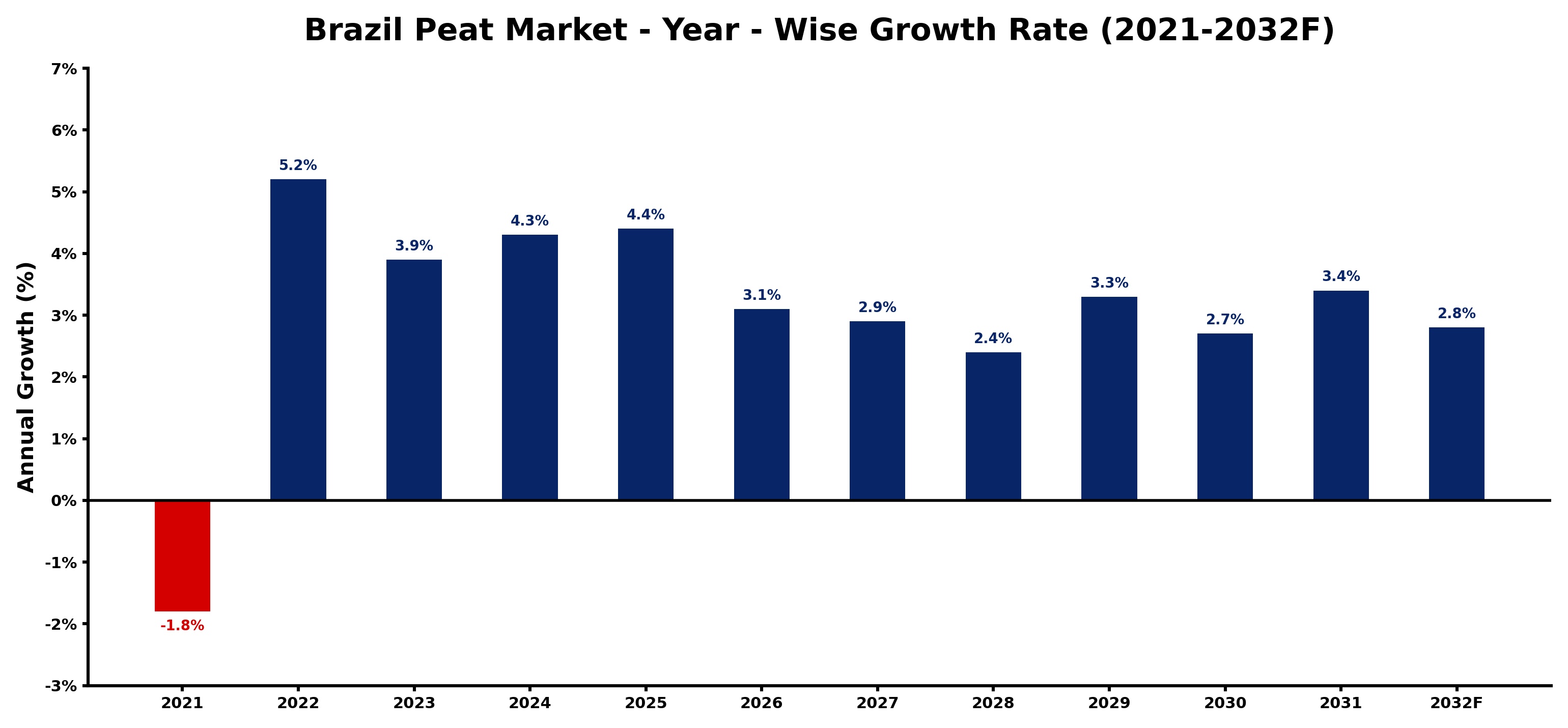
The table below presents the year‑wise growth rates along with the key drivers influencing the market
| Year | Growth Rate | Major Drivers |
| 2021 | -1.8% | Declining export demand diminished peat production capacity in Brazil |
| 2022 | 5.2% | Technological upgrades in peat processing boost domestic supply efficiency |
| 2023 | 3.9% | Domestic peat production enhancements drive export market competitiveness |
| 2024 | 4.3% | Foundry modernization drives peat production efficiency and export potential |
| 2025 | 4.4% | Manufacturing investments in foundry modernization enhance peat processing efficiency |
| 2026 | 3.1% | Export driven peat production growth supports biofuel manufacturing capacity expansion |
| 2027 | 2.9% | Foundry modernization projects boosted peat extraction efficiency significantly |
| 2028 | 2.4% | Investment in automated peat processing enhances domestic production efficiency |
| 2029 | 3.3% | Higher capacity utilization in peat production enhances export competitiveness |
| 2030 | 2.7% | Technology integration in peat processing boosts export capabilities significantly |
| 2031 | 3.4% | Foundry modernization initiatives drive domestic peat processing efficiency |
| 2032 | 2.8% | Domestic peat extraction advancements boost horticultural substrate production capacity |
Note - Market size estimations and growth projections presented in this report are based on 6Wresearch's advanced forecasting approach, validated with industry datasets as of June 2026.
Brazil Peat Market Synopsis
The most significant force currently shaping the Brazil Peat Market is the increasing demand for sustainable agricultural practices. As Brazilian farmers strive to adopt organic methods, the need for high-quality soil amendments, including peat, has surged. This demand is closely aligned with global trends in eco-friendly agriculture, where peat's unique properties are recognized as vital for soil enhancement.
In addition to agricultural applications, the horticulture sector is experiencing a renaissance, further bolstered by urban gardening trends and landscaping requirements. These sectors are continuously seeking efficient growth mediums that can deliver both performance and sustainability, thus driving interest in peat products.
Brazil Peat Market Key Takeaways
- The market is experiencing steady growth due to rising applications in sustainable agriculture.
- Environmental conservation efforts are pushing for responsible peat extraction practices.
- Government policies increasingly support sustainable resource management in peat utilization.
- Investment in eco-friendly extraction technologies is becoming a focal point for industry players.
- Organic farming trends are boosting demand for high-quality peat as a soil amendment.
Evaluation of Restraints in Brazil Peat Market
The Brazil Peat Market is facing several critical restraints that may hinder its growth. Environmental concerns surrounding peat extraction have become prominent, leading to increased regulatory scrutiny. The potential ecological impacts associated with peat harvesting raise questions about sustainability, forcing companies to reevaluate their sourcing methods. Additionally, as alternative soil amendments gain traction in the market, the demand for peat may see challenges unless it is effectively marketed as a sustainable option. Businesses must prioritize sustainable extraction methods and responsible usage to mitigate these concerns.
Brazil Peat Market Trends
Several current and emerging trends are shaping the Brazil Peat Market. A notable trend is the shift towards organic farming, with producers increasingly relying on peat to improve soil health without synthetic fertilizers. Additionally, urban gardening initiatives are on the rise, driving demand for lightweight and effective growing mediums. Technological innovations in extraction processes are also enhancing the efficiency of peat harvesting, making operations more sustainable and less ecologically disruptive.
Brazil Peat Market Opportunities
The Brazil Peat Market presents numerous growth and investment opportunities. With the increasing focus on sustainable agriculture and eco-friendly practices, companies that invest in sustainable extraction technologies stand to benefit significantly. Furthermore, the expanding horticultural sector offers potential for developing specialized peat blends tailored to urban gardening and landscape applications. Collaboration with local governments to promote responsible peat sourcing can also create new avenues for market players.
Government Initiatives in the Brazil Peat Market
Government initiatives in Brazil play a crucial role in shaping the peat market. Policies aimed at environmental conservation and sustainable resource management are being implemented, influencing extraction practices. Regulations concerning peat extraction and land reclamation are in place to ensure that companies prioritize ecological preservation. Incentives for research into alternative soil amendments are also gaining traction, underscoring the government's commitment to fostering sustainable agricultural practices.
Future Insights of the Brazil Peat Market
Looking ahead to 2026-2032, the Brazil Peat Market is poised for moderate growth, driven by the ongoing demand for sustainable agricultural practices. As regulatory frameworks evolve, market participants are likely to shift towards more eco-friendly extraction methods, which will enhance their competitive edge. Moreover, the integration of peat within urban gardening contexts could reshape its market dynamics, opening up new niches that align with consumer preferences for sustainability.
Brazil Peat Market Latest Developments (May 2025 - June 2026)
Recent developments in the Brazil Peat Market highlight a trend towards sustainable practices. Industry players are increasingly investing in research to develop eco-friendly extraction technologies. Moreover, collaborations with environmental organizations are becoming common as companies seek to enhance their sustainability credentials. There is also a notable increase in educational initiatives aimed at promoting responsible peat usage among consumers and farmers alike, further driving the market's evolution.
Brazil Peat Market - Key Attractiveness of the Report
- 10 Years of Market Numbers
- Historical Data Starting from 2022 to 2025
- Base Year: 2025
- Forecast Data until 2032
- Key Performance Indicators Impacting the Market
- Major Upcoming Developments and Projects
Key Highlights of the Report:
- Brazil Peat Market Outlook
- Market Size of Brazil Peat Market, 2025
- Forecast of Brazil Peat Market, 2032
- Historical Data and Forecast of Brazil Peat Revenues & Volume for the Period 2022-2032F
- Brazil Peat Market Trend Evolution
- Brazil Peat Market Drivers and Challenges
- Brazil Peat Price Trends
- Brazil Peat Porter's Five Forces
- Brazil Peat Industry Life Cycle
- Historical Data and Forecast of Brazil Peat Market Revenues & Volume By Type for the Period 2022-2032F
- Historical Data and Forecast of Brazil Peat Market Revenues & Volume By Coco Peat for the Period 2022-2032F
- Historical Data and Forecast of Brazil Peat Market Revenues & Volume By Sod Peat for the Period 2022-2032F
- Historical Data and Forecast of Brazil Peat Market Revenues & Volume By Other for the Period 2022-2032F
- Historical Data and Forecast of Brazil Peat Market Revenues & Volume By Material Type for the Period 2022-2032F
- Historical Data and Forecast of Brazil Peat Market Revenues & Volume By Fibric for the Period 2022-2032F
- Historical Data and Forecast of Brazil Peat Market Revenues & Volume By Hemic for the Period 2022-2032F
- Historical Data and Forecast of Brazil Peat Market Revenues & Volume By Sapric for the Period 2022-2032F
- Historical Data and Forecast of Brazil Peat Market Revenues & Volume By Others for the Period 2022-2032F
- Historical Data and Forecast of Brazil Peat Market Revenues & Volume By Application for the Period 2022-2032F
- Historical Data and Forecast of Brazil Peat Market Revenues & Volume By Agriculture for the Period 2022-2032F
- Historical Data and Forecast of Brazil Peat Market Revenues & Volume By Fuel & Energy for the Period 2022-2032F
- Historical Data and Forecast of Brazil Peat Market Revenues & Volume By Others for the Period 2022-2032F
- Brazil Peat Import Export Trade Statistics
- Market Opportunity Assessment By Type
- Market Opportunity Assessment By Material Type
- Market Opportunity Assessment By Application
- Brazil Peat Top Companies Market Share
- Brazil Peat Competitive Benchmarking By Technical and Operational Parameters
- Brazil Peat Company Profiles
- Brazil Peat Key Strategic Recommendations






































