Brazil Peer-to-peer (P2P) lending Market Size, Share & Growth Rate
The Brazil Peer-to-peer (P2P) lending Market was estimated at USD 367 Million in 2025 and is projected to reach USD 440 Million by 2032, growing at a CAGR of 2.6% from 2026 to 2032. This growth trajectory is driven by a rising demand for accessible credit options and the increasing appeal of digital financial services, which enhance lending efficiencies. The regulatory landscape is becoming more favorable, and the acceptance of fintech solutions is expanding, paving the way for further investment and innovation in the sector.
Brazil Peer-to-peer (P2P) lending Market Year-wise Growth Rate and Key Drivers
This graph highlights how the Brazil Peer-to-peer (P2P) lending Market has steadily grown over the years, supported by major growth factors.
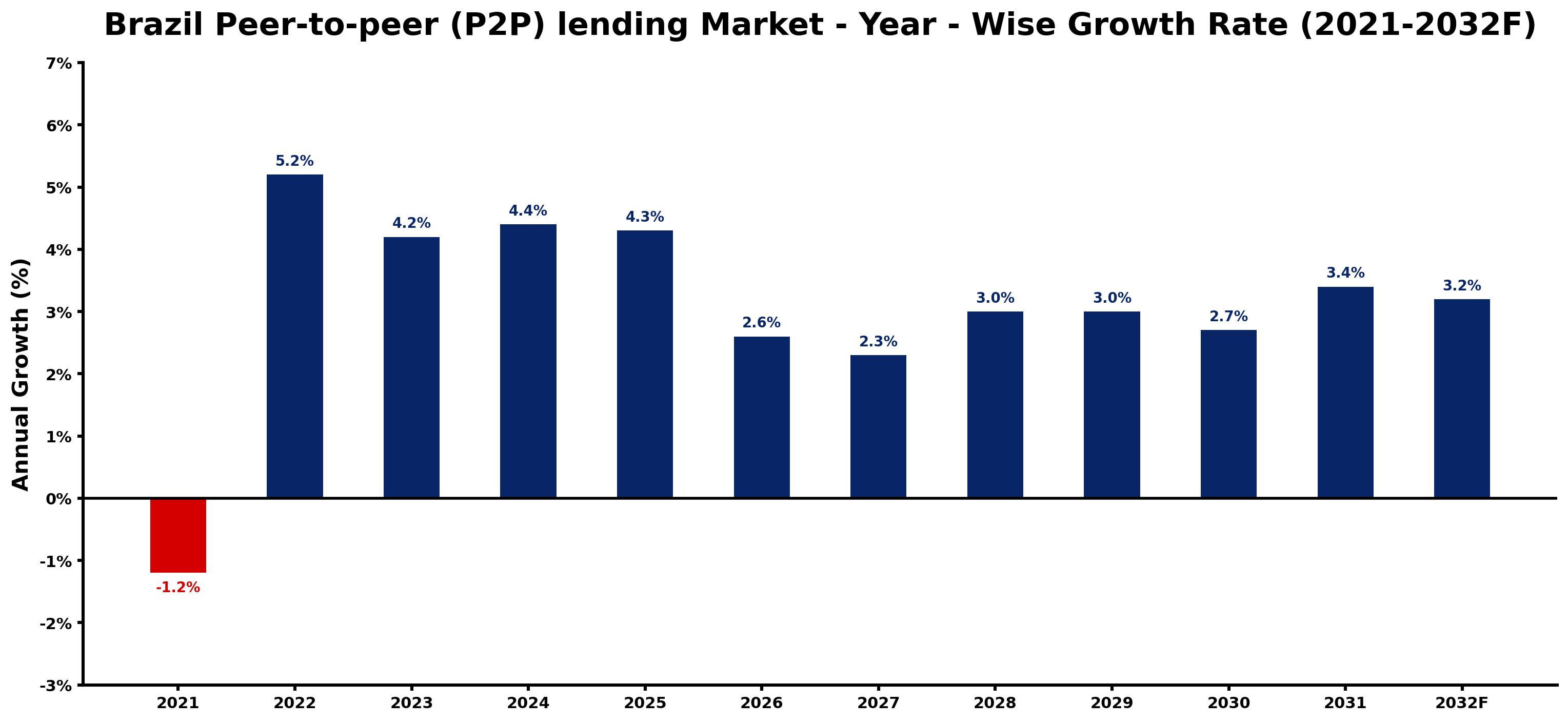
The table below presents the year‑wise growth rates along with the key drivers influencing the market
| Year | Growth Rate | Major Drivers |
| 2021 | -1.2% | Growing renewable energy integration projects |
| 2022 | 5.2% | Increasing industrial automation investments |
| 2023 | 4.2% | Growing renewable energy integration projects |
| 2024 | 4.4% | Rising electricity demand across industries |
| 2025 | 4.3% | Expansion of transportation and logistics networks |
| 2026 | 2.6% | Rising electricity demand across industries |
| 2027 | 2.3% | Expansion of commercial construction activities |
| 2028 | 3.0% | Increasing industrial automation investments |
| 2029 | 3.0% | Expansion of manufacturing activities |
| 2030 | 2.7% | Government infrastructure modernization initiatives |
| 2031 | 3.4% | Expansion of manufacturing activities |
| 2032 | 3.2% | Government infrastructure modernization initiatives |
Note - Market size estimations and growth projections presented in this report are based on 6Wresearch’s advanced forecasting approach, validated with industry datasets as of June 2026.
Brazil Peer-to-peer (P2P) lending Market Synopsis
The Brazilian P2P lending market has witnessed remarkable momentum in recent years, characterized by a shift towards alternative lending avenues. As borrowers increasingly turn to these platforms for faster and more flexible credit solutions, the market is set for a transformation that challenges traditional banking paradigms.
Looking ahead, the landscape is evolving as regulatory frameworks are fine-tuned, and borrower expectations shift. The focus is now on balancing growth with risk management, which will likely define the competitive dynamics within the P2P lending space in Brazil.
Brazil Peer-to-peer (P2P) lending Market Key Takeaways
- The Brazilian P2P lending market is projected to reach USD 440 Million by 2032.
- Rising demand for financial inclusion is driving the adoption of alternative lending platforms.
- Regulatory advancements are fostering a more conducive environment for P2P lending operations.
- Technological innovations are enhancing the efficiency and accessibility of credit.
- Investors are drawn to P2P lending for its potential to yield higher returns compared to traditional investments.
Evaluation of Restraints in Brazil Peer-to-peer (P2P) lending Market
Despite its potential, the Brazilian P2P lending market faces significant constraints. Regulatory hurdles and compliance challenges can complicate operations for lending platforms, posing risks to scalability. Additionally, the market grapples with issues related to credit risk assessment and borrower default rates, which influence investor confidence. The competition from established financial institutions, combined with limited access to comprehensive credit information, further complicates growth and can dampen enthusiasm among both borrowers and investors.
Brazil Peer-to-peer (P2P) lending Market Trends
Currently, the P2P lending landscape in Brazil is shaped by a number of key trends. There is a notable shift towards enhanced digitalization, with platforms incorporating sophisticated algorithms for risk assessment and lending decisions. Moreover, a growing emphasis on social impact investing is prompting many investors to seek opportunities that contribute to financial inclusion and support small businesses. As consumers become more tech-savvy, the demand for seamless online experiences and personalized lending solutions is on the rise.
Brazil Peer-to-peer (P2P) lending Market Opportunities
Opportunities within the Brazilian P2P lending market are abundant. The expansion of digital payment systems and mobile banking can facilitate greater access to P2P platforms, particularly for underbanked populations. Additionally, there is significant room for growth in niche lending segments such as green financing and personal loans tailored for specific demographics. Strategic partnerships between P2P platforms and fintech firms can also unlock innovative solutions and broaden market reach.
Government Initiatives in the Brazil Peer-to-peer (P2P) lending Market
The Brazilian government has been active in promoting policies that enhance financial inclusion and consumer protection within the P2P lending sector. Initiatives may include regulatory frameworks designed to ensure responsible lending practices while safeguarding the interests of both borrowers and lenders. Additionally, there is a focus on establishing oversight mechanisms to monitor P2P lending activities, thereby mitigating systemic risks and fostering a stable lending environment.
Future Insights of the Brazil Peer-to-peer (P2P) lending Market
Looking towards 2026-2032, the Brazilian P2P lending market is expected to undergo transformative changes. The integration of advanced technologies like artificial intelligence and blockchain could enhance transparency and efficiency within the sector. As the regulatory landscape continues to evolve, platforms that adapt swiftly will likely emerge as leaders. Moreover, the growing acceptance of P2P lending among consumers will further solidify its position as a key player in Brazil's financial ecosystem, marking a pivotal shift in how credit is accessed.
Brazil Peer-to-peer (P2P) lending Market Latest Developments (May 2025 - June 2026)
In recent months, the P2P lending landscape in Brazil has seen notable developments, with platforms enhancing their offerings through improved user interfaces and tailored loan products. There is a heightened focus on incorporating data analytics for better risk assessment, which is drawing interest from both investors and borrowers alike. Additionally, discussions around further regulatory updates are ongoing, aiming to create a more robust framework for P2P lending operations.
Brazil Peer-to-peer (P2P) lending Market - Key Attractiveness of the Report
- 10 Years of Market Numbers
- Historical Data Starting from 2022 to 2025
- Base Year: 2025
- Forecast Data until 2032
- Key Performance Indicators Impacting the Market
- Major Upcoming Developments and Projects
Key Highlights of the Report:
- Brazil Peer-to-peer (P2P) lending Market Outlook
- Market Size of Brazil Peer-to-peer (P2P) lending Market, 2025
- Forecast of Brazil Peer-to-peer (P2P) lending Market, 2032
- Historical Data and Forecast of Brazil Peer-to-peer (P2P) lending Revenues & Volume for the Period 2022-2032F
- Brazil Peer-to-peer (P2P) lending Market Trend Evolution
- Brazil Peer-to-peer (P2P) lending Market Drivers and Challenges
- Brazil Peer-to-peer (P2P) lending Price Trends
- Brazil Peer-to-peer (P2P) lending Porter's Five Forces
- Brazil Peer-to-peer (P2P) lending Industry Life Cycle
- Historical Data and Forecast of Brazil Peer-to-peer (P2P) lending Market Revenues & Volume By Business Model for the Period 2022-2032F
- Historical Data and Forecast of Brazil Peer-to-peer (P2P) lending Market Revenues & Volume By Alternate Marketplace Lending for the Period 2022-2032F
- Historical Data and Forecast of Brazil Peer-to-peer (P2P) lending Market Revenues & Volume By Traditional Lending for the Period 2022-2032F
- Historical Data and Forecast of Brazil Peer-to-peer (P2P) lending Market Revenues & Volume By Type for the Period 2022-2032F
- Historical Data and Forecast of Brazil Peer-to-peer (P2P) lending Market Revenues & Volume By Consumer Lending for the Period 2022-2032F
- Historical Data and Forecast of Brazil Peer-to-peer (P2P) lending Market Revenues & Volume By Business Lending for the Period 2022-2032F
- Historical Data and Forecast of Brazil Peer-to-peer (P2P) lending Market Revenues & Volume By End User for the Period 2022-2032F
- Historical Data and Forecast of Brazil Peer-to-peer (P2P) lending Market Revenues & Volume By Consumer Credit Loans for the Period 2022-2032F
- Historical Data and Forecast of Brazil Peer-to-peer (P2P) lending Market Revenues & Volume By Small Business Loans for the Period 2022-2032F
- Historical Data and Forecast of Brazil Peer-to-peer (P2P) lending Market Revenues & Volume By Student Loans for the Period 2022-2032F
- Historical Data and Forecast of Brazil Peer-to-peer (P2P) lending Market Revenues & Volume By Real Estate Loans for the Period 2022-2032F
- Brazil Peer-to-peer (P2P) lending Import Export Trade Statistics
- Market Opportunity Assessment By Business Model
- Market Opportunity Assessment By Type
- Market Opportunity Assessment By End User
- Brazil Peer-to-peer (P2P) lending Top Companies Market Share
- Brazil Peer-to-peer (P2P) lending Competitive Benchmarking By Technical and Operational Parameters
- Brazil Peer-to-peer (P2P) lending Company Profiles
- Brazil Peer-to-peer (P2P) lending Key Strategic Recommendations






































