Brazil Personal Computers Market Size, Share & Growth Rate
The Brazil Personal Computers Market was estimated at USD 319 Million in 2025 and is projected to reach USD 381 Million by 2032, growing at a CAGR of 2.6% from 2026 to 2032. This growth trajectory is primarily driven by the ongoing digital transformation across various sectors, including education, finance, and government services, coupled with the rising adoption of remote work and online learning. As organizations and individuals increasingly rely on personal computers for both productivity and entertainment, the demand for versatile and powerful computing devices continues to flourish.
Brazil Personal Computers Market Year-wise Growth Rate and Key Drivers
This graph highlights how the Brazil Personal Computers Market has steadily grown over the years, supported by major growth factors.
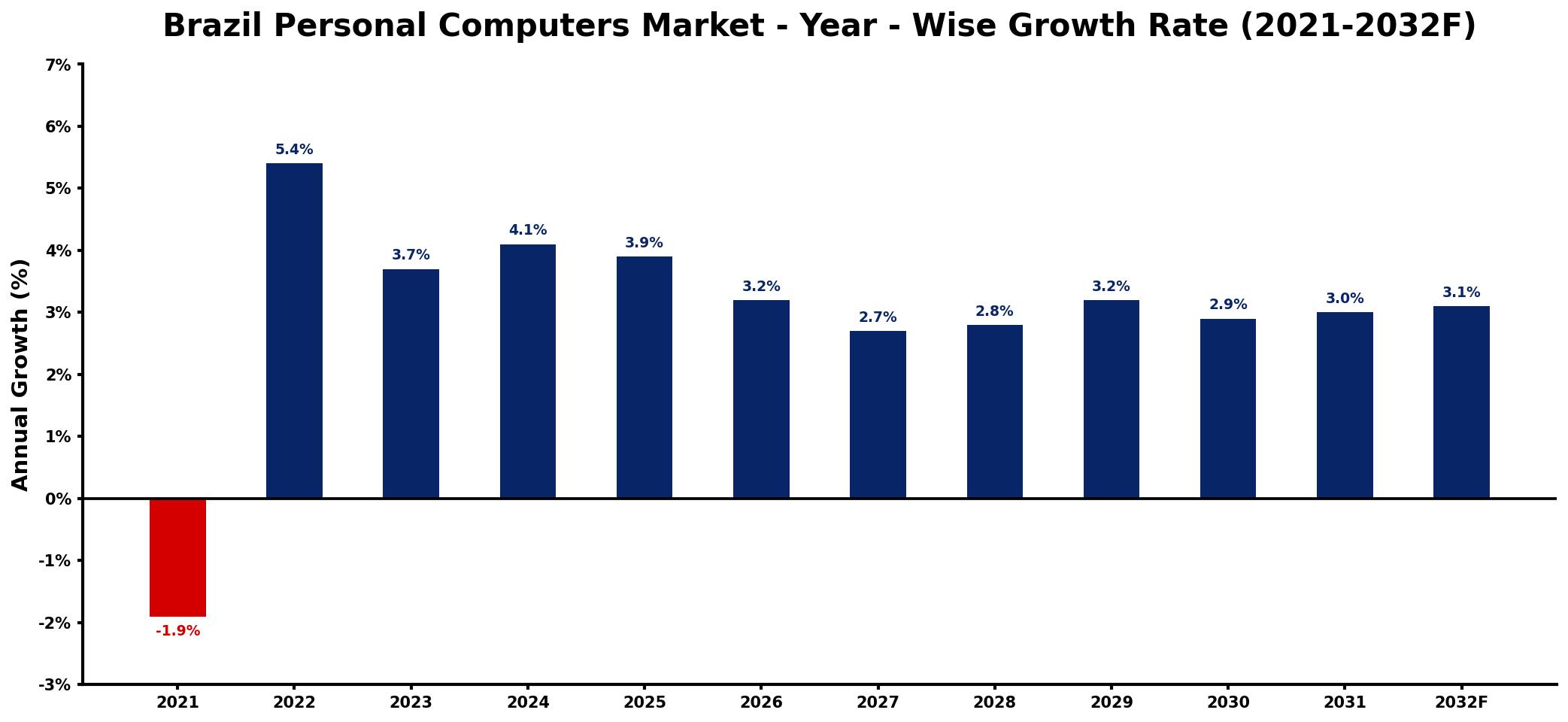
The table below presents the year‑wise growth rates along with the key drivers influencing the market
| Year | Growth Rate | Major Drivers |
| 2021 | -1.9% | decreased consumer electronics spending |
| 2022 | 5.4% | rise in remote work adoption |
| 2023 | 3.7% | increased digital learning initiatives |
| 2024 | 4.1% | growing cloud computing investments |
| 2025 | 3.9% | expansion of e-commerce platforms |
| 2026 | 3.2% | surge in gaming industry growth |
| 2027 | 2.7% | enhanced internet infrastructure developments |
| 2028 | 2.8% | increased demand for online services |
| 2029 | 3.2% | growth in telehealth applications |
| 2030 | 2.9% | growing automotive sector requirements |
| 2031 | 3.0% | improved processing technologies adoption |
| 2032 | 3.1% | increased focus on cybersecurity solutions |
Note: Market size estimations and growth projections presented in this report are based on 6Wresearch's proprietary forecasting methodology, utilizing the latest available industry data, government publications, and primary research inputs.
Brazil Personal Computers Market Synopsis
In recent years, the Brazil Personal Computers Market has gained momentum, fueled by the pandemic-induced shift towards remote working and online education. This has highlighted the importance of reliable computing devices, pushing personal computers back into the spotlight amidst the dominance of mobile devices.
Looking forward, however, the market is projected to encounter headwinds. Economic fluctuations and competitive pressures from smartphones and tablets could potentially dampen growth rates. Nevertheless, the underlying need for robust computing solutions across numerous sectors indicates that personal computers will continue to play a vital role in Brazil's technological landscape.
Brazil Personal Computers Market Key Takeaways
- The market is driven by increasing digitalization and demand for versatile computing solutions.
- Remote work and online learning trends are significantly contributing to market growth.
- Technological advancements are enhancing product appeal and performance.
- Economic factors and competition from mobile devices pose challenges to sustained growth.
- Government initiatives aim to promote digital inclusion and access to affordable computing devices.
Evaluation of Restraints in Brazil Personal Computers Market
Despite the overall positive outlook, several restraints are impacting the Brazil Personal Computers Market. Competition from increasingly capable mobile devices poses a significant challenge as consumers weigh their options between traditional PCs and smartphones or tablets. Furthermore, economic downturns can curtail consumer spending on electronics, affecting overall sales. Additionally, rapid technological advancements can lead to obsolescence, making it difficult for products to maintain their relevance in the fast-evolving tech landscape. As such, companies need to navigate these restraints carefully to sustain growth.
Brazil Personal Computers Market Trends
Several current and emerging trends are shaping the Brazil Personal Computers Market. The rise of cloud computing solutions is influencing consumer preferences for devices that can efficiently support remote access and collaboration. Furthermore, sustainability initiatives are prompting manufacturers to adopt eco-friendly materials and production processes. As consumers become increasingly health-conscious, ergonomic designs in personal computers are also gaining traction, appealing to users who prioritize comfort and wellness during extended periods of device use.
Brazil Personal Computers Market Opportunities
There are genuine growth and investment opportunities in the Brazil Personal Computers Market. As the government continues to push for greater digital inclusion, there's potential for increased demand for affordable computing devices. Emerging segments such as gaming PCs and high-performance laptops are also gaining traction, driven by a burgeoning gaming community and a rise in content creation. Investment in R&D can yield innovative solutions that enhance user experiences and meet evolving consumer needs, providing companies a competitive edge.
Government Initiatives in the Brazil Personal Computers Market
The Brazilian government plays a crucial role in shaping the personal computers market. Policies aimed at increasing access to affordable technology and digital literacy are essential components of their strategy. Initiatives to incentivize local manufacturing help reduce import dependency and foster domestic innovation in the IT sector. Furthermore, public spending on technology adoption, especially in education and public services, supports the growing demand for personal computers across various demographics.
Future Insights of the Brazil Personal Computers Market
Looking ahead to 2026-2032, the Brazil Personal Computers Market is poised for continued evolution. The increasing integration of AI and machine learning into personal computing devices will enhance user experiences, making them more intuitive and capable. Additionally, as remote work becomes a permanent feature in many sectors, the demand for robust and reliable personal computers will likely grow. Balancing technological advancements with affordability will be crucial for manufacturers to capitalize on emerging opportunities and sustain market growth.
Brazil Personal Computers Market Latest Developments (2025 - 2026)
Recent developments in the Brazil Personal Computers Market have highlighted a trend towards hybrid work environments, leading to increased investments in portable devices with enhanced connectivity features. Manufacturers are focusing on delivering high-performance laptops and desktops tailored for both business and personal use. Meanwhile, initiatives to expand digital access in underserved areas are gaining traction, further underscoring the importance of personal computers in bridging the digital divide.
Brazil Personal Computers Market - Key Attractiveness of the Report
- 10 Years of Market Numbers
- Historical Data Starting from 2022 to 2025
- Base Year: 2025
- Forecast Data until 2032
- Key Performance Indicators Impacting the Market
- Major Upcoming Developments and Projects
Key Highlights of the Report:
- Brazil Personal Computers Market Outlook
- Market Size of Brazil Personal Computers Market, 2025
- Forecast of Brazil Personal Computers Market, 2032
- Historical Data and Forecast of Brazil Personal Computers Revenues & Volume for the Period 2022-2032F
- Brazil Personal Computers Market Trend Evolution
- Brazil Personal Computers Market Drivers and Challenges
- Brazil Personal Computers Price Trends
- Brazil Personal Computers Porter's Five Forces
- Brazil Personal Computers Industry Life Cycle
- Historical Data and Forecast of Brazil Personal Computers Market Revenues & Volume By Product Type for the Period 2022-2032F
- Historical Data and Forecast of Brazil Personal Computers Market Revenues & Volume By Desktop for the Period 2022-2032F
- Historical Data and Forecast of Brazil Personal Computers Market Revenues & Volume By Notebook for the Period 2022-2032F
- Historical Data and Forecast of Brazil Personal Computers Market Revenues & Volume By Workstation for the Period 2022-2032F
- Historical Data and Forecast of Brazil Personal Computers Market Revenues & Volume By Others for the Period 2022-2032F
- Historical Data and Forecast of Brazil Personal Computers Market Revenues & Volume By Distribution Channel for the Period 2022-2032F
- Historical Data and Forecast of Brazil Personal Computers Market Revenues & Volume By Business-To-Business (B2B) for the Period 2022-2032F
- Historical Data and Forecast of Brazil Personal Computers Market Revenues & Volume By Business-To-Consumer (B2C) for the Period 2022-2032F
- Historical Data and Forecast of Brazil Personal Computers Market Revenues & Volume By Application for the Period 2022-2032F
- Historical Data and Forecast of Brazil Personal Computers Market Revenues & Volume By Consumer for the Period 2022-2032F
- Historical Data and Forecast of Brazil Personal Computers Market Revenues & Volume By Commercial for the Period 2022-2032F
- Historical Data and Forecast of Brazil Personal Computers Market Revenues & Volume By Industrial for the Period 2022-2032F
- Brazil Personal Computers Import Export Trade Statistics
- Market Opportunity Assessment By Product Type
- Market Opportunity Assessment By Distribution Channel
- Market Opportunity Assessment By Application
- Brazil Personal Computers Top Companies Market Share
- Brazil Personal Computers Competitive Benchmarking By Technical and Operational Parameters
- Brazil Personal Computers Company Profiles
- Brazil Personal Computers Key Strategic Recommendations






































