Brazil Polio Vaccine Market Size, Share & Growth Rate
The Brazil Polio Vaccine Market was estimated at USD 240 Million in 2025 and is projected to reach USD 285 Million by 2032, growing at a CAGR of 2.5% from 2026 to 2032. This growth trajectory is primarily fueled by the government's unwavering commitment to eradicating polio, as evidenced by ongoing vaccination campaigns and routine immunization efforts. Additionally, international partnerships play a pivotal role in enhancing vaccine availability and awareness, solidifying Brazil's position in global health initiatives aimed at disease eradication.
Brazil Polio Vaccine Market Year-wise Growth Rate and Key Drivers
This graph highlights how the Brazil Polio Vaccine Market has steadily grown over the years, supported by major growth factors.
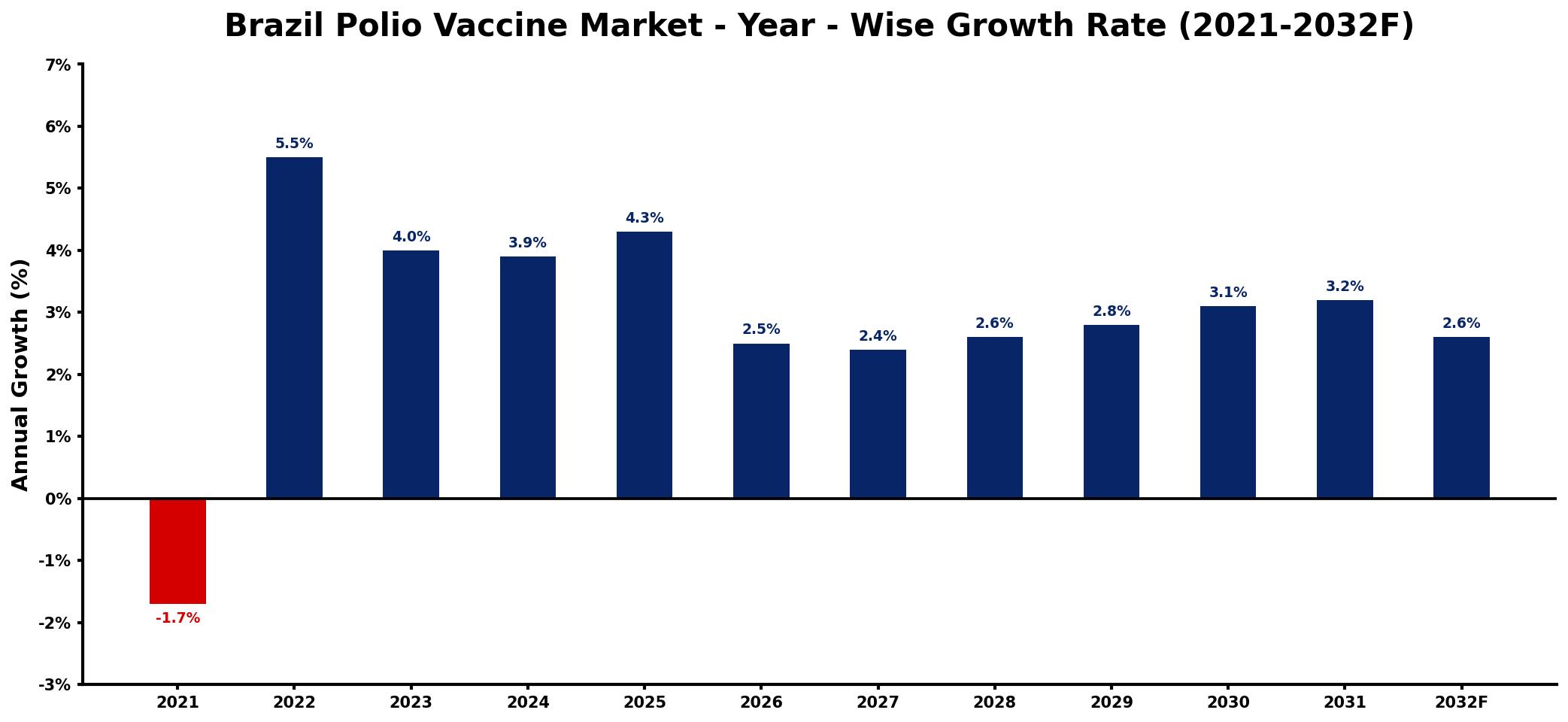
The table below presents the year‑wise growth rates along with the key drivers influencing the market
| Year | Growth Rate | Major Drivers |
| 2021 | -1.7% | decreased public health funding allocations |
| 2022 | 5.5% | increased immunization program investments |
| 2023 | 4.0% | growing public health awareness campaigns |
| 2024 | 3.9% | rising healthcare infrastructure improvements |
| 2025 | 4.3% | expanding global health partnerships |
| 2026 | 2.5% | increased research funding availability |
| 2027 | 2.4% | growing demand for preventive healthcare |
| 2028 | 2.6% | enhanced community health initiatives |
| 2029 | 2.8% | strengthened healthcare distribution networks |
| 2030 | 3.1% | expanding international health collaborations |
| 2031 | 3.2% | increased focus on child health |
| 2032 | 2.6% | growing interest in preventive measures |
Note: Market size estimations and growth projections presented in this report are based on 6Wresearch's proprietary forecasting methodology, utilizing the latest available industry data, government publications, and primary research inputs.
Brazil Polio Vaccine Market Synopsis
The most significant force shaping the Brazil Polio Vaccine Market is the robust public health infrastructure, which is backed by government and international support. This synergy enables efficient vaccine distribution and creates a framework for widespread community engagement and education on the importance of immunization.
Alongside the government's active role, collaboration with international organizations has bolstered Brazil's vaccination initiatives. These partnerships not only strengthen logistics but also ensure that the country remains vigilant against potential outbreaks, safeguarding its hard-won polio-free status.
Brazil Polio Vaccine Market Key Takeaways
- Continued investment in research and vaccine production is vital for market growth.
- Community engagement is crucial for maintaining high vaccination coverage.
- Partnerships with international organizations bolster vaccine accessibility.
- Government policies prioritize public health and immunization efforts.
- Surveillance systems are essential for monitoring vaccine efficacy and safety.
Evaluation of Restraints in Brazil Polio Vaccine Market
Despite its strong growth potential, the Brazil Polio Vaccine Market faces notable restraints. One of the primary concerns is ensuring sustained high vaccination coverage across diverse populations. Vaccine supply shortages can disrupt immunization efforts and compromise herd immunity. Additionally, the emergence of vaccine-derived poliovirus outbreaks further complicates eradication strategies, necessitating a collaborative approach among health authorities, stakeholders, and the community to mitigate these risks effectively.
Brazil Polio Vaccine Market Trends
Emerging trends in the Brazil Polio Vaccine Market highlight a move towards integrating advanced technologies in vaccine development and distribution. The rise of digital platforms for community education and vaccine tracking is enhancing public awareness and participation in vaccination campaigns. Additionally, there's a growing emphasis on research for improved polio vaccines that may offer broader immunity and longer-lasting protection.
Brazil Polio Vaccine Market Opportunities
Significant growth opportunities are present in Brazils polio vaccine landscape, particularly in enhancing public-private partnerships for vaccine distribution. Investing in local vaccine production capabilities can reduce dependency on imports and ensure timely availability. Furthermore, the increasing emphasis on global health security presents an avenue for Brazil to lead initiatives aimed at not just polio eradication but also the prevention of other infectious diseases.
Government Initiatives in the Brazil Polio Vaccine Market
The Brazilian government is actively prioritizing disease eradication and public health promotion through a variety of initiatives. This includes extensive vaccination campaigns and the implementation of surveillance systems to monitor immunization coverage and effectiveness. Regulatory bodies, such as the National Health Surveillance Agency (ANVISA), oversee vaccine approval and distribution, ensuring adherence to safety standards while fostering international cooperation in health initiatives.
Future Insights of the Brazil Polio Vaccine Market
Looking ahead to the period from 2026 to 2032, the Brazil Polio Vaccine Market is poised for continued growth. Increasingly proactive government policies, coupled with heightened public awareness, will likely lead to improved immunization rates and community participation. Furthermore, ongoing advancements in vaccine technology and formulation are expected to enhance the effectiveness of polio vaccines, reinforcing Brazil's commitment to achieving and maintaining a polio-free status.
Brazil Polio Vaccine Market Latest Developments (2025 - 2026)
Recent developments in the Brazil Polio Vaccine Market indicate a heightened focus on community engagement and education efforts. Health authorities have initiated new awareness campaigns to combat misinformation about vaccines, improving public perception and acceptance. Furthermore, collaborations with non-governmental organizations have expanded outreach efforts, ensuring that underprivileged populations receive essential immunizations.
Brazil Polio Vaccine Market - Key Attractiveness of the Report
- 10 Years of Market Numbers
- Historical Data Starting from 2022 to 2025
- Base Year: 2025
- Forecast Data until 2032
- Key Performance Indicators Impacting the Market
- Major Upcoming Developments and Projects
Key Highlights of the Report:
- Brazil Polio Vaccine Market Outlook
- Market Size of Brazil Polio Vaccine Market, 2025
- Forecast of Brazil Polio Vaccine Market, 2032
- Historical Data and Forecast of Brazil Polio Vaccine Revenues & Volume for the Period 2022-2032F
- Brazil Polio Vaccine Market Trend Evolution
- Brazil Polio Vaccine Market Drivers and Challenges
- Brazil Polio Vaccine Price Trends
- Brazil Polio Vaccine Porter's Five Forces
- Brazil Polio Vaccine Industry Life Cycle
- Historical Data and Forecast of Brazil Polio Vaccine Market Revenues & Volume By Type for the Period 2022-2032F
- Historical Data and Forecast of Brazil Polio Vaccine Market Revenues & Volume By Oral Polio Vaccine (OPV) for the Period 2022-2032F
- Historical Data and Forecast of Brazil Polio Vaccine Market Revenues & Volume By Inactivated Poliomyelitis Vaccine (IPV) for the Period 2022-2032F
- Historical Data and Forecast of Brazil Polio Vaccine Market Revenues & Volume By Application for the Period 2022-2032F
- Historical Data and Forecast of Brazil Polio Vaccine Market Revenues & Volume By Public for the Period 2022-2032F
- Historical Data and Forecast of Brazil Polio Vaccine Market Revenues & Volume By Private for the Period 2022-2032F
- Brazil Polio Vaccine Import Export Trade Statistics
- Market Opportunity Assessment By Type
- Market Opportunity Assessment By Application
- Brazil Polio Vaccine Top Companies Market Share
- Brazil Polio Vaccine Competitive Benchmarking By Technical and Operational Parameters
- Brazil Polio Vaccine Company Profiles
- Brazil Polio Vaccine Key Strategic Recommendations






































