Brazil Railway Platform Security Market Size & Growth Rate (2026-2032)
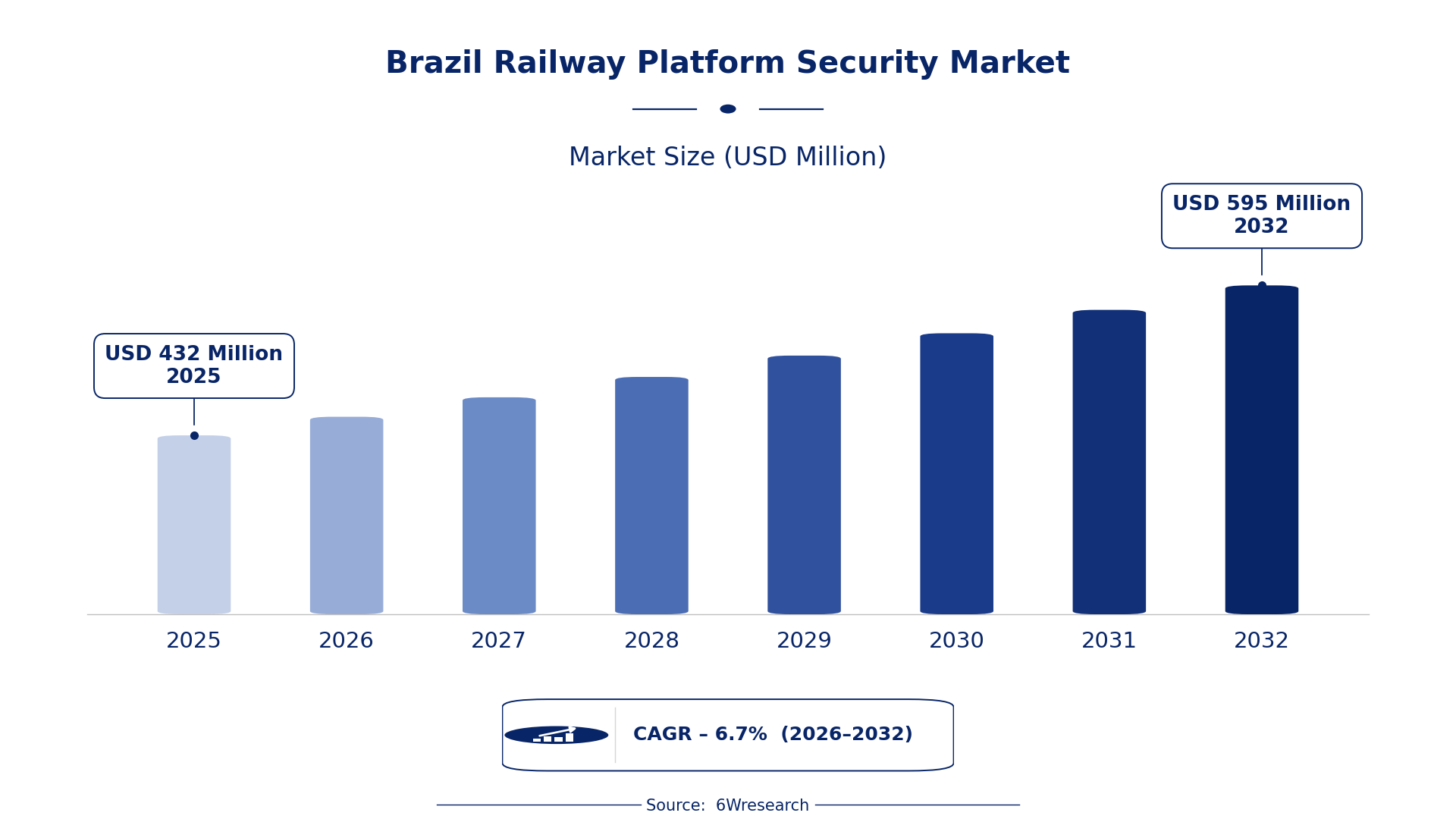
The Brazil Railway Platform Security Market was estimated at USD 432 Million in 2025 and is projected to reach USD 595 Million by 2032, growing at a CAGR of 6.7% from 2026 to 2032.
Brazil Railway Platform Security Market Synopsis
Brazil's railway platform security market has recently experienced a surge in investments due to heightened security concerns. As the nation invests in modernizing its railway infrastructure, the focus on advanced security solutions has intensified, creating a significant market opportunity.
Looking ahead, this market is poised for steady growth. The integration of Internet of Things (IoT) technologies and artificial intelligence is transforming traditional security measures, paving the way for enhanced passenger safety and operational efficiency within the railway sector.
Brazil Railway Platform Security Market Year-wise Growth Rate and Key Drivers
This graph illustrates the annual growth rates of the Brazil Railway Platform Security Market from 2021 to 2032, highlighting a steady upward trajectory and projected expansion over the forecast period.
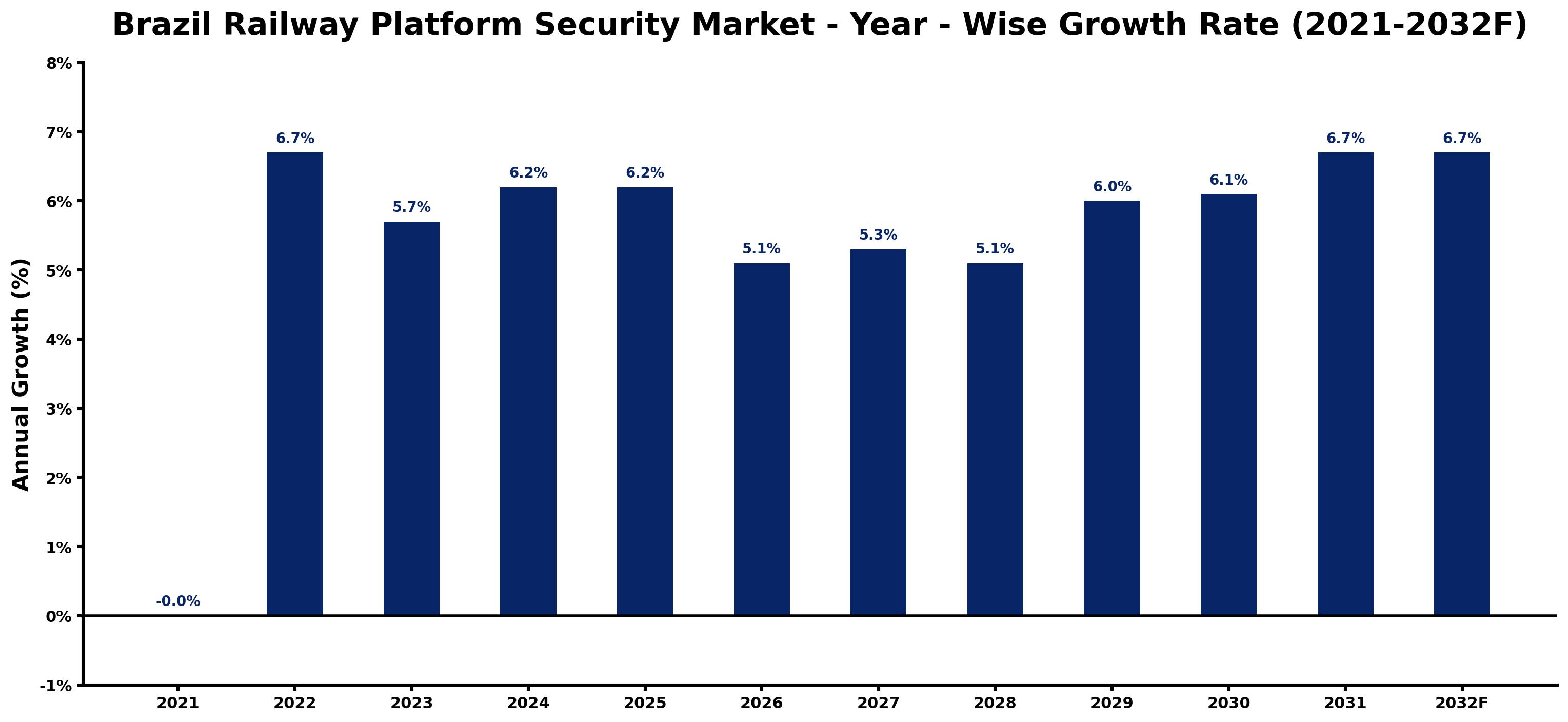
The table below presents the year‑wise growth rates along with the key drivers influencing the market
| Year | Growth Rate | Major Drivers |
| 2021 | -0.0% | Expansion of manufacturing activities |
| 2022 | 6.7% | Increased investment in railway safety regulations by ANTT. |
| 2023 | 5.7% | Expanded biometrics implementation across major train stations. |
| 2024 | 6.2% | Growth in anti-terrorism initiatives affecting public transport security. |
| 2025 | 6.2% | Government subsidies encouraging surveillance technology in railways. |
| 2026 | 5.1% | Rise in urban public transport usage post-pandemic. |
| 2027 | 5.3% | Adoption of smart ticketing increasing cybersecurity needs. |
| 2028 | 5.1% | New cybersecurity legislation mandating upgrades for transport systems. |
| 2029 | 6.0% | Railway expansions necessitating enhanced platform security measures. |
| 2030 | 6.1% | Public-private partnerships improving security technology deployment. |
| 2031 | 6.7% | Increased passenger demand driving investments in security systems. |
| 2032 | 6.7% | Focus on infrastructure resilience due to climate change threats. |
Note: Market size estimations and growth projections presented in this report are based on 6Wresearch's proprietary forecasting methodology, utilizing the latest available industry data, government publications, and primary research inputs.
Brazil Railway Platform Security Market Key Takeaways
Below are some of the specific key takeaways from the market, including:
- Investment in video surveillance and access control systems is on the rise, driven by safety concerns.
- The integration of AI-powered analytics is enhancing situational awareness for railway operators.
- Regulatory initiatives are encouraging modernization in security technology across railway platforms.
- Growing urbanization in Brazil is increasing the demand for efficient and secure transportation systems.
- Collaborations between technology vendors and railway operators are fostering innovation in security solutions.
Evaluation of Restraints in Brazil Railway Platform Security Market
Despite the positive momentum, several constraints affect the growth of the Brazil railway platform security market. One major issue is the limited budget allocations for security upgrades, particularly in rural areas where funding is often prioritized for basic infrastructure needs. Additionally, the challenge of ensuring interoperability among various security systems can hinder the swift implementation of advanced technologies. Concerns surrounding data privacy and regulatory compliance also pose significant barriers, as railway operators must navigate complex legislation while striving to enhance their security frameworks.
Brazil Railway Platform Security Market Trends
The trend toward incorporating AI and machine learning into security systems is gaining traction, enabling real-time threat detection and response. on top of that, the adoption of IoT devices is facilitating proactive monitoring of railway platforms, thus enhancing safety protocols. Another emerging trend is the increased emphasis on user-friendly interfaces, allowing staff to respond swiftly to security breaches. Public-private partnerships are also becoming more common, focusing on shared responsibilities for security improvements and technological advancements.
Brazil Railway Platform Security Market Opportunities
There are substantial opportunities for growth within this market, particularly in urban centers where railway traffic is heavy. The rising demand for integrated security solutions presents a unique chance for technology providers to offer tailored services. Additionally, the upcoming international events and major public transportation projects are likely to drive investments in cutting-edge security technologies. on top of that, expanding digital infrastructure will open doors for innovative security applications that can significantly enhance operational efficiency.
Government Initiatives in the Brazil Railway Platform Security Market
Government actions are crucial in shaping the Brazil railway platform security market. With a focus on public safety, recent policies have mandated improvements in transportation security. The Brazilian government is actively promoting funding initiatives aimed at upgrading railway security infrastructure to meet modern standards.
- A national public safety initiative launched in early 2025 focuses on enhancing surveillance systems across major railway stations.
- Currently underway is a regulatory review aimed at establishing stricter compliance guidelines for security technologies in transportation.
- A planned framework expected to be introduced by 2026 will support public-private partnerships to invest in innovative security solutions.
- Recent legislation has allocated funds specifically for the integration of AI technologies within railway security systems.
- Ongoing discussions among government bodies aim to improve data protection measures in railway operations, fostering trust among passengers.
Future Insights of the Brazil Railway Platform Security Market
The Brazil railway platform security market is set to evolve significantly from 2026 to 2032. As investments in technology become more pronounced, the focus will shift toward creating interconnected security ecosystems that enhance operational efficiency and passenger safety. The increasing reliance on data-driven decision-making is expected to spur the development of more sophisticated security solutions tailored to the unique challenges faced by Brazilian railways. In this dynamic environment, partnerships between the public and private sectors will be critical in driving innovation and ensuring comprehensive security measures are in place.
Brazil Railway Platform Security Market Latest Developments
In the past year, the Brazil railway platform security market has witnessed several notable developments, reflecting a commitment to enhancing safety and security. Industry stakeholders are increasingly adopting advanced technologies, signaling a shift toward more proactive security measures. Collaboration between technology providers and railway operators is resulting in innovative solutions tailored to meet emerging security challenges.
- A major technology vendor launched an AI-driven surveillance system in Q1 2025, aimed at improving threat detection capabilities.
- An initiative that began in mid-2025 and remains underway is focused on integrating IoT sensors across key railway platforms for real-time monitoring.
- In early 2025, a regional operator completed the installation of advanced access control systems in multiple railway stations.
- A planned rollout expected to begin in the second half of 2026 will introduce a comprehensive emergency response framework across the railway network.
Brazil Railway Platform Security Market - Key Attractiveness of the Report
- 10 Years of Market Numbers
- Historical Data Starting from 2022 to 2025
- Base Year: 2025
- Forecast Data until 2032
- Key Performance Indicators Impacting the Market
- Major Upcoming Developments and Projects
Key Highlights of the Report:
- Brazil Railway Platform Security Market Outlook
- Market Size of Brazil Railway Platform Security Market, 2025
- Forecast of Brazil Railway Platform Security Market, 2032
- Historical Data and Forecast of Brazil Railway Platform Security Revenues & Volume for the Period 2022-2032F
- Brazil Railway Platform Security Market Trend Evolution
- Brazil Railway Platform Security Market Drivers and Challenges
- Brazil Railway Platform Security Price Trends
- Brazil Railway Platform Security Porter's Five Forces
- Brazil Railway Platform Security Industry Life Cycle
- Historical Data and Forecast of Brazil Railway Platform Security Market Revenues & Volume By Components for the Period 2022-2032F
- Historical Data and Forecast of Brazil Railway Platform Security Market Revenues & Volume By Solutions for the Period 2022-2032F
- Historical Data and Forecast of Brazil Railway Platform Security Market Revenues & Volume By Services for the Period 2022-2032F
- Historical Data and Forecast of Brazil Railway Platform Security Market Revenues & Volume By Applications for the Period 2022-2032F
- Historical Data and Forecast of Brazil Railway Platform Security Market Revenues & Volume By Subways for the Period 2022-2032F
- Historical Data and Forecast of Brazil Railway Platform Security Market Revenues & Volume By Trains for the Period 2022-2032F
- Brazil Railway Platform Security Import Export Trade Statistics
- Market Opportunity Assessment By Components
- Market Opportunity Assessment By Applications
- Brazil Railway Platform Security Top Companies Market Share
- Brazil Railway Platform Security Competitive Benchmarking By Technical and Operational Parameters
- Brazil Railway Platform Security Company Profiles
- Brazil Railway Platform Security Key Strategic Recommendations






































