Argentina Railway Platform Security Market Size & Growth Rate (2026-2032)
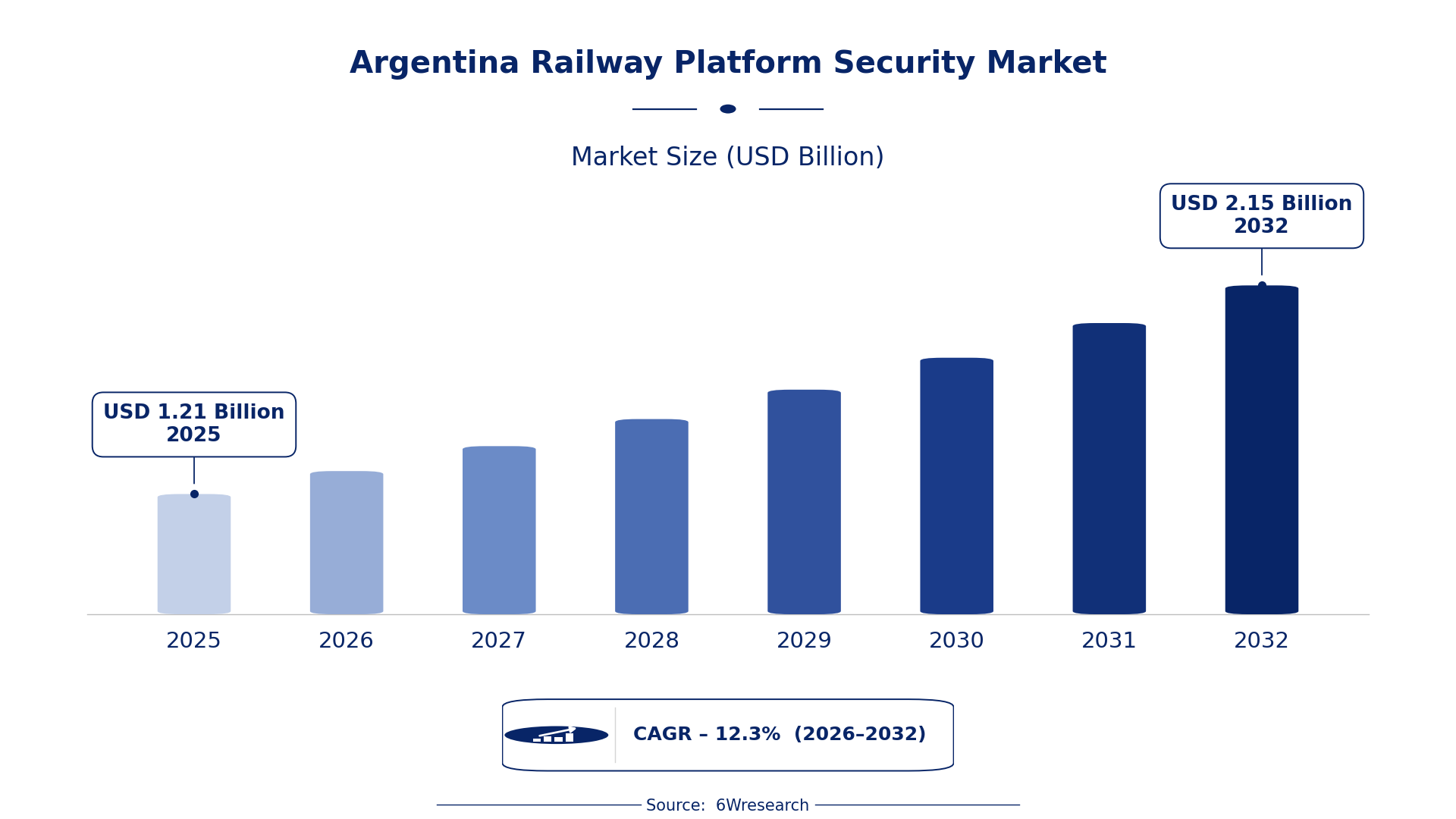
The Argentina Railway Platform Security Market was estimated at USD 1205 Million in 2025 and is projected to reach USD 2146 Million by 2032, growing at a CAGR of 12.3% from 2026 to 2032.
Argentina Railway Platform Security Market Synopsis
In Argentina, the railway platform security sector is evolving rapidly as a response to mounting safety concerns among passengers and infrastructure operators. Enhanced security measures, driven by increased investments in technology, are reshaping how railway platforms manage safety and risk. This shift is essential in ensuring a secure environment for the millions who rely on public transport daily.
The growing adoption of advanced security technologies, such as video surveillance, access control, and intrusion detection systems, reflects a proactive approach to addressing threats. As railway authorities prioritize these upgrades, the market is not only set for expansion but also for significant transformation, aligning with global best practices in transportation safety.
Argentina Railway Platform Security Market Year-wise Growth Rate and Key Drivers
This graph illustrates the annual growth rates of the Argentina Railway Platform Security Market from 2021 to 2032, highlighting a steady upward trajectory and projected expansion over the forecast period.
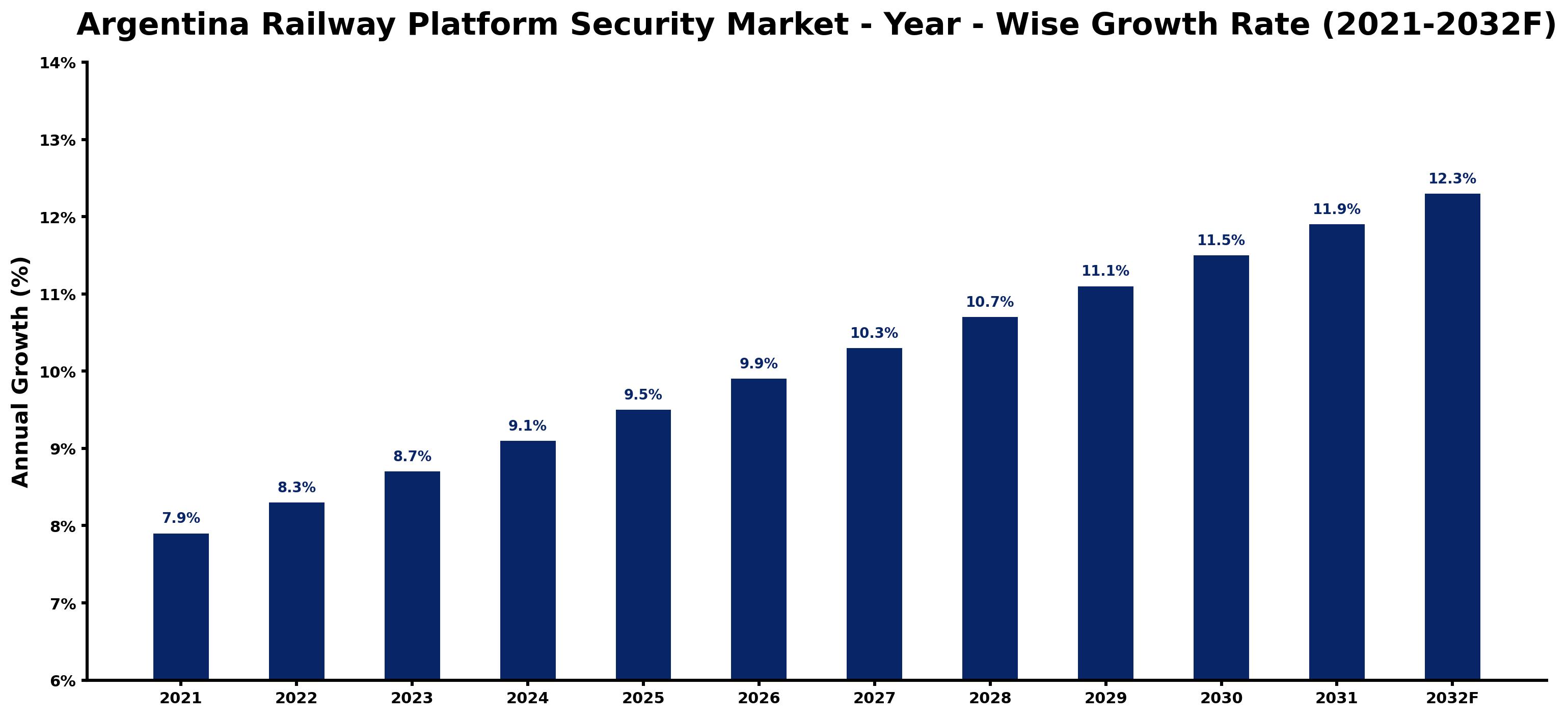
The table below presents the year‑wise growth rates along with the key drivers influencing the market
| Year | Growth Rate | Major Drivers |
| 2021 | 7.9% | Government investment in railway modernization initiatives. |
| 2022 | 8.3% | Enhanced safety regulations from Agencia Nacional de Seguridad. |
| 2023 | 8.7% | Growing urbanization increases demand for regional train security. |
| 2024 | 9.1% | Investment in biometric systems for passenger verification. |
| 2025 | 9.5% | Increased public transport usage post-pandemic influences security upgrades. |
| 2026 | 9.9% | Digitalization of ticketing systems necessitating improved cybersecurity. |
| 2027 | 10.3% | Local partnerships formed to enhance railway surveillance technology. |
| 2028 | 10.7% | Rising concerns over unauthorized access driving platform security demand. |
| 2029 | 11.1% | Increased funding from national government for security enhancements. |
| 2030 | 11.5% | Integration of AI-driven analytics in railway operations. |
| 2031 | 11.9% | Emergence of new security technologies tailored for railways. |
| 2032 | 12.3% | Public initiatives promoting safer travel experiences for commuters. |
Note: Market size estimations and growth projections presented in this report are based on 6Wresearch's proprietary forecasting methodology, utilizing the latest available industry data, government publications, and primary research inputs.
Argentina Railway Platform Security Market Key Takeaways
Below are some of the specific key takeaways from the market, including:
- Increasing investments are being made in technology-driven security solutions for railway platforms.
- The focus on integrating AI and biometric systems is gaining traction to enhance access control.
- Government initiatives are pivotal in shaping the security infrastructure and regulatory framework.
- Cloud-based solutions are becoming essential for real-time monitoring and management of security systems.
- Concerns over vandalism and terrorism are prompting a shift toward comprehensive security measures.
Evaluation of Restraints in Argentina Railway Platform Security Market
Despite the positive outlook, the Argentina Railway Platform Security Market faces notable hurdles. A primary challenge is the substantial investment required to develop and maintain cutting-edge security infrastructure across numerous railway platforms. Many locations are difficult to monitor effectively, and insufficient resources can lead to vulnerabilities. The bureaucratic nature of coordinating between various stakeholders often results in delays, which complicates the implementation of cohesive security strategies. Addressing these constraints demands a concerted effort among government bodies, railway operators, and private security firms.
Argentina Railway Platform Security Market Trends
Emerging trends in the Argentina Railway Platform Security Market are indicative of a broader shift toward proactive safety measures. The integration of video analytics and AI into surveillance systems is enhancing threat detection and response times. Simultaneously, the use of mobile applications for passenger safety alerts is gaining traction. The market is also witnessing a shift toward cloud-based solutions, allowing for centralized management of security systems across multiple locations. These trends highlight a clear movement towards modernization and improved efficiency in security operations.
Argentina Railway Platform Security Market Opportunities
The Argentina Railway Platform Security Market presents numerous opportunities for growth and innovation. The increasing demand for integrated security solutions that combine various technologies offers significant prospects for providers. Implementing advanced analytics and machine learning can further enhance security protocols by allowing real-time data interpretation. Additionally, the transition towards biometric identification systems provides an avenue for improving access control and passenger screening. Investing in these technologies can yield substantial returns as the market continues to evolve.
Government Initiatives in the Argentina Railway Platform Security Market
Government policies play a crucial role in shaping the Argentina Railway Platform Security Market. With a focus on modernizing infrastructure, authorities are prioritizing the enhancement of security measures across railway platforms. These initiatives are designed to create a safer environment for passengers and staff, reflecting a commitment to public safety and efficient transportation systems.
- A recent initiative involved the installation of surveillance cameras and emergency response systems at major railway stations to enhance security measures.
- Currently ongoing is a nationwide upgrade program aimed at integrating advanced access control technologies across various railway platforms.
- Plans are underway for a public awareness campaign, expected to launch in early 2026, to educate passengers about safety protocols and reporting suspicious activities.
- In 2024, the government introduced regulations mandating regular safety inspections of all railway platforms to ensure compliance with updated security standards.
- A planned initiative to develop a centralized monitoring system for railway security is expected to begin in late 2026, enhancing real-time response capabilities.
Future Insights of the Argentina Railway Platform Security Market
Looking ahead to 2026-2032, the Argentina Railway Platform Security Market is anticipated to grow steadily, driven by ongoing investments in security technologies and infrastructure. The focus on passenger safety will remain paramount, with authorities likely to push for more advanced and integrated solutions. Technologies like IoT and AI will become increasingly important, providing enhanced monitoring capabilities and predictive analytics for threat detection. As security becomes more sophisticated, the market will adapt to address new challenges and opportunities.
Argentina Railway Platform Security Market Latest Developments
In the past year, the Argentina Railway Platform Security Market has seen a surge in activity, with various projects aimed at bolstering safety measures. Authorities are making concerted efforts to implement cutting-edge technologies that address growing security concerns and enhance passenger confidence.
- A leading regional operator launched an upgraded video surveillance system in mid-2025, improving the monitoring capabilities across several key railway stations.
- An ongoing initiative, started in early 2025, focuses on training personnel in the use of advanced security technologies, ensuring staff are well-equipped to respond to potential threats.
- A partnership between the government and private technology firms was formed in late 2025 to develop a comprehensive security framework for railway platforms.
- Upcoming in early 2026, plans are set to deploy biometric scanners at major terminals to streamline passenger access and enhance security protocols.
- By late 2025, a new policy mandating the installation of intrusion detection systems at vulnerable stations was introduced, reflecting a proactive approach to security.
Argentina Railway Platform Security Market - Key Attractiveness of the Report
- 10 Years of Market Numbers
- Historical Data Starting from 2022 to 2025
- Base Year: 2025
- Forecast Data until 2032
- Key Performance Indicators Impacting the Market
- Major Upcoming Developments and Projects
Key Highlights of the Report:
- Argentina Railway Platform Security Market Outlook
- Market Size of Argentina Railway Platform Security Market, 2025
- Forecast of Argentina Railway Platform Security Market, 2032
- Historical Data and Forecast of Argentina Railway Platform Security Revenues & Volume for the Period 2022-2032F
- Argentina Railway Platform Security Market Trend Evolution
- Argentina Railway Platform Security Market Drivers and Challenges
- Argentina Railway Platform Security Price Trends
- Argentina Railway Platform Security Porter's Five Forces
- Argentina Railway Platform Security Industry Life Cycle
- Historical Data and Forecast of Argentina Railway Platform Security Market Revenues & Volume By Components for the Period 2022-2032F
- Historical Data and Forecast of Argentina Railway Platform Security Market Revenues & Volume By Solutions for the Period 2022-2032F
- Historical Data and Forecast of Argentina Railway Platform Security Market Revenues & Volume By Services for the Period 2022-2032F
- Historical Data and Forecast of Argentina Railway Platform Security Market Revenues & Volume By Applications for the Period 2022-2032F
- Historical Data and Forecast of Argentina Railway Platform Security Market Revenues & Volume By Subways for the Period 2022-2032F
- Historical Data and Forecast of Argentina Railway Platform Security Market Revenues & Volume By Trains for the Period 2022-2032F
- Argentina Railway Platform Security Import Export Trade Statistics
- Market Opportunity Assessment By Components
- Market Opportunity Assessment By Applications
- Argentina Railway Platform Security Top Companies Market Share
- Argentina Railway Platform Security Competitive Benchmarking By Technical and Operational Parameters
- Argentina Railway Platform Security Company Profiles
- Argentina Railway Platform Security Key Strategic Recommendations






































