China Railway Platform Security Market Size & Growth Rate (2026-2032)
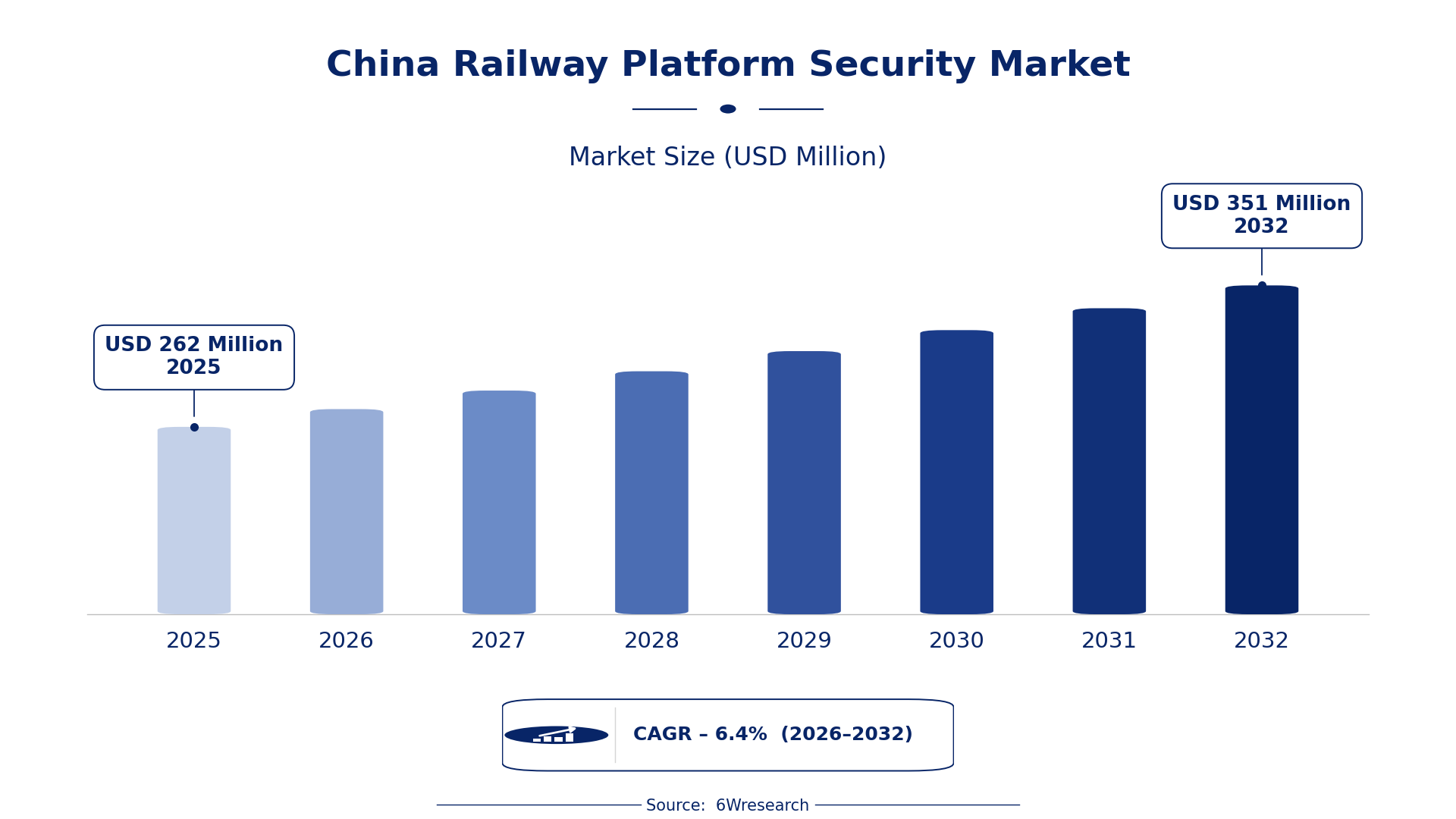
The China Railway Platform Security Market was estimated at USD 262 Million in 2025 and is projected to reach USD 351 Million by 2032, growing at a CAGR of 6.4% from 2026 to 2032.
China Railway Platform Security Market Synopsis
As the backbone of China’s extensive transportation network, the railway system is witnessing an unprecedented push towards security enhancements. The rapid expansion of high-speed rail services necessitates advanced security solutions that can ensure passenger safety and protect critical infrastructure from various threats.
Digital transformation in railway operations is a key driver of growth in the China Railway Platform Security Market. With the integration of advanced technologies, including AI and IoT, the focus on cybersecurity has intensified, reflecting the need to safeguard sensitive passenger data and operational integrity.
China Railway Platform Security Market Year-wise Growth Rate and Key Drivers
This graph illustrates the annual growth rates of the China Railway Platform Security Market from 2021 to 2032, highlighting a steady upward trajectory and projected expansion over the forecast period.
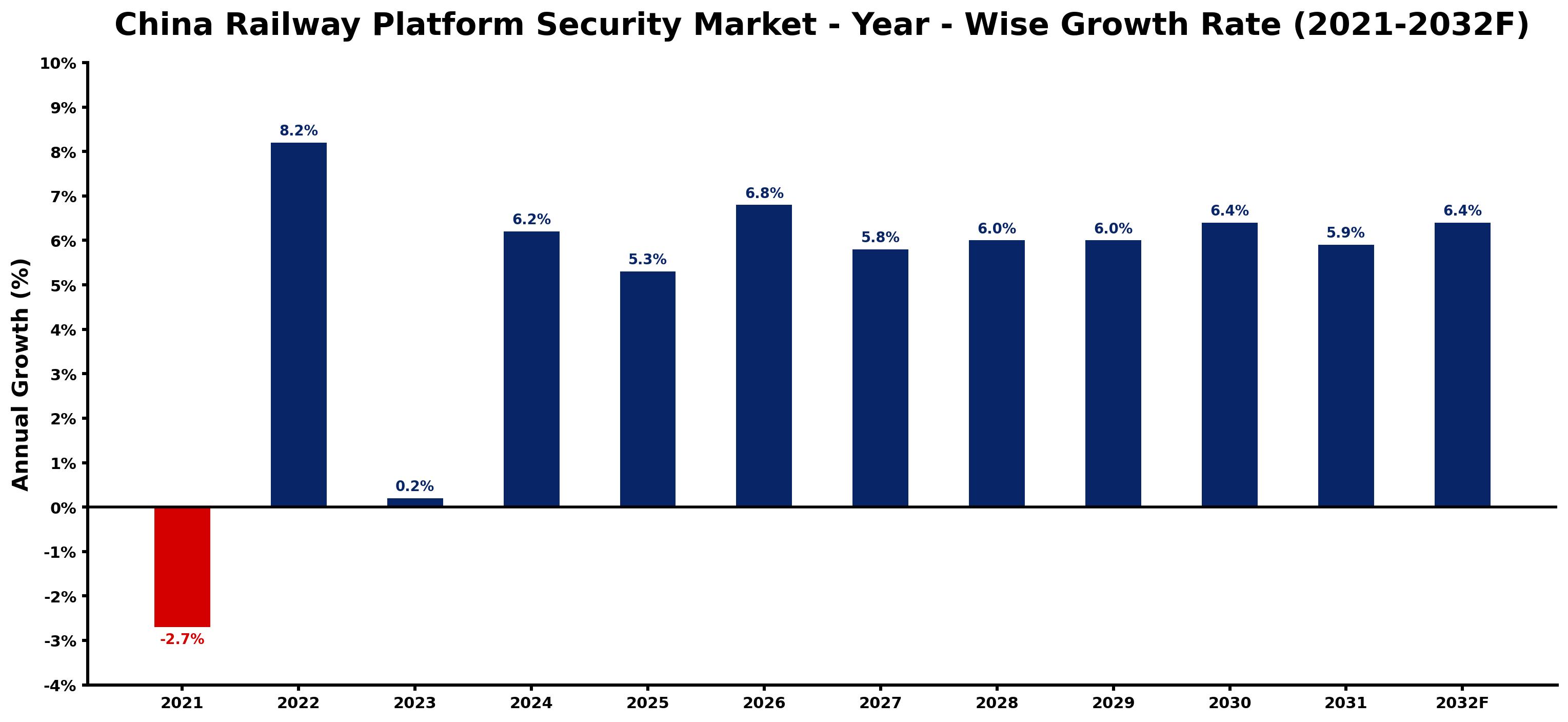
The table below presents the year‑wise growth rates along with the key drivers influencing the market
| Year | Growth Rate | Major Drivers |
| 2021 | -2.7% | China's strict cybersecurity regulations slowed platform upgrades. |
| 2022 | 8.2% | Increased safety regulations by the China Railway Corporation |
| 2023 | 0.2% | Post-pandemic focus on enhanced transportation security measures |
| 2024 | 6.2% | Implementation of AI surveillance for railway safety |
| 2025 | 5.3% | Government funding boosts security technology upgrades |
| 2026 | 6.8% | Rising urban rail network expansion drives security enhancements |
| 2027 | 5.8% | Growing public demand for safer railway travel experiences |
| 2028 | 6.0% | Smart technology adoption in railway station security systems |
| 2029 | 6.0% | Integration of biometric identification systems for passenger safety |
| 2030 | 6.4% | Enhanced cybersecurity mandates for railway operations |
| 2031 | 5.9% | Development of real-time monitoring solutions in stations |
| 2032 | 6.4% | Collaboration with tech firms for advanced security solutions |
Note: Market size estimations and growth projections presented in this report are based on 6Wresearch's proprietary forecasting methodology, utilizing the latest available industry data, government publications, and primary research inputs.
China Railway Platform Security Market Key Takeaways
Below are some of the specific key takeaways from the market, including:
- The market is experiencing a shift toward integrated security solutions that combine physical and cybersecurity measures.
- Government policies are increasingly mandating the adoption of advanced surveillance technologies across railway platforms.
- Investment in research and development for innovative security technologies is on the rise, reflecting the growing complexity of threats.
- Cybersecurity concerns are prompting railway operators to prioritize real-time monitoring and incident response capabilities.
- The market is seeing an upward trend in cloud-based security solutions for scalability and operational efficiency.
Evaluation of Restraints in China Railway Platform Security Market
Despite the growth potential, several factors hinder the advancement of the China Railway Platform Security Market. The increasing sophistication of cyber threats poses a significant risk, particularly as railway systems become more interconnected. Integrating diverse security solutions across various railway platforms complicates effective implementation. Compliance with stringent regulatory requirements adds to the operational burden on stakeholders, who must balance security enhancements with operational efficiency. Finally, the rapid pace of technological change means that security measures must continuously evolve, which can strain resources.
China Railway Platform Security Market Trends
Several key trends are shaping the China Railway Platform Security Market. The rise of AI and machine learning is enabling predictive analytics for threat detection, improving response times to potential incidents. Additionally, blockchain technology is being explored for secure transaction processes related to ticketing and data management. The trend toward automation in security operations is gaining traction, driven by the need for real-time monitoring and enhanced operational efficiency. on top of that, as digital ticketing and passenger data management become more prevalent, the focus on safeguarding this information against cyber threats is paramount.
China Railway Platform Security Market Opportunities
The market presents promising investment opportunities, particularly in cybersecurity technologies tailored to the railway sector. As digital systems proliferate, there is a pressing need for solutions that protect against cyber threats and ensure the integrity of operations. Companies specializing in innovative security software, hardware, and services are on track to benefit. Research and development initiatives aimed at creating cutting-edge technologies for railway security are also likely to yield lucrative returns. Investors should focus on sectors that align with the ongoing digital transformation of the railway industry.
Government Initiatives in the China Railway Platform Security Market
The Chinese government plays a crucial role in shaping the security framework of the railway sector through targeted policies and regulations. Recent initiatives emphasize the importance of advanced technology in enhancing safety protocols. With a commitment to protecting passenger data and critical infrastructure, these policies are vital for fostering a secure operational environment in the railway industry.
- A national regulatory framework was introduced in 2025 mandating enhanced surveillance and access control systems at railway stations.
- Current initiatives include a widespread rollout of facial recognition technology across major railway hubs to improve security measures.
- Plans are underway for a comprehensive upgrade of cybersecurity protocols, expected to begin in late 2026.
- The government has initiated a public-private partnership aimed at developing advanced threat detection systems for real-time monitoring.
- In 2023, new guidelines were implemented to enhance emergency response capabilities and improve coordination among railway security agencies.
Future Insights of the China Railway Platform Security Market
Looking ahead, the China Railway Platform Security Market is set for substantial growth driven by ongoing digital transformation. The increasing complexity of cyber threats will necessitate continuous investment in advanced security solutions. Railway operators will prioritize integrating intelligent security systems that leverage AI and machine learning for real-time threat detection. As the demand for safe and efficient rail travel grows, the market will evolve to meet these challenges, ensuring the resilience of railway operations in an increasingly interconnected world.
China Railway Platform Security Market Latest Developments
In the past year, activity in the China Railway Platform Security Market has accelerated, with a focus on integrating advanced technologies into security frameworks. Stakeholders are increasingly prioritizing investments in cybersecurity solutions as threats evolve and operational requirements change.
- A major technology vendor launched a new AI-driven surveillance system in Q1 2025, aimed at enhancing monitoring capabilities at key railway stations.
- An initiative began in early 2025 to train railway staff on advanced cybersecurity practices, ensuring heightened awareness of potential threats.
- Currently ongoing is a pilot program testing blockchain technology for secure ticketing processes across select railway lines, expected to conclude in late 2025.
- A partnership formed in mid-2025 between regional operators and cybersecurity firms is developing a comprehensive threat intelligence network.
- Upcoming is a planned rollout of an upgraded incident response system, set to begin in early 2026, enhancing the ability to manage security breaches effectively.
China Railway Platform Security Market - Key Attractiveness of the Report
- 10 Years of Market Numbers
- Historical Data Starting from 2022 to 2025
- Base Year: 2025
- Forecast Data until 2032
- Key Performance Indicators Impacting the Market
- Major Upcoming Developments and Projects
Key Highlights of the Report:
- China Railway Platform Security Market Outlook
- Market Size of China Railway Platform Security Market, 2025
- Forecast of China Railway Platform Security Market, 2032
- Historical Data and Forecast of China Railway Platform Security Revenues & Volume for the Period 2022-2032F
- China Railway Platform Security Market Trend Evolution
- China Railway Platform Security Market Drivers and Challenges
- China Railway Platform Security Price Trends
- China Railway Platform Security Porter's Five Forces
- China Railway Platform Security Industry Life Cycle
- Historical Data and Forecast of China Railway Platform Security Market Revenues & Volume By Components for the Period 2022-2032F
- Historical Data and Forecast of China Railway Platform Security Market Revenues & Volume By Solutions for the Period 2022-2032F
- Historical Data and Forecast of China Railway Platform Security Market Revenues & Volume By Services for the Period 2022-2032F
- Historical Data and Forecast of China Railway Platform Security Market Revenues & Volume By Applications for the Period 2022-2032F
- Historical Data and Forecast of China Railway Platform Security Market Revenues & Volume By Subways for the Period 2022-2032F
- Historical Data and Forecast of China Railway Platform Security Market Revenues & Volume By Trains for the Period 2022-2032F
- China Railway Platform Security Import Export Trade Statistics
- Market Opportunity Assessment By Components
- Market Opportunity Assessment By Applications
- China Railway Platform Security Top Companies Market Share
- China Railway Platform Security Competitive Benchmarking By Technical and Operational Parameters
- China Railway Platform Security Company Profiles
- China Railway Platform Security Key Strategic Recommendations






































