Brazil Sail Canvas Market Size, Share & Growth Rate
The Brazil Sail Canvas Market was estimated at USD 294 Million in 2025 and is projected to reach USD 404 Million by 2032, growing at a CAGR of 4.6% from 2026 to 2032. This growth trajectory is fueled by a robust increase in sailing and recreational boating activities, significantly influenced by Brazil's extensive coastline and favorable climate. Additionally, the rising interest in competitive sailing and advancements in sail canvas technology are enhancing the performance attributes demanded by enthusiasts and professionals alike.
Brazil Sail Canvas Market Year-wise Growth Rate and Key Drivers
This graph highlights how the Brazil Sail Canvas Market has steadily grown over the years, supported by major growth factors.
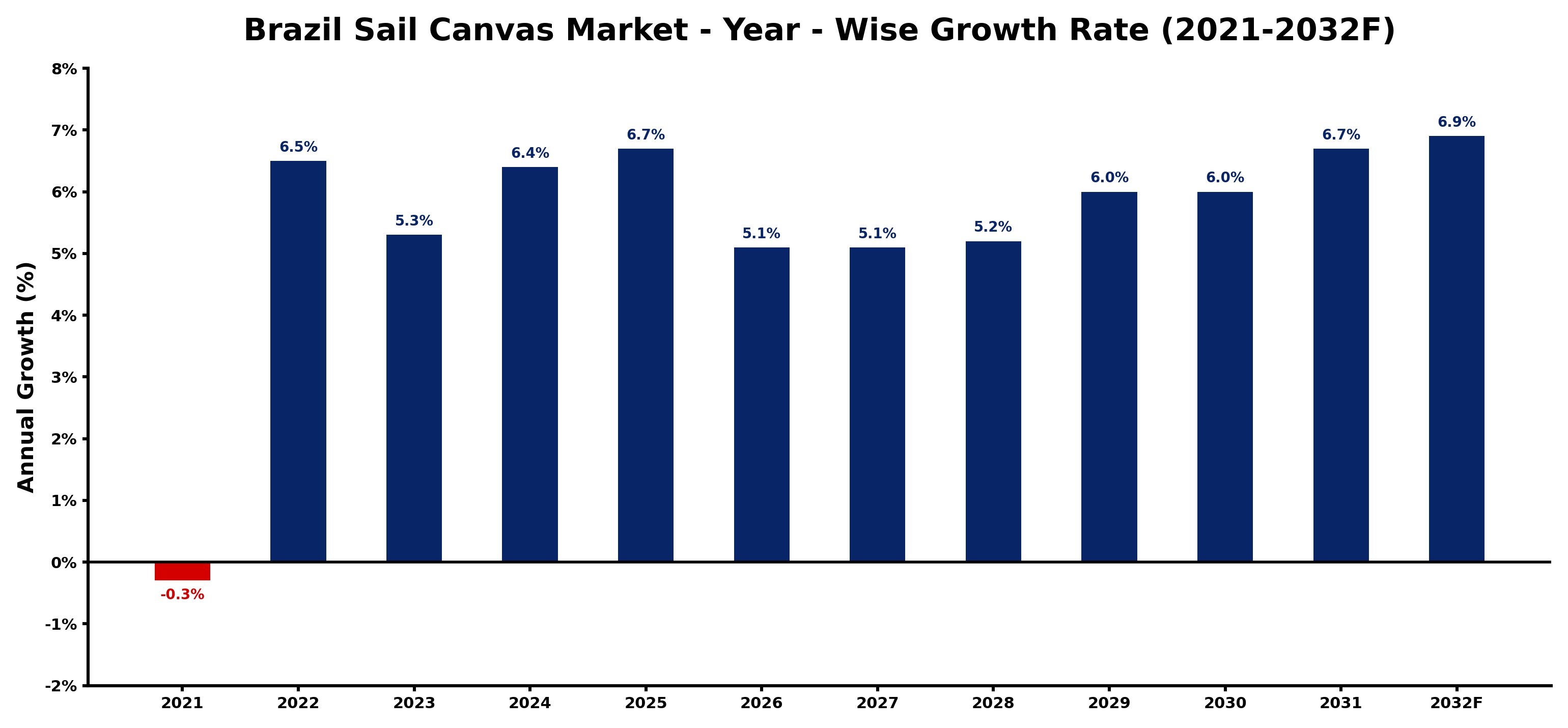
The table below presents the year‑wise growth rates along with the key drivers influencing the market
| Year | Growth Rate | Major Drivers |
| 2021 | -0.3% | Declining manufacturing investments limited supply chain modernization efforts |
| 2022 | 6.5% | Domestic manufacturing recovery spurred investments in sail canvas production |
| 2023 | 5.3% | Domestic manufacturing recovery boosted demand for sail fabric production |
| 2024 | 6.4% | Domestic manufacturing recovery drives sail canvas production capacity expansion |
| 2025 | 6.7% | Domestic manufacturing recovery boosts demand for sail canvas exports |
| 2026 | 5.1% | Technology integration boosted efficiency in domestic sail canvas production |
| 2027 | 5.1% | Technological upgrades in local manufacturing boost sail production efficiency |
| 2028 | 5.2% | Foundry modernization efforts boosted sail canvas manufacturing capabilities |
| 2029 | 6.0% | Export driven demand boosts local sail canvas production capacity |
| 2030 | 6.0% | Domestic manufacturing recovery boosts demand for high quality sail canvas |
| 2031 | 6.7% | Improved domestic manufacturing efficiency boosts Brazil's sail canvas exports |
| 2032 | 6.9% | Domestic manufacturing investments boost local sail canvas production capabilities |
Note - Market size estimations and growth projections presented in this report are based on 6Wresearch's advanced forecasting approach, validated with industry datasets as of June 2026.
Brazil Sail Canvas Market Synopsis
The Brazil Sail Canvas market is currently experiencing a surge, buoyed by the nation's rich maritime culture and increasing popularity of water sports. Sail canvas serves as a vital element in the manufacturing of sails, catering to both leisure and professional sailing markets that are expanding in tandem with consumer interest.
As water-based recreational activities gain traction, manufacturers are innovating with materials that offer enhanced durability and weather resistance. This trend reflects a broader shift towards lightweight, high-performance sails that can withstand the rigors of diverse marine environments.
Brazil Sail Canvas Market Key Takeaways
- The market is anticipated to grow significantly due to rising recreational boating and competitive sailing.
- Innovations in sail canvas technology are leading to improved performance and longevity.
- Brazil's unique geography promotes increased participation in water sports, driving demand.
- Government initiatives promoting sustainability are shaping manufacturing practices within the market.
- Consumers are increasingly seeking eco-friendly materials, influencing product offerings.
Evaluation of Restraints in Brazil Sail Canvas Market
The Brazil Sail Canvas market faces certain constraints, particularly related to shifts in consumer preferences. Traditional sailing has seen a decline in favor of newer, alternative water sports, which could divert interest away from sail canvases. Additionally, the introduction of innovative materials poses a competitive threat, as manufacturers are tasked with adapting to new technologies while ensuring they maintain the expected quality and performance characteristics. These factors may challenge the established market dynamics and require strategic pivots from stakeholders.
Brazil Sail Canvas Market Trends
Several trends are influencing the Brazil Sail Canvas market. First, there is a clear shift towards the adoption of sustainable materials, driven by increased environmental awareness among consumers and regulatory pressures. Second, the technological advancements in sail design and materials are creating opportunities for enhanced performance, attracting a broader range of sailing enthusiasts. Finally, digital platforms for purchasing and engaging with sailing communities are emerging, changing how consumers interact with brands and products in this market.
Brazil Sail Canvas Market Opportunities
Opportunities in the Brazil Sail Canvas market are robust, particularly in the realm of sustainability and innovation. Companies that invest in developing eco-friendly materials and sustainable manufacturing practices can gain a competitive edge. Additionally, tapping into the growing trend of experiential sailing, such as chartering and sailing schools, presents a pathway for market expansion. Furthermore, partnerships with local tourism initiatives can drive awareness and encourage participation in sailing activities, bolstering demand for sail canvases.
Government Initiatives in the Brazil Sail Canvas Market
The Brazilian government is actively influencing the sail canvas market through policies that prioritize environmental sustainability. Regulations aimed at reducing the ecological impact of textile manufacturing are prompting innovations in the use of recyclable and eco-friendly materials. Additionally, public spending on marine infrastructure and tourism can enhance the sailing experience, creating a positive feedback loop for market growth. Government support for sustainable practices is aligning the industry with global standards, positioning Brazil as a forward-thinking player in the maritime sector.
Future Insights of the Brazil Sail Canvas Market
Looking ahead to 2026-2032, the Brazil Sail Canvas market is poised for continued growth, driven by both recreational and competitive sailing sectors. As environmental concerns become more pronounced, businesses will need to focus on sustainability without compromising performance. The increasing integration of technology in sail manufacturing and design will likely foster innovation, allowing for more customized and high-performance products. The market landscape will evolve, shaped by consumer preferences that favor both quality and sustainability.
Brazil Sail Canvas Market Latest Developments (May 2025 - June 2026)
Recent developments in the Brazil Sail Canvas market indicate a strong focus on sustainability and technology. Many manufacturers are exploring partnerships with environmental organizations to enhance their eco-credentials. Furthermore, innovations in digital marketing strategies are being adopted to reach a younger audience that is increasingly engaged in sailing activities. The trend towards lightweight, high-performance materials is also being echoed in product launches, reflecting the market's responsiveness to evolving consumer demands.
Brazil Sail Canvas Market - Key Attractiveness of the Report
- 10 Years of Market Numbers
- Historical Data Starting from 2022 to 2025
- Base Year: 2025
- Forecast Data until 2032
- Key Performance Indicators Impacting the Market
- Major Upcoming Developments and Projects
Key Highlights of the Report:
- Brazil Sail Canvas Market Outlook
- Market Size of Brazil Sail Canvas Market, 2025
- Forecast of Brazil Sail Canvas Market, 2032
- Historical Data and Forecast of Brazil Sail Canvas Revenues & Volume for the Period 2022-2032F
- Brazil Sail Canvas Market Trend Evolution
- Brazil Sail Canvas Market Drivers and Challenges
- Brazil Sail Canvas Price Trends
- Brazil Sail Canvas Porter's Five Forces
- Brazil Sail Canvas Industry Life Cycle
- Historical Data and Forecast of Brazil Sail Canvas Market Revenues & Volume By Type for the Period 2022-2032F
- Historical Data and Forecast of Brazil Sail Canvas Market Revenues & Volume By 8 Ann Canvas for the Period 2022-2032F
- Historical Data and Forecast of Brazil Sail Canvas Market Revenues & Volume By 12 Ann Canvas for the Period 2022-2032F
- Historical Data and Forecast of Brazil Sail Canvas Market Revenues & Volume By Polyester Canvas for the Period 2022-2032F
- Historical Data and Forecast of Brazil Sail Canvas Market Revenues & Volume By Others for the Period 2022-2032F
- Historical Data and Forecast of Brazil Sail Canvas Market Revenues & Volume By Application for the Period 2022-2032F
- Historical Data and Forecast of Brazil Sail Canvas Market Revenues & Volume By Sailing for the Period 2022-2032F
- Historical Data and Forecast of Brazil Sail Canvas Market Revenues & Volume By Yacht for the Period 2022-2032F
- Historical Data and Forecast of Brazil Sail Canvas Market Revenues & Volume By Others for the Period 2022-2032F
- Brazil Sail Canvas Import Export Trade Statistics
- Market Opportunity Assessment By Type
- Market Opportunity Assessment By Application
- Brazil Sail Canvas Top Companies Market Share
- Brazil Sail Canvas Competitive Benchmarking By Technical and Operational Parameters
- Brazil Sail Canvas Company Profiles
- Brazil Sail Canvas Key Strategic Recommendations






































