Brazil Silicon Alloys Market Size, Share & Growth Rate
The Brazil Silicon Alloys Market was estimated at USD 81 Million in 2025 and is projected to reach USD 96 Million by 2032, growing at a CAGR of 2.5% from 2026 to 2032. This growth trajectory is largely attributed to the escalating demand from the automotive and aerospace sectors for lightweight, high-strength materials. Additionally, the electronics industry's increasing reliance on high-purity silicon alloys for semiconductor manufacturing further bolsters this upward trend.
Brazil Silicon Alloys Market Growth Rate Analysis (2021-2032)
The Brazil silicon alloys market has experienced a notable recovery following a 1.7% decline in 2021, rebounding with a 5.4% growth in 2022. This upward trend continued, with growth rates of 3.6% in 2023 and projected increases of 3.9% in 2024, fueled by rising industrial demand, particularly from steel and aluminum sectors, which increasingly rely on silicon alloys for improved performance and energy efficiency. Furthermore, investments in infrastructure and the energy transition have created additional opportunities. By 2025, growth is anticipated at 4.5%, before stabilizing around 2.5% to 3.2% through 2032, reflecting a maturing market where digitalization and evolving consumer preferences are playing crucial roles.
Brazil Silicon Alloys Market Year-wise Growth Rate and Key Drivers
This graph highlights how the Brazil Silicon Alloys Market has steadily grown over the past five years, supported by major growth factors.
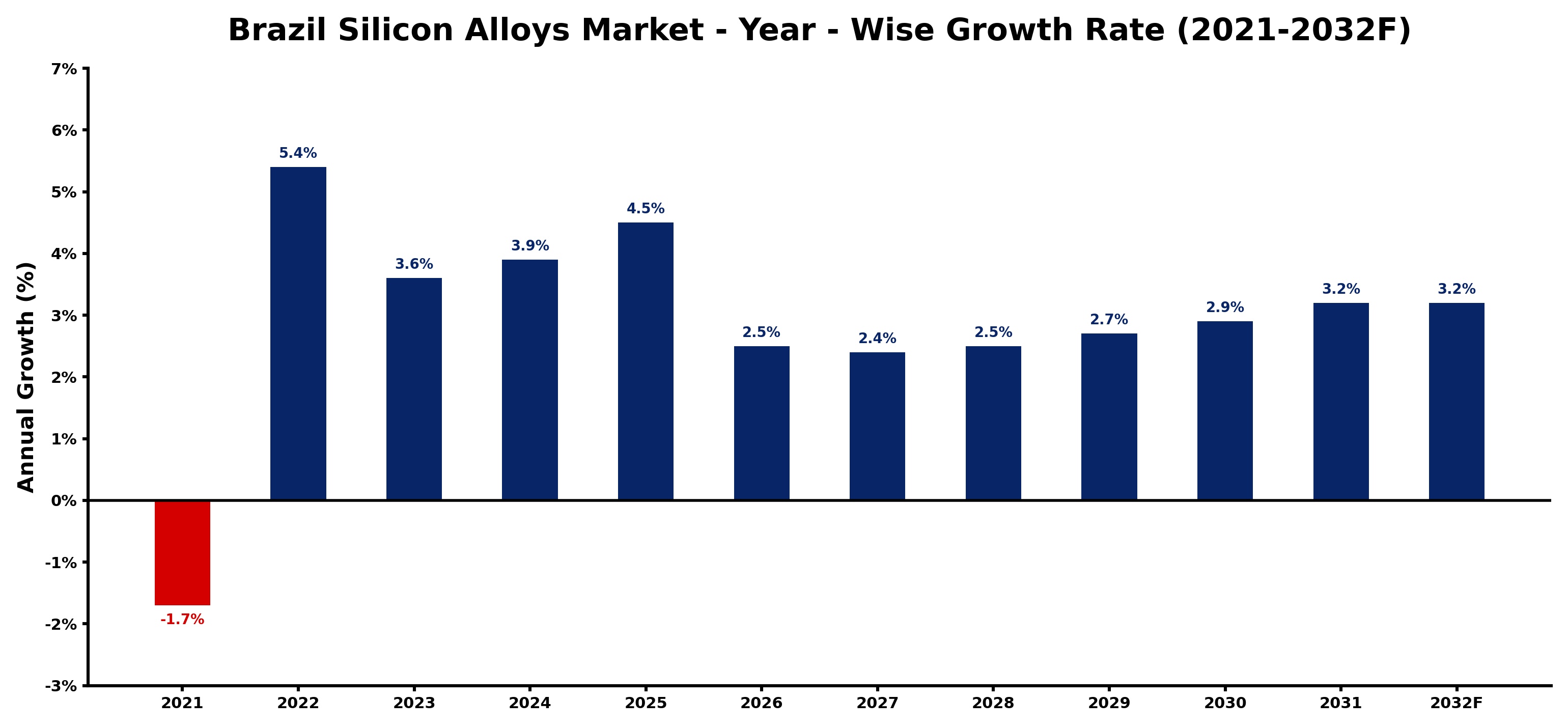
The table below presents the year‑wise growth rates along with the key drivers influencing the market
| Year | Growth Rate | Major Drivers |
| 2021 | -1.7% | Manufacturing slowdowns curtailed silicon alloy demand in Brazil |
| 2022 | 5.4% | Technology integration in foundries boosted silicon alloy production efficiency |
| 2023 | 3.6% | Domestic silicon alloy production upgrades drive foundry modernization efforts |
| 2024 | 3.9% | Higher silicon alloy demand drives investment in foundry upgrades |
| 2025 | 4.5% | Domestic silicon alloy manufacturing investments boost foundry modernization efforts |
| 2026 | 2.5% | Foundry modernization projects boosted capacity utilization in silicon alloy production |
| 2027 | 2.4% | Technology integration in foundries boosts silicon alloy production efficiency |
| 2028 | 2.5% | Foundry modernization drives demand for high quality silicon alloys |
| 2029 | 2.7% | Foundry modernization projects boosted silicon alloy production efficiency |
| 2030 | 2.9% | Domestic foundry modernization drives demand for high quality silicon alloys |
| 2031 | 3.2% | Foundry modernization projects boosted domestic silicon alloy production capacity |
| 2032 | 3.2% | Domestic manufacturing recovery boosts silicon alloy production efficiency |
Note - Market size estimations and growth projections presented in this report are based on 6Wresearch's advanced forecasting approach, validated with industry datasets as of June 2026.
Brazil Silicon Alloys Market Synopsis
Brazil's silicon alloys market is currently in a robust state, benefiting from its integral role in both the metallurgical and electronics industries. The necessity for enhanced properties in materials like steel and aluminum alloys drives demand, highlighting the market's potential for sustained growth.
Recent developments in technology and production processes are reshaping the landscape of silicon alloys, as manufacturers seek to optimize quality and efficiency. This evolving dynamic presents opportunities for innovation, though companies must remain agile in adapting to global market shifts and consumer preferences.
Brazil Silicon Alloys Market Key Takeaways
- The market is projected to reach USD 96 Million by 2032, indicating steady growth.
- Demand is primarily driven by the automotive, aerospace, and electronics industries.
- High-purity silicon alloys are crucial for the semiconductor sector.
- Technological advancements are influencing production techniques and alloy properties.
- Government policies are shaping the operational landscape for market players.
Evaluation of Restraints in Brazil Silicon Alloys Market
The Brazil Silicon Alloys market faces several significant restraints that can hinder its growth. Fluctuating energy prices present a financial challenge for manufacturers, affecting production costs and ultimately the pricing strategies of silicon alloys. Additionally, global supply chain disruptions have caused delays and inefficiencies, making it crucial for companies to implement resilient strategies to navigate these obstacles. Trade restrictions and price volatility further complicate the market landscape, requiring stakeholders to remain vigilant and adaptable.
Brazil Silicon Alloys Market Trends
Several current and emerging trends are shaping the Brazil Silicon Alloys market. A notable trend is the increasing preference for sustainable and environmentally friendly production methods, spurred by heightened regulatory scrutiny and consumer demand for greener alternatives. Furthermore, the adoption of advanced manufacturing technologies, such as automation and AI, is beginning to optimize production efficiencies while reducing waste. Additionally, innovations in alloy formulations continue to emerge, enabling enhanced performance in various applications.
Brazil Silicon Alloys Market Opportunities
The Brazil Silicon Alloys market presents ample growth and investment opportunities, particularly in the realm of research and development. Companies that invest in developing high-performance silicon alloys tailored for specific applications, such as electric vehicles or renewable energy systems, stand to gain significant competitive advantages. Furthermore, expanding into international markets could offer access to new customer bases, especially as global demand for advanced materials continues to grow.
Government Initiatives in the Brazil Silicon Alloys Market
Government policies and initiatives play a pivotal role in the development of the Brazil Silicon Alloys market. Policies aimed at enhancing the metallurgical industry, along with incentives for sustainable practices, contribute to a stable business environment. Efforts to regulate trade and ensure high-quality standards help foster a competitive market landscape. Overall, the government's involvement in promoting technological innovation and environmental responsibility is critical for the long-term success of the silicon alloys sector.
Future Insights of the Brazil Silicon Alloys Market
Looking ahead to 2026-2032, the Brazil Silicon Alloys market is poised for continued growth driven by innovation and strategic investments. As industries evolve, particularly in automotive and electronics, the demand for specialized and high-performance alloys will likely increase. Furthermore, companies that leverage advancements in technology and sustainability will be well-positioned to capture market share, making this an exciting period for stakeholders in the silicon alloys sector.
Brazil Silicon Alloys Market Latest Developments (May 2025 - June 2026)
In recent months, there has been a noticeable shift towards sustainable practices within the Brazil Silicon Alloys market. Companies are increasingly exploring renewable energy sources for production, aiming to reduce their carbon footprints. Additionally, collaborations between industry leaders and research institutions are on the rise, focusing on developing innovative alloy compositions that meet evolving market demands. These developments signal a proactive approach to addressing both regulatory pressures and consumer expectations.
Brazil Silicon Alloys Market - Key Attractiveness of the Report
- 10 Years of Market Numbers
- Historical Data Starting from 2022 to 2025
- Base Year: 2025
- Forecast Data until 2032
- Key Performance Indicators Impacting the Market
- Major Upcoming Developments and Projects
Key Highlights of the Report:
- Brazil Silicon Alloys Market Outlook
- Market Size of Brazil Silicon Alloys Market, 2025
- Forecast of Brazil Silicon Alloys Market, 2032
- Historical Data and Forecast of Brazil Silicon Alloys Revenues & Volume for the Period 2022-2032F
- Brazil Silicon Alloys Market Trend Evolution
- Brazil Silicon Alloys Market Drivers and Challenges
- Brazil Silicon Alloys Price Trends
- Brazil Silicon Alloys Porter's Five Forces
- Brazil Silicon Alloys Industry Life Cycle
- Historical Data and Forecast of Brazil Silicon Alloys Market Revenues & Volume By Type for the Period 2022-2032F
- Historical Data and Forecast of Brazil Silicon Alloys Market Revenues & Volume By Ferrosilicon for the Period 2022-2032F
- Historical Data and Forecast of Brazil Silicon Alloys Market Revenues & Volume By Deoxidizers for the Period 2022-2032F
- Historical Data and Forecast of Brazil Silicon Alloys Market Revenues & Volume By Inoculants for the Period 2022-2032F
- Historical Data and Forecast of Brazil Silicon Alloys Market Revenues & Volume By Others for the Period 2022-2032F
- Historical Data and Forecast of Brazil Silicon Alloys Market Revenues & Volume By Application for the Period 2022-2032F
- Historical Data and Forecast of Brazil Silicon Alloys Market Revenues & Volume By Carbon Steel & Other Alloy Steel for the Period 2022-2032F
- Historical Data and Forecast of Brazil Silicon Alloys Market Revenues & Volume By Stainless Steel for the Period 2022-2032F
- Historical Data and Forecast of Brazil Silicon Alloys Market Revenues & Volume By Electrical Steel for the Period 2022-2032F
- Historical Data and Forecast of Brazil Silicon Alloys Market Revenues & Volume By Cast Iron for the Period 2022-2032F
- Historical Data and Forecast of Brazil Silicon Alloys Market Revenues & Volume By Others for the Period 2022-2032F
- Brazil Silicon Alloys Import Export Trade Statistics
- Market Opportunity Assessment By Type
- Market Opportunity Assessment By Application
- Brazil Silicon Alloys Top Companies Market Share
- Brazil Silicon Alloys Competitive Benchmarking By Technical and Operational Parameters
- Brazil Silicon Alloys Company Profiles
- Brazil Silicon Alloys Key Strategic Recommendations






































