Brazil Sodium Hydride Market Size, Share & Growth Rate
The Brazil Sodium Hydride Market was estimated at USD 175 Million in 2025 and is projected to reach USD 207 Million by 2032, growing at a CAGR of 2.4% from 2026 to 2032. This steady growth trajectory is largely driven by the expanding pharmaceutical industry in Brazil, which relies heavily on sodium hydride for the synthesis of intermediates and fine chemicals. As the demand for custom synthesis services rises, coupled with increasing R&D investments aimed at developing innovative pharmaceutical compounds, the market is set to experience consistent momentum.
Brazil Sodium Hydride Market Year-wise Growth Rate and Key Drivers
This graph highlights how the Brazil Sodium Hydride Market has steadily grown over the years, supported by major growth factors.
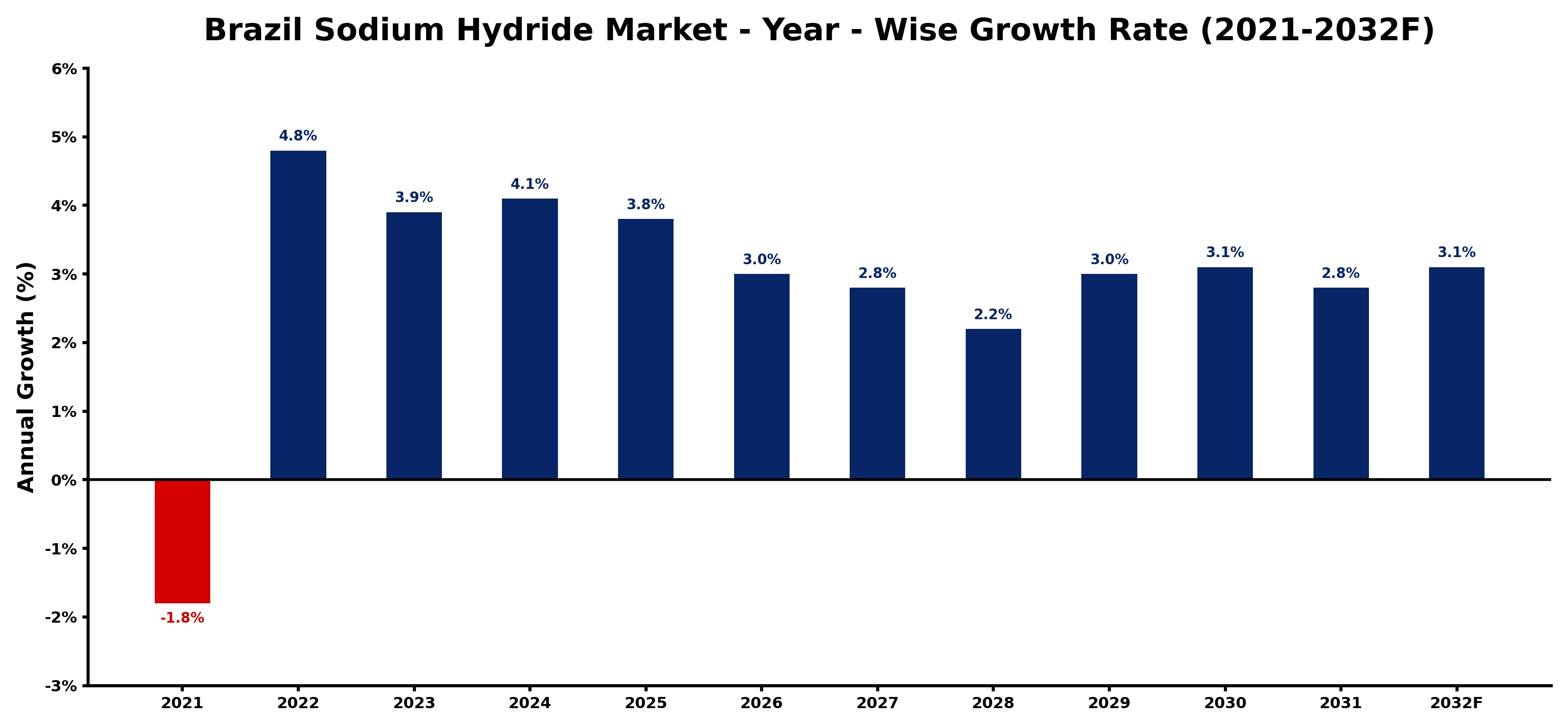
The table below presents the year‑wise growth rates along with the key drivers influencing the market
| Year | Growth Rate | Major Drivers |
| 2021 | -1.8% | Global supply chain disruptions impacted |
| 2022 | 4.8% | Chemical manufacturing capacity increased |
| 2023 | 3.9% | Rising demand for specialty chemicals |
| 2024 | 4.1% | Technological advancements enhanced production |
| 2025 | 3.8% | Export opportunities expanded significantly |
| 2026 | 3.0% | Sustainable practices gained traction |
| 2027 | 2.8% | Investment in R&D accelerated growth |
| 2028 | 2.2% | Partnerships with local suppliers strengthened |
| 2029 | 3.0% | Regulatory support fostered innovation |
| 2030 | 3.1% | Market diversification strategies implemented |
| 2031 | 2.8% | Consumer awareness of applications increased |
| 2032 | 3.1% | Collaborative ventures drove market expansion |
Note - Market size estimations and growth projections presented in this report are based on 6Wresearch’s advanced forecasting approach, validated with industry datasets as of June 2026.
Brazil Sodium Hydride Market Synopsis
The Brazilian sodium hydride market is characterized by a growing appetite across several key sectors, notably pharmaceuticals and organic synthesis. As a vital reducing agent and strong base, sodium hydride is integral to many chemical reactions, highlighting its importance in Brazil's evolving industrial landscape.
In recent years, the country's commitment to advancing its pharmaceutical capabilities has spurred significant market growth. As companies pivot towards custom synthesis solutions to meet unique client demands, the role of sodium hydride continues to expand, reflecting a robust future outlook for the market.
Brazil Sodium Hydride Market Key Takeaways
- The market is primarily driven by robust demand in pharmaceutical manufacturing and organic synthesis applications.
- Investment in research and development for novel pharmaceutical compounds is a key growth factor.
- Strict safety regulations and the need for innovative production processes present ongoing challenges.
- Government policies are actively promoting domestic production and supply chain stability.
- Continuous advancements in technology are crucial for maintaining competitiveness in the market.
Evaluation of Restraints in Brazil Sodium Hydride Market
While the Brazil sodium hydride market demonstrates strong growth potential, it faces significant constraints. Chief among these are the stringent safety regulations that govern the handling and transportation of sodium hydride, a highly reactive compound. Compliance with these regulations can incur additional costs and necessitate specialized training. Furthermore, advancements in production processes mean that traditional methods could become obsolete, pressuring companies to innovate continuously. The emergence of safer alternatives also poses a risk to market incumbents, who must adapt to remain relevant in this dynamic environment.
Brazil Sodium Hydride Market Trends
Current trends indicate a marked increase in demand for sodium hydride in fine chemical synthesis as the pharmaceutical industry emphasizes efficiency and precision. Additionally, the shift towards greener chemistry solutions is prompting research into more sustainable production methods for sodium hydride. This convergence of traditional chemical applications and modern sustainability initiatives represents a significant trend that is shaping the future landscape of the market.
Brazil Sodium Hydride Market Opportunities
Opportunities in the Brazil sodium hydride market are particularly abundant in the realm of custom synthesis services. As pharmaceutical companies strive to develop targeted and personalized therapies, the demand for specialized chemical intermediates will likely increase. Furthermore, investments in R&D for new applications of sodium hydride in other sectors, such as metallurgy, could unlock additional revenue streams, fostering a favorable investment climate.
Government Initiatives in the Brazil Sodium Hydride Market
The Brazilian government recognizes the strategic importance of sodium hydride for various industrial applications. Policies aimed at fostering domestic production capabilities are being implemented, which include investment incentives and infrastructure development initiatives. These measures not only aim to enhance supply chain reliability but also encourage collaboration between public and private sectors to drive technological advancements within the sodium hydride market.
Future Insights of the Brazil Sodium Hydride Market
Looking ahead to 2026-2032, the Brazil sodium hydride market is poised for progressive growth fueled by its pivotal role in pharmaceuticals and emerging industries. As investments in research escalate, innovations in sodium hydride applications will likely emerge, further cementing its significance in organic synthesis. Moreover, with the government's supportive stance, the market is expected to navigate challenges effectively, positioning itself as a cornerstone of Brazil's chemical manufacturing landscape.
Brazil Sodium Hydride Market Latest Developments (May 2025 - June 2026)
In the latest industry updates, there has been a notable focus on enhancing safety protocols surrounding sodium hydride. Companies are actively seeking innovative solutions to improve handling procedures and minimize risks associated with this highly reactive compound. Additionally, advancements in production techniques are being explored, aiming to increase efficiency and sustainability in sodium hydride manufacturing. As these developments unfold, they signify an ongoing commitment to addressing industry challenges while fostering growth.
Brazil Sodium Hydride Market - Key Attractiveness of the Report
- 10 Years of Market Numbers
- Historical Data Starting from 2022 to 2025
- Base Year: 2025
- Forecast Data until 2032
- Key Performance Indicators Impacting the Market
- Major Upcoming Developments and Projects
Key Highlights of the Report:
- Brazil Sodium Hydride Market Outlook
- Market Size of Brazil Sodium Hydride Market, 2025
- Forecast of Brazil Sodium Hydride Market, 2032
- Historical Data and Forecast of Brazil Sodium Hydride Revenues & Volume for the Period 2022-2032F
- Brazil Sodium Hydride Market Trend Evolution
- Brazil Sodium Hydride Market Drivers and Challenges
- Brazil Sodium Hydride Price Trends
- Brazil Sodium Hydride Porter's Five Forces
- Brazil Sodium Hydride Industry Life Cycle
- Historical Data and Forecast of Brazil Sodium Hydride Market Revenues & Volume By Product Range for the Period 2022-2032F
- Historical Data and Forecast of Brazil Sodium Hydride Market Revenues & Volume By Sodium Hydride 60% for the Period 2022-2032F
- Historical Data and Forecast of Brazil Sodium Hydride Market Revenues & Volume By Sodium Hydride 55% for the Period 2022-2032F
- Historical Data and Forecast of Brazil Sodium Hydride Market Revenues & Volume By Sodium Hydride 45% for the Period 2022-2032F
- Historical Data and Forecast of Brazil Sodium Hydride Market Revenues & Volume By Other for the Period 2022-2032F
- Historical Data and Forecast of Brazil Sodium Hydride Market Revenues & Volume By Application for the Period 2022-2032F
- Historical Data and Forecast of Brazil Sodium Hydride Market Revenues & Volume By Chemical Industry for the Period 2022-2032F
- Historical Data and Forecast of Brazil Sodium Hydride Market Revenues & Volume By Pharmaceutical Industry for the Period 2022-2032F
- Historical Data and Forecast of Brazil Sodium Hydride Market Revenues & Volume By Pesticide Industry for the Period 2022-2032F
- Brazil Sodium Hydride Import Export Trade Statistics
- Market Opportunity Assessment By Product Range
- Market Opportunity Assessment By Application
- Brazil Sodium Hydride Top Companies Market Share
- Brazil Sodium Hydride Competitive Benchmarking By Technical and Operational Parameters
- Brazil Sodium Hydride Company Profiles
- Brazil Sodium Hydride Key Strategic Recommendations






































