Brazil Stainless Steel Market Growth Rate Analysis (2021-2031)
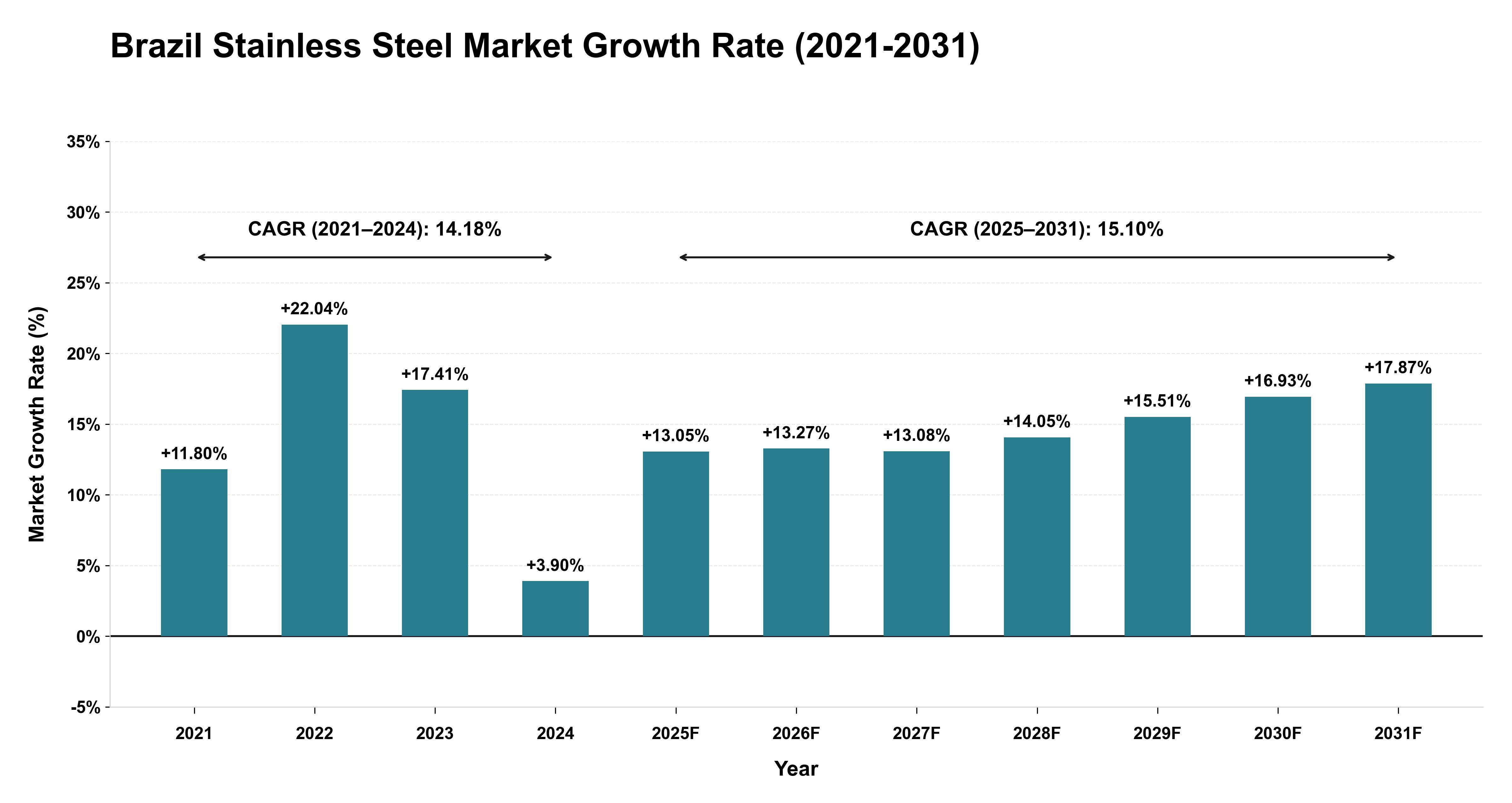
The Brazil Stainless Steel Market exhibited robust growth from 2021 to 2024, with a CAGR of 14.18%, driven by increasing industrial activities and infrastructure projects. Notably, there was a significant surge in 2022, expanding by 22.04%, reflecting strong demand and investment in stainless steel products. Although growth moderated in 2024 to 3.90%, indicating a temporary slowdown or market adjustment phase, the forecast period from 2025 to 2031 anticipates a steady growth trajectory with a projected CAGR of 15.10%. This forecast underscores continued confidence in the sector, supported by sustained industrial development and construction projects necessitating stainless steel materials. The consistent growth rates projected for the upcoming years underscore the market's resilience and long-term potential in Brazil's economic landscape.
Brazil Stainless Steel Market Overview
Brazil stainless steel market is driven by factors such as urbanization, infrastructure modernization, and the expansion of key industries like construction and automotive manufacturing. Stainless steel`s corrosion resistance, durability, and aesthetic appeal make it a preferred choice for a wide range of applications, from household appliances to industrial machinery.
Drivers of the market
The stainless steel market in Brazil is influenced by factors such as the food and beverage industry, architectural applications, and consumer preferences for corrosion-resistant materials. Trends in kitchen and home decor also impact the demand for stainless steel products. Technological advancements in stainless steel production, environmental considerations, and trade dynamics contribute to the market`s growth and evolution.
Challenges of the market
The stainless steel market in Brazil confronts challenges such as intense competition from foreign manufacturers and import tariffs, impacting pricing dynamics and market share for domestic producers. Moreover, fluctuations in nickel and chromium prices, key alloying elements for stainless steel production, pose challenges for cost management and profitability in the market.
Government Policy of the market
In the stainless steel market, government policies focus on promoting the use of high-quality stainless steel products in various industrial sectors while ensuring environmental sustainability and product safety. These policies include regulations on stainless steel specifications, production processes, and recycling initiatives. Additionally, the government supports initiatives to enhance the competitiveness of Brazil stainless steel manufacturers through investment incentives, export promotion, and research and development grants.
Key Highlights of the Report:
- Brazil Stainless Steel Market Outlook
- Market Size of Brazil Stainless Steel Market, 2021
- Forecast of Brazil Stainless Steel Market, 2028
- Historical Data and Forecast of Brazil Stainless Steel Revenues & Volume for the Period 2018 - 2028
- Brazil Stainless Steel Market Trend Evolution
- Brazil Stainless Steel Market Drivers and Challenges
- Brazil Stainless Steel Price Trends
- Brazil Stainless Steel Porter's Five Forces
- Brazil Stainless Steel Industry Life Cycle
- Historical Data and Forecast of Brazil Stainless Steel Market Revenues & Volume By Product for the Period 2018 - 2028
- Historical Data and Forecast of Brazil Stainless Steel Market Revenues & Volume By Long for the Period 2018 - 2028
- Historical Data and Forecast of Brazil Stainless Steel Market Revenues & Volume By Flat for the Period 2018 - 2028
- Historical Data and Forecast of Brazil Stainless Steel Market Revenues & Volume By Application for the Period 2018 - 2028
- Historical Data and Forecast of Brazil Stainless Steel Market Revenues & Volume By Polish finishing for the Period 2018 - 2028
- Historical Data and Forecast of Brazil Stainless Steel Market Revenues & Volume By Exhaust system for the Period 2018 - 2028
- Historical Data and Forecast of Brazil Stainless Steel Market Revenues & Volume By Surgical instrument for the Period 2018 - 2028
- Historical Data and Forecast of Brazil Stainless Steel Market Revenues & Volume By Others for the Period 2018 - 2028
- Historical Data and Forecast of Brazil Stainless Steel Market Revenues & Volume By End User for the Period 2018 - 2028
- Historical Data and Forecast of Brazil Stainless Steel Market Revenues & Volume By Consumer goods for the Period 2018 - 2028
- Historical Data and Forecast of Brazil Stainless Steel Market Revenues & Volume By Automotive for the Period 2018 - 2028
- Historical Data and Forecast of Brazil Stainless Steel Market Revenues & Volume By Food & beverage for the Period 2018 - 2028
- Historical Data and Forecast of Brazil Stainless Steel Market Revenues & Volume By Oil & gas for the Period 2018 - 2028
- Historical Data and Forecast of Brazil Stainless Steel Market Revenues & Volume By Others for the Period 2018 - 2028
- Brazil Stainless Steel Import Export Trade Statistics
- Market Opportunity Assessment By Product
- Market Opportunity Assessment By Application
- Market Opportunity Assessment By End User
- Brazil Stainless Steel Top Companies Market Share
- Brazil Stainless Steel Competitive Benchmarking By Technical and Operational Parameters
- Brazil Stainless Steel Company Profiles
- Brazil Stainless Steel Key Strategic Recommendations






































