Brazil Talc and Steatite Market Size, Share & Growth Rate
The Brazil Talc and Steatite Market was estimated at USD 95 Million in 2025 and is projected to reach USD 113 Million by 2032, growing at a CAGR of 2.5% from 2026 to 2032. This growth trajectory is primarily driven by robust demand from the industrial and construction sectors, where talc and steatite serve critical roles as functional additives. Increasing applications in plastics, ceramics, and coatings further bolster the market, alongside a rising focus on innovative product solutions and sustainability initiatives.
Brazil Talc and Steatite Market Year-wise Growth Rate and Key Drivers
This graph highlights how the Brazil Talc and Steatite Market has steadily grown over the years, supported by major growth factors.
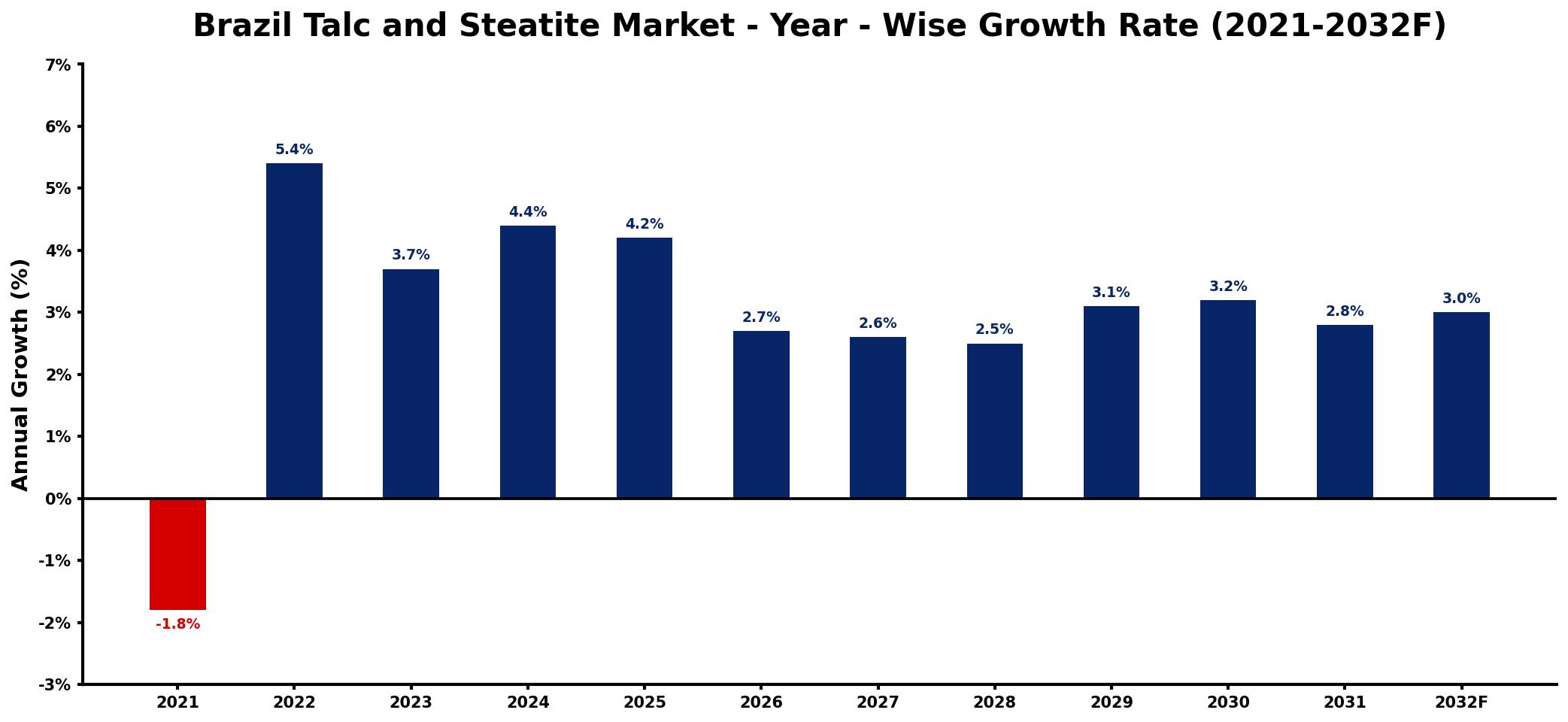
The table below presents the year‑wise growth rates along with the key drivers influencing the market
| Year | Growth Rate | Major Drivers |
| 2021 | -1.8% | decreased industrial production activities |
| 2022 | 5.4% | increased demand from cosmetics sector |
| 2023 | 3.7% | expanding construction material applications |
| 2024 | 4.4% | growing interest in personal care |
| 2025 | 4.2% | rising usage in automotive industry |
| 2026 | 2.7% | increased investments in mining sector |
| 2027 | 2.6% | higher demand from pharmaceutical industries |
| 2028 | 2.5% | expanding applications in plastics manufacturing |
| 2029 | 3.1% | increased focus on eco-friendly products |
| 2030 | 3.2% | growing demand in paper industry |
| 2031 | 2.8% | rising procurement volume requirements |
| 2032 | 3.0% | increased applications in electronics sector |
Note: Market size estimations and growth projections presented in this report are based on 6Wresearch's proprietary forecasting methodology, utilizing the latest available industry data, government publications, and primary research inputs.
Brazil Talc and Steatite Market Synopsis
Recently, the Brazil talc and steatite market has witnessed a resurgence, fueled by a booming industrial sector eager for versatile raw materials. Looking ahead, the focus on sustainable practices and environmental compliance is set to shape the industry's direction significantly. This emphasis on sustainability not only reflects consumer preferences but also aligns with global trends in resource management.
As the market evolves, stakeholders are diversifying their product offerings and enhancing their manufacturing processes to adapt to shifting demand patterns. Enhanced regulatory frameworks around environmental protection will also influence operational strategies, ensuring that companies remain competitive while minimizing their ecological footprint.
Brazil Talc and Steatite Market Key Takeaways
- The market is projected to grow steadily, reaching USD 113 Million by 2032.
- Industrial applications, particularly in construction and plastics, are key drivers of demand.
- Technological innovation and product differentiation are crucial for maintaining competitiveness.
- Sustainability and adherence to environmental regulations are shaping industry practices.
- Diversification of product lines is necessary to mitigate market fluctuations and enhance resilience.
Evaluation of Restraints in Brazil Talc and Steatite Market
While the Brazil talc and steatite market exhibits promising growth, several constraints hinder its potential. Environmental regulations related to mining practices create challenges, as companies must navigate complex compliance landscapes, which can elevate operational costs. Additionally, fluctuations in demand across industries—particularly in cosmetics and ceramics—can create unpredictability. The rise of alternative materials further complicates the market, necessitating innovative approaches to maintain relevance and competitive edge in an evolving landscape.
Brazil Talc and Steatite Market Trends
Several trends are currently shaping the Brazil talc and steatite market. A notable shift towards eco-friendly products is gaining momentum, as manufacturers prioritize sustainable sourcing and processing methods. Additionally, advancements in technology are leading to the development of high-performance talc and steatite products tailored for specific applications, such as high-temperature ceramics. The growing influence of digital tools in manufacturing and supply chain management is also enhancing operational efficiency across the sector.
Brazil Talc and Steatite Market Opportunities
Opportunities abound in the Brazil talc and steatite market, particularly in the context of growing industrial demand and a focus on sustainability. Investing in sustainable mining technologies and practices can provide a significant competitive edge, attracting environmentally conscious consumers. Furthermore, exploring emerging applications in sectors such as biotechnology and pharmaceuticals may unveil new revenue streams. The increasing need for high-performance materials in construction also presents avenues for growth, especially as infrastructure projects expand.
Government Initiatives in the Brazil Talc and Steatite Market
In Brazil, government policy surrounding the talc and steatite market is largely focused on mining regulations and environmental protection. Authorities enforce stringent licensing and permitting processes to ensure that mining operations comply with environmental and safety standards. Regular inspections and monitoring are conducted to mitigate pollution risks associated with mining activities, while regulations also emphasize the health and safety of workers within the industry. These initiatives aim to create a balanced approach to resource extraction that protects both the environment and local communities.
Future Insights of the Brazil Talc and Steatite Market
Looking ahead to 2026-2032, the Brazil talc and steatite market is poised for sustained growth as industry dynamics evolve. The increasing integration of sustainable practices will likely influence supply chain decisions, compelling stakeholders to adopt greener methodologies. Furthermore, as technological advancements continue to emerge, the ability to innovate will be paramount in addressing the unique needs of various industries. Overall, the market is set to adapt to changing economic conditions, consumer preferences, and regulatory landscapes, ensuring that it remains a vital component of Brazil's industrial fabric.
Brazil Talc and Steatite Market Latest Developments (2025 - 2026)
Recent developments in the Brazil talc and steatite market indicate a growing emphasis on sustainable practices among manufacturers. Companies are increasingly exploring new extraction methods that minimize environmental impact, and there is a heightened focus on transparency throughout the supply chain. Innovations in product formulation are also emerging, with a clear shift towards high-performance materials designed to meet the specific needs of diverse industrial applications. Additionally, partnerships among industry players are becoming more common as organizations seek to leverage complementary strengths and enhance their market positioning.
Brazil Talc and Steatite Market - Key Attractiveness of the Report
- 10 Years of Market Numbers
- Historical Data Starting from 2022 to 2025
- Base Year: 2025
- Forecast Data until 2032
- Key Performance Indicators Impacting the Market
- Major Upcoming Developments and Projects
Key Highlights of the Report:
- Brazil Talc and Steatite Market Outlook
- Market Size of Brazil Talc and Steatite Market, 2025
- Forecast of Brazil Talc and Steatite Market, 2032
- Historical Data and Forecast of Brazil Talc and Steatite Revenues & Volume for the Period 2022-2032F
- Brazil Talc and Steatite Market Trend Evolution
- Brazil Talc and Steatite Market Drivers and Challenges
- Brazil Talc and Steatite Price Trends
- Brazil Talc and Steatite Porter's Five Forces
- Brazil Talc and Steatite Industry Life Cycle
- Historical Data and Forecast of Brazil Talc and Steatite Market Revenues & Volume By Product Type for the Period 2022-2032F
- Historical Data and Forecast of Brazil Talc and Steatite Market Revenues & Volume By Crushed for the Period 2022-2032F
- Historical Data and Forecast of Brazil Talc and Steatite Market Revenues & Volume By Powdered for the Period 2022-2032F
- Brazil Talc and Steatite Import Export Trade Statistics
- Market Opportunity Assessment By Product Type
- Brazil Talc and Steatite Top Companies Market Share
- Brazil Talc and Steatite Competitive Benchmarking By Technical and Operational Parameters
- Brazil Talc and Steatite Company Profiles
- Brazil Talc and Steatite Key Strategic Recommendations






































