Brazil Threat Intelligence Market Size & Growth Rate (2026-2032)
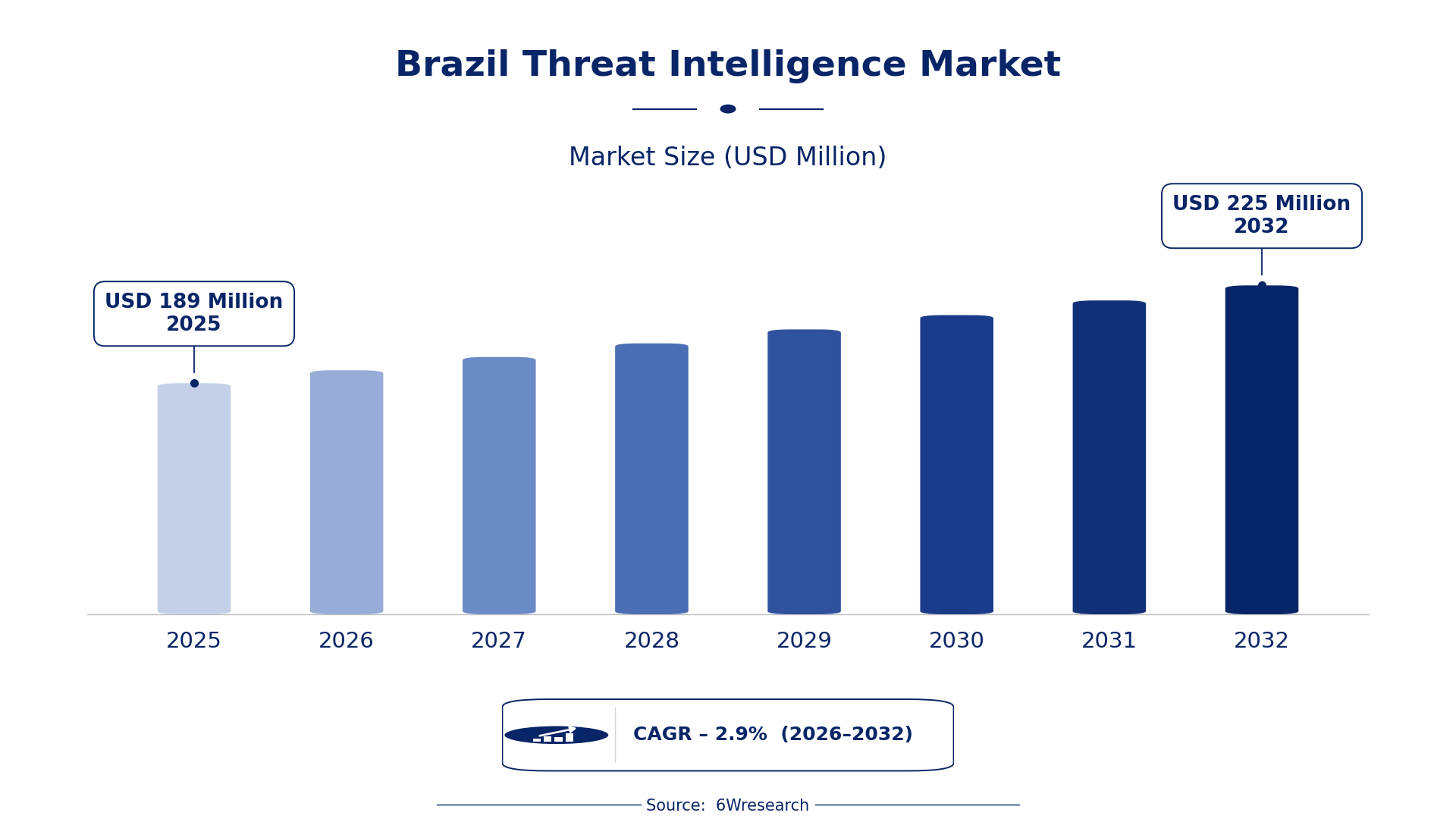
The Brazil Threat Intelligence Market was estimated at USD 189 Million in 2025 and is projected to reach USD 225 Million by 2032, growing at a CAGR of 2.9% from 2026 to 2032.
Brazil Threat Intelligence Market Synopsis
The escalating sophistication of cyber threats is the strongest force shaping the Brazil Threat Intelligence Market. Organizations across Brazil are increasingly aware of the need for proactive measures to counteract these threats, which has amplified demand for real-time threat intelligence solutions.
A significant challenge remains, however: the dynamic nature of the threat landscape complicates effective information sharing and collaboration among stakeholders. As entities strive to integrate threat intelligence into their cybersecurity frameworks, a comprehensive approach that addresses both technology and collaboration hurdles becomes essential.
Brazil Threat Intelligence Market Year-wise Growth Rate and Key Drivers
This graph illustrates the annual growth rates of the Brazil Threat Intelligence Market from 2021 to 2032, highlighting a steady upward trajectory and projected expansion over the forecast period.
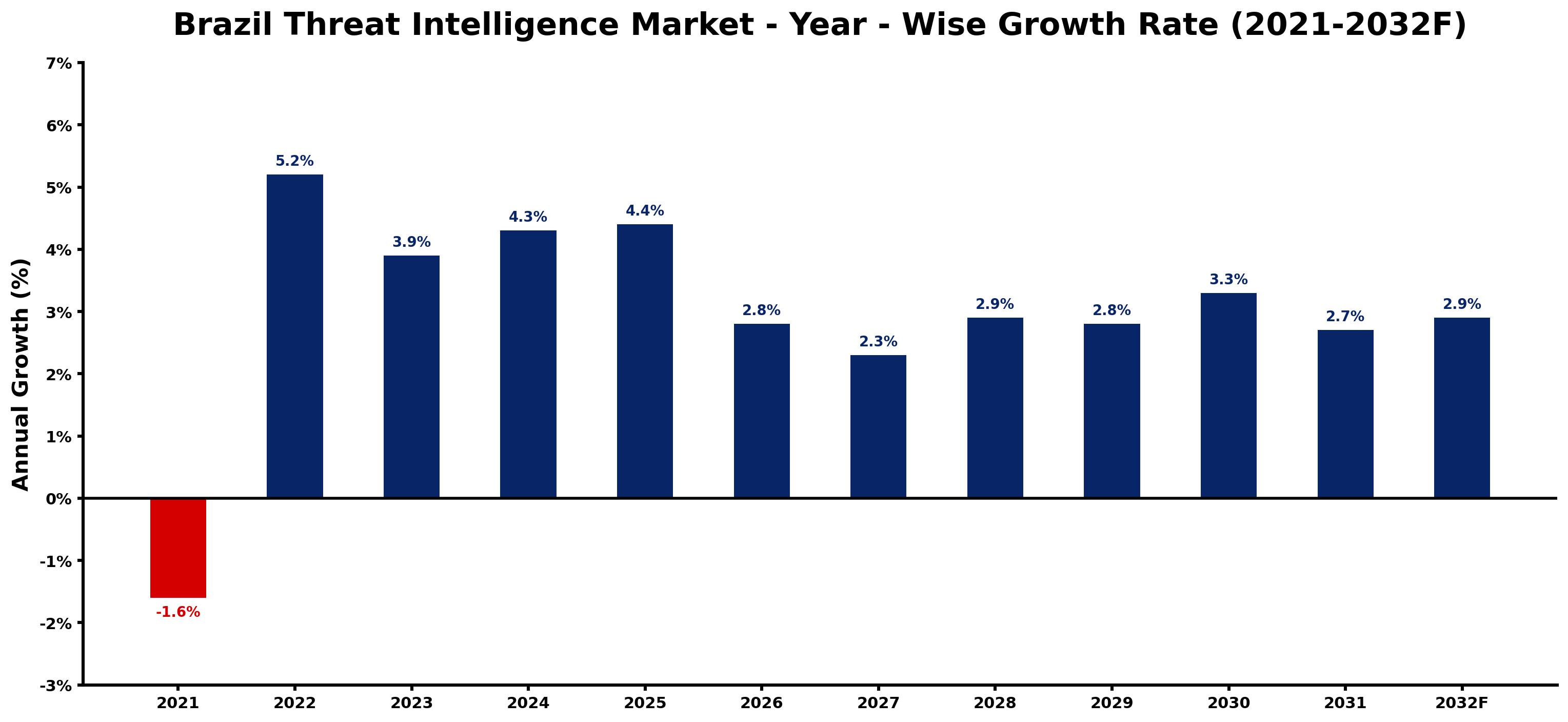
The table below presents the year‑wise growth rates along with the key drivers influencing the market
| Year | Growth Rate | Major Drivers |
| 2021 | -1.6% | Cybersecurity regulations from SERPRO hinder market adoption. |
| 2022 | 5.2% | Increase in ransomware attacks prompting enhanced cybersecurity measures |
| 2023 | 3.9% | Federal policies mandating advanced threat detection technologies |
| 2024 | 4.3% | Rising awareness of data breaches among Brazilian enterprises |
| 2025 | 4.4% | Investment in cybersecurity training driven by recent public sector incidents |
| 2026 | 2.8% | Local tech startups enhancing threat intelligence solutions availability |
| 2027 | 2.3% | Higher adoption of cloud services increasing security needs |
| 2028 | 2.9% | Government partnerships boosting threat intelligence sharing frameworks |
| 2029 | 2.8% | E-commerce growth necessitating robust cybersecurity infrastructures |
| 2030 | 3.3% | Emerging cybersecurity laws stimulating compliance-driven threat intelligence |
| 2031 | 2.7% | Corporate mergers escalating demand for integrated security solutions |
| 2032 | 2.9% | Increase in digital banking users driving personalized security threats |
Note: Market size estimations and growth projections presented in this report are based on 6Wresearch's proprietary forecasting methodology, utilizing the latest available industry data, government publications, and primary research inputs.
Brazil Threat Intelligence Market Key Takeaways
Below are some of the specific key takeaways from the market, including:
- The growing complexity of cyber threats is pushing organizations to adopt threat intelligence as a core aspect of their cybersecurity strategy.
- Real-time insights and analytics have become crucial for anticipating potential breaches and minimizing response time.
- Regulatory compliance pressures are motivating organizations to invest in advanced threat intelligence solutions.
- Collaboration between public and private sectors is essential for developing effective information-sharing frameworks.
- Organizations are increasingly focusing on integrating threat intelligence into their incident response mechanisms.
Evaluation of Restraints in Brazil Threat Intelligence Market
Despite the growth potential, several restraints limit the market’s progress. A significant challenge lies in the inconsistent sharing of threat intelligence across different industries. Organizations often operate in silos, which hampers collaboration and the flow of critical information needed to combat cyber threats effectively. Moreover, the rapid evolution of threats necessitates continuous adaptation and upgrading of security measures, which can strain resources and budgets. The lack of standardized protocols for sharing intelligence further complicates the situation, making it difficult for entities to establish effective partnerships.
Brazil Threat Intelligence Market Trends
In recent months, the Brazil Threat Intelligence Market has seen a surge in organizations adopting AI-driven analytics for threat detection. These advanced tools allow companies to process vast amounts of data quickly, enabling them to identify threats before they escalate. Another noticeable trend is the move towards integration, where businesses are incorporating threat intelligence into their existing security infrastructures, enhancing overall resilience. Increased focus on employee training and awareness programs also reflects a shift toward a more holistic cybersecurity approach.
Brazil Threat Intelligence Market Opportunities
Growth opportunities are abundant in the Brazil Threat Intelligence Market. The ongoing digital transformation across sectors presents a fertile ground for tailored threat intelligence solutions. Organizations seeking to enhance their cybersecurity posture can explore partnerships with tech firms to develop customized analytics platforms. Furthermore, rising regulatory requirements for data protection can drive investment in comprehensive threat intelligence frameworks, providing avenues for sustained market expansion.
Government Initiatives in the Brazil Threat Intelligence Market
Government policy plays a crucial role in shaping the Brazil Threat Intelligence Market. The Brazilian government has initiated several programs to bolster national cybersecurity efforts, encouraging public-private partnerships aimed at enhancing intelligence sharing. As cyber threats grow more sophisticated, these initiatives are increasingly vital in establishing a cohesive defense strategy against potential attacks.
- A recent initiative aimed at developing a national cybersecurity framework was launched in late 2022 to standardize practices across industries.
- Currently underway is a public-private collaboration focused on creating a centralized threat intelligence sharing platform expected to be operational by 2025.
- Planned for 2026 is an expansion of cybersecurity awareness programs aimed at increasing private sector engagement with threat intelligence solutions.
- The government is also working on updating existing regulations to address emerging cyber threats more effectively, expected to be introduced in 2025.
- A nationwide cybersecurity skills training program is being developed, projected to roll out by mid-2026 to enhance the workforce's capabilities in threat intelligence.
Future Insights of the Brazil Threat Intelligence Market
Looking ahead to 2026-2032, the Brazil Threat Intelligence Market is expected to evolve significantly. As cyber threats become even more advanced, the demand for integrated and proactive threat intelligence solutions will rise. Organizations will increasingly adopt automation and AI technologies to enhance detection and response capabilities. Additionally, the focus on regulatory compliance will drive investment in robust intelligence solutions, creating a more dynamic market environment.
Brazil Threat Intelligence Market Latest Developments
In the last year, industry activity within the Brazil Threat Intelligence Market has accelerated. Companies are increasingly investing in technologies that bolster their cybersecurity infrastructures, often driven by regulatory pressures and the growing recognition of cyber threats. The collaboration between tech firms and governmental bodies has further enhanced the momentum in this sector.
- In Q3 2025, a major technology vendor launched a comprehensive threat intelligence platform designed to integrate seamlessly with existing cybersecurity systems.
- A leading regional operator announced an ongoing project that began in early 2025 to establish a centralized hub for threat intelligence data sharing among organizations.
- Upcoming is a scheduled rollout of a national cybersecurity certification program for businesses aiming to strengthen their cyber defense mechanisms, expected to commence in late 2025.
- A collaborative initiative launched in early 2025 is now underway, focused on creating an industry-specific threat intelligence database to enhance sector resilience.
Brazil Threat Intelligence Market - Key Attractiveness of the Report
- 10 Years of Market Numbers
- Historical Data Starting from 2022 to 2025
- Base Year: 2025
- Forecast Data until 2032
- Key Performance Indicators Impacting the Market
- Major Upcoming Developments and Projects
Which trends are influencing the market’s future?
Key Highlights of the Report:
- Brazil Threat Intelligence Market Outlook
- Market Size of Brazil Threat Intelligence Market, 2025
- Forecast of Brazil Threat Intelligence Market, 2032
- Historical Data and Forecast of Brazil Threat Intelligence Revenues & Volume for the Period 2022-2032F
- Brazil Threat Intelligence Market Trend Evolution
- Brazil Threat Intelligence Market Drivers and Challenges
- Brazil Threat Intelligence Price Trends
- Brazil Threat Intelligence Porter's Five Forces
- Brazil Threat Intelligence Industry Life Cycle
- Historical Data and Forecast of Brazil Threat Intelligence Market Revenues & Volume By Component for the Period 2022-2032F
- Historical Data and Forecast of Brazil Threat Intelligence Market Revenues & Volume By Solutions for the Period 2022-2032F
- Historical Data and Forecast of Brazil Threat Intelligence Market Revenues & Volume By Services for the Period 2022-2032F
- Historical Data and Forecast of Brazil Threat Intelligence Market Revenues & Volume By Vertical for the Period 2022-2032F
- Historical Data and Forecast of Brazil Threat Intelligence Market Revenues & Volume By BFSI for the Period 2022-2032F
- Historical Data and Forecast of Brazil Threat Intelligence Market Revenues & Volume By IT for the Period 2022-2032F
- Historical Data and Forecast of Brazil Threat Intelligence Market Revenues & Volume By ITeS for the Period 2022-2032F
- Historical Data and Forecast of Brazil Threat Intelligence Market Revenues & Volume By Retail for the Period 2022-2032F
- Historical Data and Forecast of Brazil Threat Intelligence Market Revenues & Volume By Healthcare for the Period 2022-2032F
- Historical Data and Forecast of Brazil Threat Intelligence Market Revenues & Volume By Life Sciences for the Period 2022-2032F
- Historical Data and Forecast of Brazil Threat Intelligence Market Revenues & Volume By Organization Size for the Period 2022-2032F
- Historical Data and Forecast of Brazil Threat Intelligence Market Revenues & Volume By Large Enterprises for the Period 2022-2032F
- Historical Data and Forecast of Brazil Threat Intelligence Market Revenues & Volume By SMEs for the Period 2022-2032F
- Historical Data and Forecast of Brazil Threat Intelligence Market Revenues & Volume By Application for the Period 2022-2032F
- Historical Data and Forecast of Brazil Threat Intelligence Market Revenues & Volume By Security Information and Event Management for the Period 2022-2032F
- Historical Data and Forecast of Brazil Threat Intelligence Market Revenues & Volume By Government, Risk, and Compliance for the Period 2022-2032F
- Historical Data and Forecast of Brazil Threat Intelligence Market Revenues & Volume By Business Continuity Planning and Management for the Period 2022-2032F
- Historical Data and Forecast of Brazil Threat Intelligence Market Revenues & Volume By Deployment Mode for the Period 2022-2032F
- Historical Data and Forecast of Brazil Threat Intelligence Market Revenues & Volume By Cloud for the Period 2022-2032F
- Historical Data and Forecast of Brazil Threat Intelligence Market Revenues & Volume By On-premises for the Period 2022-2032F
- Brazil Threat Intelligence Import Export Trade Statistics
- Market Opportunity Assessment By Component
- Market Opportunity Assessment By Vertical
- Market Opportunity Assessment By Organization Size
- Market Opportunity Assessment By Application
- Market Opportunity Assessment By Deployment Mode
- Brazil Threat Intelligence Top Companies Market Share
- Brazil Threat Intelligence Competitive Benchmarking By Technical and Operational Parameters
- Brazil Threat Intelligence Company Profiles
- Brazil Threat Intelligence Key Strategic Recommendations






































