Brazil Toys and Hobby Goods Market Summary
The brazil toys and hobby goods market was estimated at USD 214 Million in 2025 and is projected to reach USD 256 Million by 2032, growing at a CAGR of 3.1% from 2026 to 2032.
Brazil Toys and Hobby Goods Market Year-wise Growth Rate and Key Drivers
This graph highlights how the Brazil Toys and Hobby Goods Market has steadily grown over the years, supported by major growth factors.
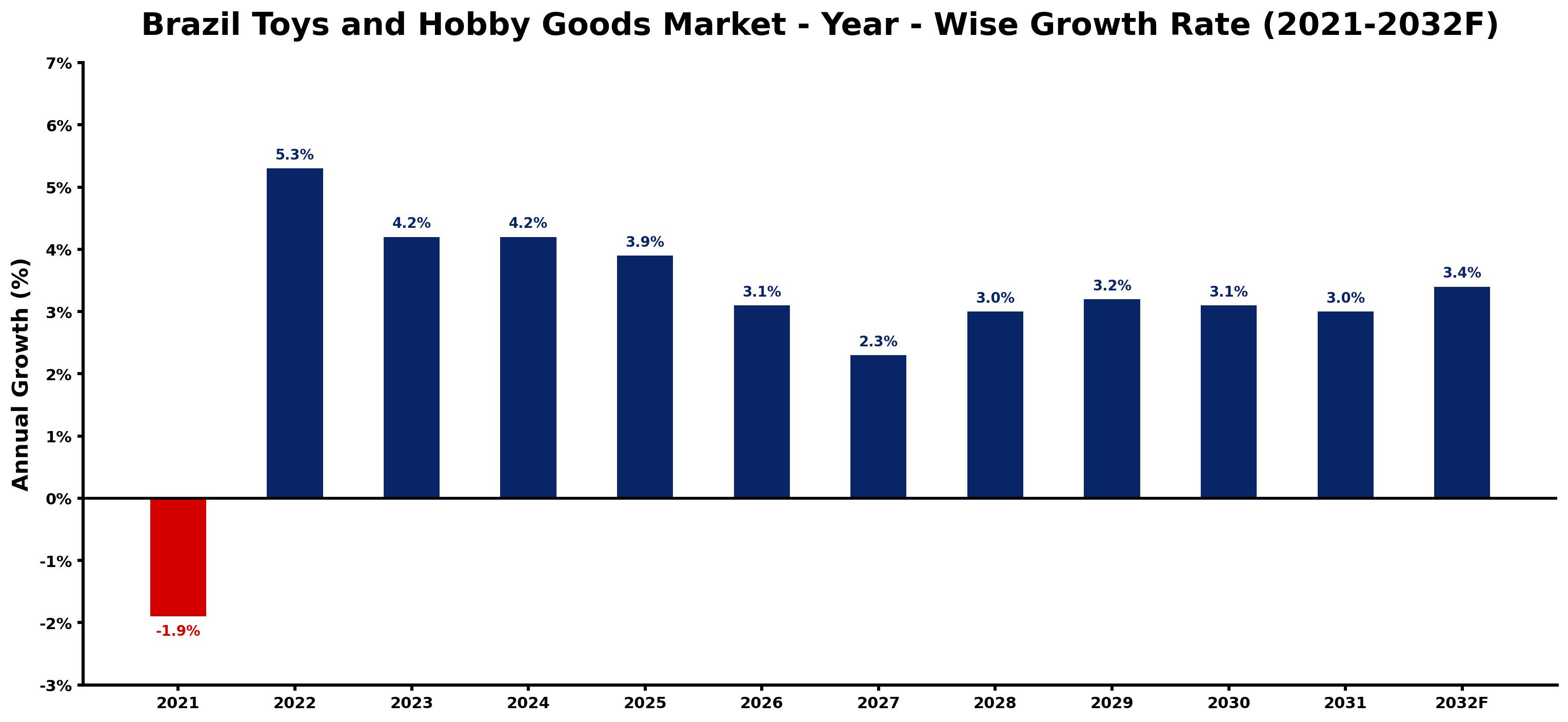
The table below presents the year wise growth rates along with the key drivers influencing the market
| Year | Growth Rate | Major Drivers |
| 2021 | -1.9% | Increased competition from digital entertainment options shifted consumer preferences away from traditional toy purchases. |
| 2022 | 5.3% | Increased consumer spending on leisure activities boosted hobby goods sales significantly. |
| 2023 | 4.2% | Localized manufacturing initiatives enhanced product availability in Brazilian markets. |
| 2024 | 4.2% | Emerging digital platforms transformed how consumers discover and purchase toys. |
| 2025 | 3.9% | Sustainability trends influenced toy designs, attracting eco-conscious consumers effectively. |
| 2026 | 3.1% | Collaborations between brands and influencers increased visibility of niche toy products. |
| 2027 | 2.3% | Innovative educational toys gained traction, appealing to parents' desires for learning. |
| 2028 | 3.0% | Economic recovery spurred investments in entertainment and leisure sectors significantly. |
| 2029 | 3.2% | Diverse cultural events highlighted traditional toys, driving local craftsmanship appreciation. |
| 2030 | 3.1% | Enhanced e-commerce platforms enabled smaller brands to reach broader audiences effectively. |
| 2031 | 3.0% | Expansion of international toy brands introduced variety and heightened competition in markets. |
| 2032 | 3.4% | Consumer interest in home-based hobbies led to increased sales of craft supplies. |
Note - Market size estimations and growth projections presented in this report are based on 6Wresearch's advanced forecasting approach, validated with industry datasets as of June 2026.
Brazil Toys and Hobby Goods Market Synopsis
The Brazil Toys and Hobby Goods Market is projected to reach 3.1% and witness significant growth during the forecast period (2026-2032). This market reflects a dynamic interplay of traditional and modern interests, influenced by cultural factors and evolving consumer preferences. The increasing digital penetration and expansion of e-commerce platforms have also facilitated greater market accessibility, thereby driving the growth of the sector.
Brazil Toys and Hobby Goods Market Growth Drivers
Several key factors are spurring the growth of the Brazil Toys and Hobby Goods Market. This includes:
- The youthful demographic of Brazil, which provides a consistent consumer base eager for both toys and hobby products, significantly influences market demand.
- Rising disposable incomes across various socioeconomic segments enable more families to invest in quality toys and hobby goods, further propelling consumption.
- The increasing emphasis on recreational activities among Brazilian families has led to a growing preference for toys that promote engagement and education.
- Technological advancements have introduced innovative products to the market, effectively merging play with learning and stimulating interest in various hobby categories.
- The popularity of licensed merchandise, such as toys associated with beloved characters, continues to attract consumers and drive sales within the sector.
Brazil Toys and Hobby Goods Market Challenges and Restraints
Despite the robust growth prospects, the Brazil Toys and Hobby Goods Market faces several challenges that could impede progress. These include:
- Shifting demographics, particularly the migration of children to digital platforms, where traditional toys may be sidelined by digital entertainment options.
- Compliance with safety regulations poses a significant challenge for manufacturers, necessitating rigorous quality control measures to ensure child safety.
- The need for effective adaptation to new consumer behaviors, particularly with the growing shift towards online shopping, which may require substantial investment in e-commerce capabilities.
- The balancing act between innovative product development and maintaining safety standards can often lead to increased costs for manufacturers.
- Intense competition from both domestic and international players can put pressure on pricing strategies, potentially affecting profitability within the market.
Brazil Toys and Hobby Goods Market Government Investment and Initiatives
The Brazilian government has implemented various policies aimed at bolstering the Toys and Hobby Goods Market. Key initiatives include:
- The establishment of stringent safety standards and quality control regulations to ensure that all products in the market are safe for children, reflecting a commitment to consumer protection.
- Increased public spending on education and recreational facilities, which indirectly stimulates demand for educational toys and hobby goods.
- Collaboration between government entities and industry stakeholders to create a more secure market environment, enhancing consumer confidence and market stability.
- Encouragement of local manufacturing initiatives, which could reduce import dependency and help stimulate economic growth within the sector.
- Periodic reviews of regulatory frameworks to adapt to changing market dynamics and consumer preferences, thereby fostering an environment conducive to innovation.
Brazil Toys and Hobby Goods Market Latest Developments (May 2025 - June 2026)
Recent developments in the Brazil Toys and Hobby Goods Market have highlighted a shift towards increased online retailing as a primary sales channel. As e-commerce continues to expand, manufacturers and retailers are adapting their strategies to enhance online presence and distribution methods. Additionally, there is a notable increase in partnerships between toy manufacturers and digital platforms, promoting the integration of technology in play. Furthermore, trends indicate that sustainability is becoming a focal point, with more companies prioritizing eco-friendly materials and practices in response to growing consumer awareness.
Brazil Toys and Hobby Goods Market - Key Attractiveness of the Report
- 10 Years of Market Numbers
- Historical Data Starting from 2022 to 2025
- Base Year: 2025
- Forecast Data until 2032
- Key Performance Indicators Impacting the Market
- Major Upcoming Developments and Projects
Key Highlights of the Report:
- Brazil Toys and Hobby Goods Market Outlook
- Market Size of Brazil Toys and Hobby Goods Market, 2025
- Forecast of Brazil Toys and Hobby Goods Market, 2032
- Historical Data and Forecast of Brazil Toys and Hobby Goods Revenues & Volume for the Period 2022-2032F
- Brazil Toys and Hobby Goods Market Trend Evolution
- Brazil Toys and Hobby Goods Market Drivers and Challenges
- Brazil Toys and Hobby Goods Price Trends
- Brazil Toys and Hobby Goods Porter's Five Forces
- Brazil Toys and Hobby Goods Industry Life Cycle
- Historical Data and Forecast of Brazil Toys and Hobby Goods Market Revenues & Volume By Type for the Period 2022-2032F
- Historical Data and Forecast of Brazil Toys and Hobby Goods Market Revenues & Volume By Sports Toys for the Period 2022-2032F
- Historical Data and Forecast of Brazil Toys and Hobby Goods Market Revenues & Volume By Intellectual Toys for the Period 2022-2032F
- Historical Data and Forecast of Brazil Toys and Hobby Goods Market Revenues & Volume By Education Toys for the Period 2022-2032F
- Historical Data and Forecast of Brazil Toys and Hobby Goods Market Revenues & Volume By Decorative Toys for the Period 2022-2032F
- Historical Data and Forecast of Brazil Toys and Hobby Goods Market Revenues & Volume By Other for the Period 2022-2032F
- Historical Data and Forecast of Brazil Toys and Hobby Goods Market Revenues & Volume By Application for the Period 2022-2032F
- Historical Data and Forecast of Brazil Toys and Hobby Goods Market Revenues & Volume By Online Sales for the Period 2022-2032F
- Historical Data and Forecast of Brazil Toys and Hobby Goods Market Revenues & Volume By Offline Sales for the Period 2022-2032F
- Historical Data and Forecast of Brazil Toys and Hobby Goods Market Revenues & Volume By Others for the Period 2022-2032F
- Brazil Toys and Hobby Goods Import Export Trade Statistics
- Market Opportunity Assessment By Type
- Market Opportunity Assessment By Application
- Brazil Toys and Hobby Goods Top Companies Market Share
- Brazil Toys and Hobby Goods Competitive Benchmarking By Technical and Operational Parameters
- Brazil Toys and Hobby Goods Company Profiles
- Brazil Toys and Hobby Goods Key Strategic Recommendations






































