Brazil Tung Oil Market Size, Share & Growth Rate
The Brazil Tung Oil Market was estimated at USD 384 Million in 2025 and is projected to reach USD 459 Million by 2032, growing at a CAGR of 2.6% from 2026 to 2032. This growth trajectory is primarily fueled by the increased adoption of tung oil across diverse industries such as woodworking, coatings, and cosmetics. The eco-friendly attributes of tung oil align with the rising consumer preference for sustainable products, further propelling demand in an era of heightened environmental awareness.
Brazil Tung Oil Market Year-wise Growth Rate and Key Drivers
This graph highlights how the Brazil Tung Oil Market has steadily grown over the years, supported by major growth factors.
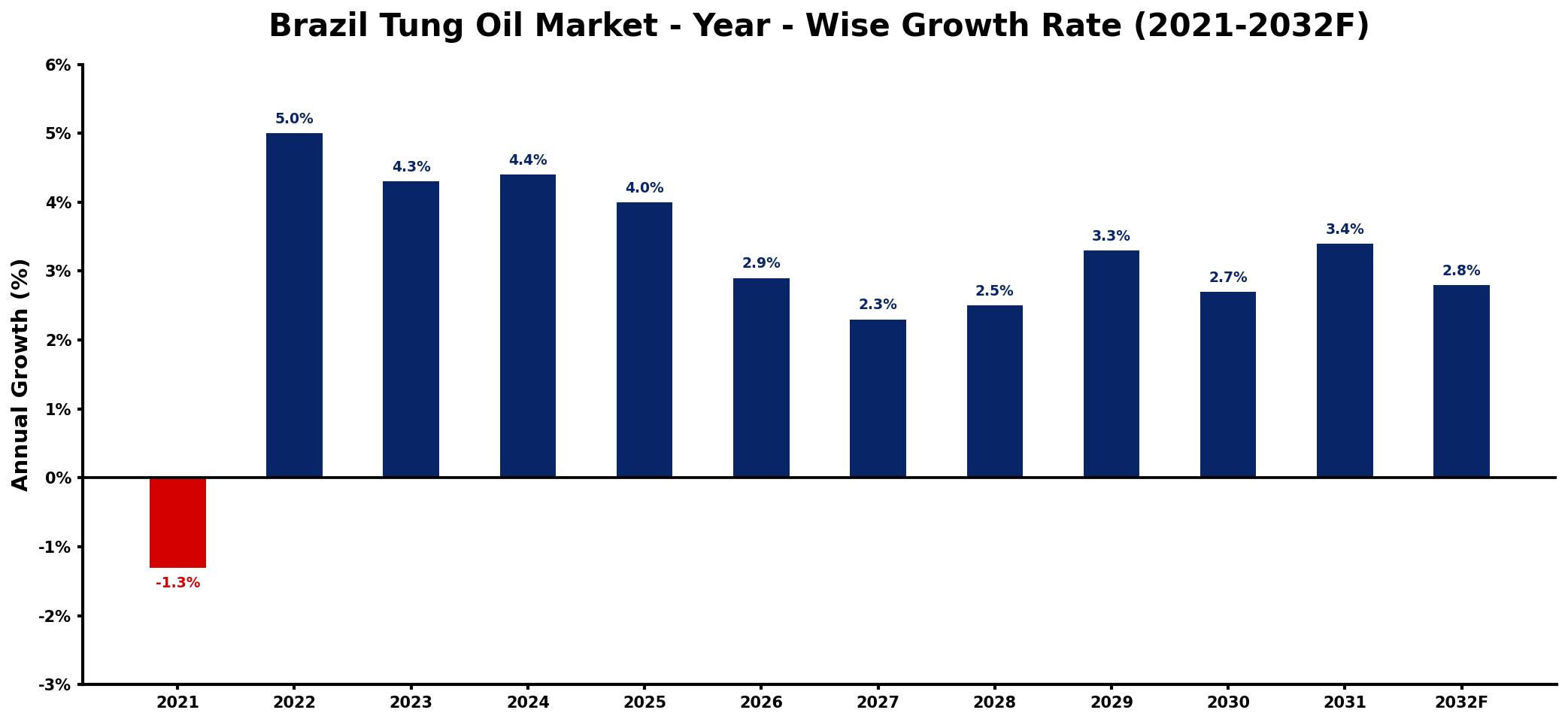
The table below presents the year‑wise growth rates along with the key drivers influencing the market
| Year | Growth Rate | Major Drivers |
| 2021 | -1.3% | decreased demand from construction sector |
| 2022 | 5.0% | increased interest in sustainable materials |
| 2023 | 4.3% | growing popularity of eco-friendly finishes |
| 2024 | 4.4% | expansion of furniture manufacturing sector |
| 2025 | 4.0% | rising investments in woodworking industries |
| 2026 | 2.9% | enhanced supply chain efficiencies observed |
| 2027 | 2.3% | increased exports to international markets |
| 2028 | 2.5% | growing consumer awareness on sustainability |
| 2029 | 3.3% | expansion in home improvement projects |
| 2030 | 2.7% | rising demand from automotive sector |
| 2031 | 3.4% | increased adoption of natural coatings |
| 2032 | 2.8% | increased overall sector activity |
Note: Market size estimations and growth projections presented in this report are based on 6Wresearch's proprietary forecasting methodology, utilizing the latest available industry data, government publications, and primary research inputs.
Brazil Tung Oil Market Synopsis
Brazil's tung oil market is witnessing a surge, particularly due to its crucial role in wood finishing applications. Its natural drying properties make it an ideal choice for high-quality wood coatings, which are increasingly sought after in the booming construction and furniture sectors. As these industries grow, they significantly contribute to the demand for tung oil.
Additionally, the cosmetic industry is recognizing the multifunctional benefits of tung oil, using it in skincare and haircare formulations. The combination of performance and sustainability in tung oil is fostering a favorable environment for market expansion, as consumers look for products that not only deliver results but are also environmentally conscious.
Brazil Tung Oil Market Key Takeaways
- The market is witnessing a notable shift towards sustainable and eco-friendly products.
- Woodworking and construction industries are primary drivers of demand for tung oil.
- Increased usage in the cosmetic sector is diversifying the applications of tung oil.
- Government regulations favor sustainable harvesting and environmental conservation efforts.
- Price volatility remains a significant challenge for market players.
Evaluation of Restraints in Brazil Tung Oil Market
Despite its growth potential, the Brazil Tung Oil Market faces considerable challenges, particularly from the vulnerabilities of tung trees to pests and diseases. This susceptibility not only threatens the supply chain but also raises concerns regarding sustainability. The need for sustainable harvesting practices is paramount; maintaining ecological balance while ensuring production can be a delicate endeavor. Furthermore, external global market dynamics and fluctuations in prices can significantly impact profitability, posing a substantial challenge for producers navigating this landscape.
Brazil Tung Oil Market Trends
A significant trend in the Brazil Tung Oil Market is the increasing emphasis on bio-based and natural ingredients, especially in coatings and cosmetic applications. Consumers are gravitating towards products that are perceived as healthier and less harmful to the environment. Moreover, technological advancements in processing tung oil are enhancing its usability and expanding its applications, making it a versatile option for various industries. This focus on innovation is expected to continue driving demand, as manufacturers seek to leverage tung oil's benefits.
Brazil Tung Oil Market Opportunities
The Brazil Tung Oil Market presents notable growth opportunities, particularly in the context of sustainability and eco-conscious consumer behavior. Companies that can innovate around the sustainable extraction and processing of tung oil stand to gain a competitive edge. Furthermore, expanding applications in the health and wellness sector, especially within natural cosmetics, signal a ripe area for investment. Collaborations with local farmers to ensure sustainable practices can not only enhance supply chain resilience but also elevate brand credibility among environmentally aware consumers.
Government Initiatives in the Brazil Tung Oil Market
Brazilian government policies are increasingly focused on promoting sustainable practices within the tung oil market. Initiatives aimed at ensuring responsible harvesting methods and ecological conservation are being emphasized. Regulatory frameworks are in place to support reforestation efforts and provide assistance to small-scale producers, reflecting Brazil's commitment to biodiversity and sustainable resource management. These efforts not only help protect the environment but also enhance the long-term viability of the tung oil industry.
Future Insights of the Brazil Tung Oil Market
Looking ahead to 2026-2032, the Brazil Tung Oil Market is expected to continue its upward trajectory, driven by sustained demand across various industries. As consumer preferences increasingly lean towards sustainable and eco-friendly products, tung oil's unique properties position it well within the market. Innovations in processing and application are likely to enhance its market footprint, while government support for sustainable practices will provide a robust framework for future growth. The convergence of these factors suggests a bright future for the Brazil Tung Oil Market.
Brazil Tung Oil Market Latest Developments (2025 - 2026)
Recent developments within the Brazil Tung Oil Market indicate a strategic shift towards embracing sustainable practices in production. Industry stakeholders are collaborating more closely with local agricultural communities to implement responsible harvesting methods. Additionally, there is a noticeable increase in research efforts aimed at enhancing the efficiency of tung oil processing technologies. These advancements are expected to play a significant role in meeting the growing demand while ensuring that ecological integrity is maintained.
Brazil Tung Oil Market - Key Attractiveness of the Report
- 10 Years of Market Numbers
- Historical Data Starting from 2022 to 2025
- Base Year: 2025
- Forecast Data until 2032
- Key Performance Indicators Impacting the Market
- Major Upcoming Developments and Projects
Key Highlights of the Report:
- Brazil Tung Oil Market Outlook
- Market Size of Brazil Tung Oil Market, 2025
- Forecast of Brazil Tung Oil Market, 2032
- Historical Data and Forecast of Brazil Tung Oil Revenues & Volume for the Period 2022-2032F
- Brazil Tung Oil Market Trend Evolution
- Brazil Tung Oil Market Drivers and Challenges
- Brazil Tung Oil Price Trends
- Brazil Tung Oil Porter's Five Forces
- Brazil Tung Oil Industry Life Cycle
- Historical Data and Forecast of Brazil Tung Oil Market Revenues & Volume By Product Type for the Period 2022-2032F
- Historical Data and Forecast of Brazil Tung Oil Market Revenues & Volume By Raw Tung Oil for the Period 2022-2032F
- Historical Data and Forecast of Brazil Tung Oil Market Revenues & Volume By Boiled Tung Oil for the Period 2022-2032F
- Historical Data and Forecast of Brazil Tung Oil Market Revenues & Volume By Application for the Period 2022-2032F
- Historical Data and Forecast of Brazil Tung Oil Market Revenues & Volume By Wood Finishing for the Period 2022-2032F
- Historical Data and Forecast of Brazil Tung Oil Market Revenues & Volume By Food and Beverage for the Period 2022-2032F
- Historical Data and Forecast of Brazil Tung Oil Market Revenues & Volume By Medicines for the Period 2022-2032F
- Historical Data and Forecast of Brazil Tung Oil Market Revenues & Volume By Others for the Period 2022-2032F
- Brazil Tung Oil Import Export Trade Statistics
- Market Opportunity Assessment By Product Type
- Market Opportunity Assessment By Application
- Brazil Tung Oil Top Companies Market Share
- Brazil Tung Oil Competitive Benchmarking By Technical and Operational Parameters
- Brazil Tung Oil Company Profiles
- Brazil Tung Oil Key Strategic Recommendations






































