Brazil TV Transmitters Market Size, Share & Growth Rate
The Brazil TV Transmitters Market was estimated at USD 151 Million in 2025 and is projected to reach USD 180 Million by 2032, growing at a CAGR of 2.5% from 2026 to 2032. This growth trajectory is fueled by the ongoing advancements in digital broadcasting technologies and the continued expansion of the media landscape in Brazil. As demand for high-definition content rises and regulatory frameworks support transition to digital standards, broadcasters are investing in upgraded transmitter infrastructure, further driving the market.
Brazil TV Transmitters Market Year-wise Growth Rate and Key Drivers
This graph highlights how the Brazil TV Transmitters Market has steadily grown over the years, supported by major growth factors.
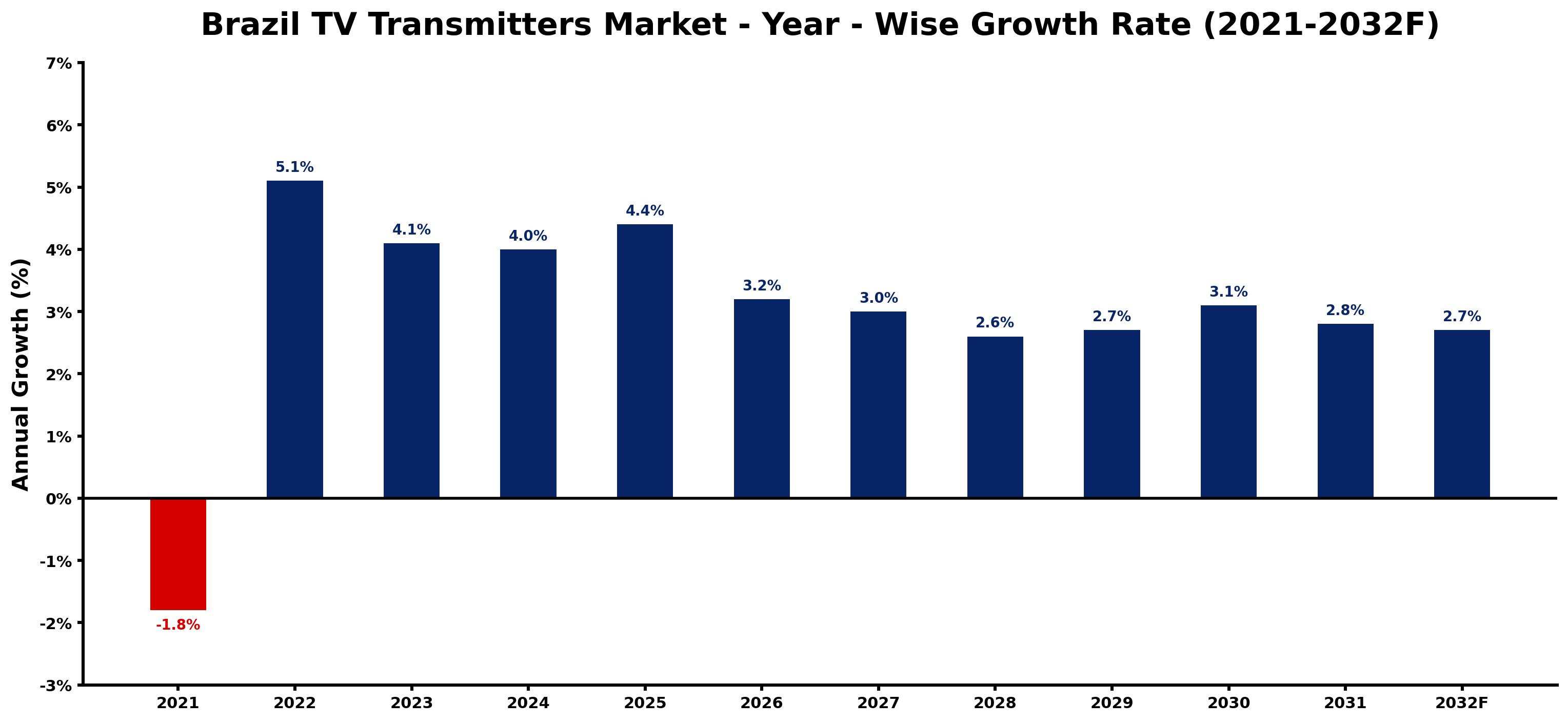
The table below presents the year‑wise growth rates along with the key drivers influencing the market
| Year | Growth Rate | Major Drivers |
| 2021 | -1.8% | Expansion of transportation and logistics networks |
| 2022 | 5.1% | Increasing industrial infrastructure investments |
| 2023 | 4.1% | Growing urbanization and commercial development |
| 2024 | 4.0% | Increasing industrial infrastructure investments |
| 2025 | 4.4% | Rapid growth in telecom and data center sectors |
| 2026 | 3.2% | Rapid growth in telecom and data center sectors |
| 2027 | 3.0% | Increasing smart city development projects |
| 2028 | 2.6% | Increasing smart city development projects |
| 2029 | 2.7% | Increasing industrial infrastructure investments |
| 2030 | 3.1% | Expansion of commercial construction activities |
| 2031 | 2.8% | Rapid growth in telecom and data center sectors |
| 2032 | 2.7% | Government infrastructure modernization initiatives |
Note - Market size estimations and growth projections presented in this report are based on 6Wresearch’s advanced forecasting approach, validated with industry datasets as of June 2026.
Brazil TV Transmitters Market Synopsis
The Brazilian TV transmitters market has experienced considerable momentum, driven by a diverse population eager for quality broadcast options. However, this market faces a pivotal shift as technological advancements demand a move toward more efficient digital broadcasting solutions. As media consumption evolves, stakeholders must adapt swiftly to remain competitive.
While the current landscape is vibrant, propelled by both domestic and international players, the future direction of the market is increasingly dependent on government policies and regulatory frameworks. With ongoing support for technological upgrades and a focus on maximizing transmission efficiency, the stage is set for continued growth amidst a rapidly changing industry.
Brazil TV Transmitters Market Key Takeaways
- Significant growth projected from USD 151 Million in 2025 to USD 180 Million by 2032.
- Ongoing technological advancements in digital broadcasting are reshaping the industry.
- Government policies are crucial in regulating and supporting market evolution.
- Investment in media infrastructure is driven by the increasing demand for HD content.
- Broadcasting infrastructure upgrades are necessary to meet new digital standards.
Evaluation of Restraints in Brazil TV Transmitters Market
Despite the optimistic outlook, the Brazil TV transmitters market faces certain restraints that could hinder growth. The rapid pace of technological change is compelling broadcasters to continually upgrade their equipment, which can strain financial resources. Additionally, competition from alternative media platforms and streaming services is intensifying, potentially diverting investment away from traditional broadcasting. As market players navigate these challenges, a strategic focus on innovation and adaptation is essential for sustained success.
Brazil TV Transmitters Market Trends
Several trends are currently shaping the Brazil TV transmitters market. The transition to digital broadcasting is not only enhancing signal quality but also expanding the scope of available content. Another trend is the increasing demand for high-definition and ultra-high-definition programming, driving broadcasters to invest in more advanced transmission technologies. Moreover, the integration of Internet Protocol Television (IPTV) solutions is gaining traction, reflecting the blending of traditional and digital media landscapes.
Brazil TV Transmitters Market Opportunities
The Brazil TV transmitters market presents numerous opportunities for growth and investment. As broadcasters prepare to meet the demands of digital audiences, there is significant potential for new players to enter the market with innovative solutions. Furthermore, investments in infrastructure aimed at improving signal coverage and quality are essential, particularly in remote areas where access to quality broadcasting remains limited. The government's push towards a more competitive and diverse media landscape will also create favorable conditions for investment.
Government Initiatives in the Brazil TV Transmitters Market
The Brazilian government is actively involved in shaping the TV transmitters market through various initiatives aimed at regulating broadcasting infrastructure. Policies focus on ensuring spectrum efficiency and supporting the media industry's development by providing necessary regulations on TV transmitter licensing and frequency allocation. Additionally, there are incentives for broadcasters to upgrade to digital TV transmission technologies, fostering improved signal quality and enhancing bandwidth utilization. Such measures aim to promote diversity and competition within the sector.
Future Insights of the Brazil TV Transmitters Market
Looking ahead to 2026-2032, the Brazil TV transmitters market is poised for a transformative phase. Continued advancements in broadcasting technology will shape content delivery, pushing the boundaries of what is possible in media consumption. As regulatory frameworks evolve, broadcasters will be better positioned to adapt to consumer demands while ensuring compliance with emerging digital standards. Investment in infrastructure and a focus on innovative transmitter technologies will be vital as the market navigates through this pivotal period.
Brazil TV Transmitters Market Latest Developments (May 2025 - June 2026)
Recent developments in the Brazil TV transmitters market indicate a shift towards more integrated broadcasting solutions, with a growing emphasis on digital technologies. Initiatives to enhance signal quality and expand coverage are becoming increasingly common as broadcasters respond to competitive pressures. Additionally, the government has rolled out new programs aimed at further facilitating the transition to digital broadcasting, aligning with global trends while fostering local industry growth.
Brazil TV Transmitters Market - Key Attractiveness of the Report
- 10 Years of Market Numbers
- Historical Data Starting from 2022 to 2025
- Base Year: 2025
- Forecast Data until 2032
- Key Performance Indicators Impacting the Market
- Major Upcoming Developments and Projects
Key Highlights of the Report:
- Brazil TV Transmitters Market Outlook
- Market Size of Brazil TV Transmitters Market, 2025
- Forecast of Brazil TV Transmitters Market, 2032
- Historical Data and Forecast of Brazil TV Transmitters Revenues & Volume for the Period 2022-2032F
- Brazil TV Transmitters Market Trend Evolution
- Brazil TV Transmitters Market Drivers and Challenges
- Brazil TV Transmitters Price Trends
- Brazil TV Transmitters Porter's Five Forces
- Brazil TV Transmitters Industry Life Cycle
- Historical Data and Forecast of Brazil TV Transmitters Market Revenues & Volume By Component for the Period 2022-2032F
- Historical Data and Forecast of Brazil TV Transmitters Market Revenues & Volume By Transmitter Type for the Period 2022-2032F
- Historical Data and Forecast of Brazil TV Transmitters Market Revenues & Volume By Professional Services for the Period 2022-2032F
- Historical Data and Forecast of Brazil TV Transmitters Market Revenues & Volume By Distribution Channel for the Period 2022-2032F
- Historical Data and Forecast of Brazil TV Transmitters Market Revenues & Volume By Company Owned for the Period 2022-2032F
- Historical Data and Forecast of Brazil TV Transmitters Market Revenues & Volume By Third Party for the Period 2022-2032F
- Historical Data and Forecast of Brazil TV Transmitters Market Revenues & Volume By Application for the Period 2022-2032F
- Historical Data and Forecast of Brazil TV Transmitters Market Revenues & Volume By Small TV Station for the Period 2022-2032F
- Historical Data and Forecast of Brazil TV Transmitters Market Revenues & Volume By Large TV Station for the Period 2022-2032F
- Brazil TV Transmitters Import Export Trade Statistics
- Market Opportunity Assessment By Component
- Market Opportunity Assessment By Distribution Channel
- Market Opportunity Assessment By Application
- Brazil TV Transmitters Top Companies Market Share
- Brazil TV Transmitters Competitive Benchmarking By Technical and Operational Parameters
- Brazil TV Transmitters Company Profiles
- Brazil TV Transmitters Key Strategic Recommendations






































