Mexico TV Transmitters Market Size, Share & Growth Rate
The Mexico TV Transmitters Market was estimated at USD 167 Million in 2025 and is projected to reach USD 193 Million by 2032, growing at a CAGR of 2.1% from 2026 to 2032. This growth trajectory is primarily driven by the ongoing shift towards digital broadcasting, which is significantly enhancing the demand for high-definition and ultra-high-definition broadcasting technologies. Furthermore, the government's commitment to upgrading broadcasting infrastructure is stimulating investment and fostering a more competitive environment, essential for meeting evolving consumer preferences.
Mexico TV Transmitters Market Year-wise Growth Rate and Key Drivers
This graph highlights how the Mexico TV Transmitters Market has steadily grown over the years, supported by major growth factors.
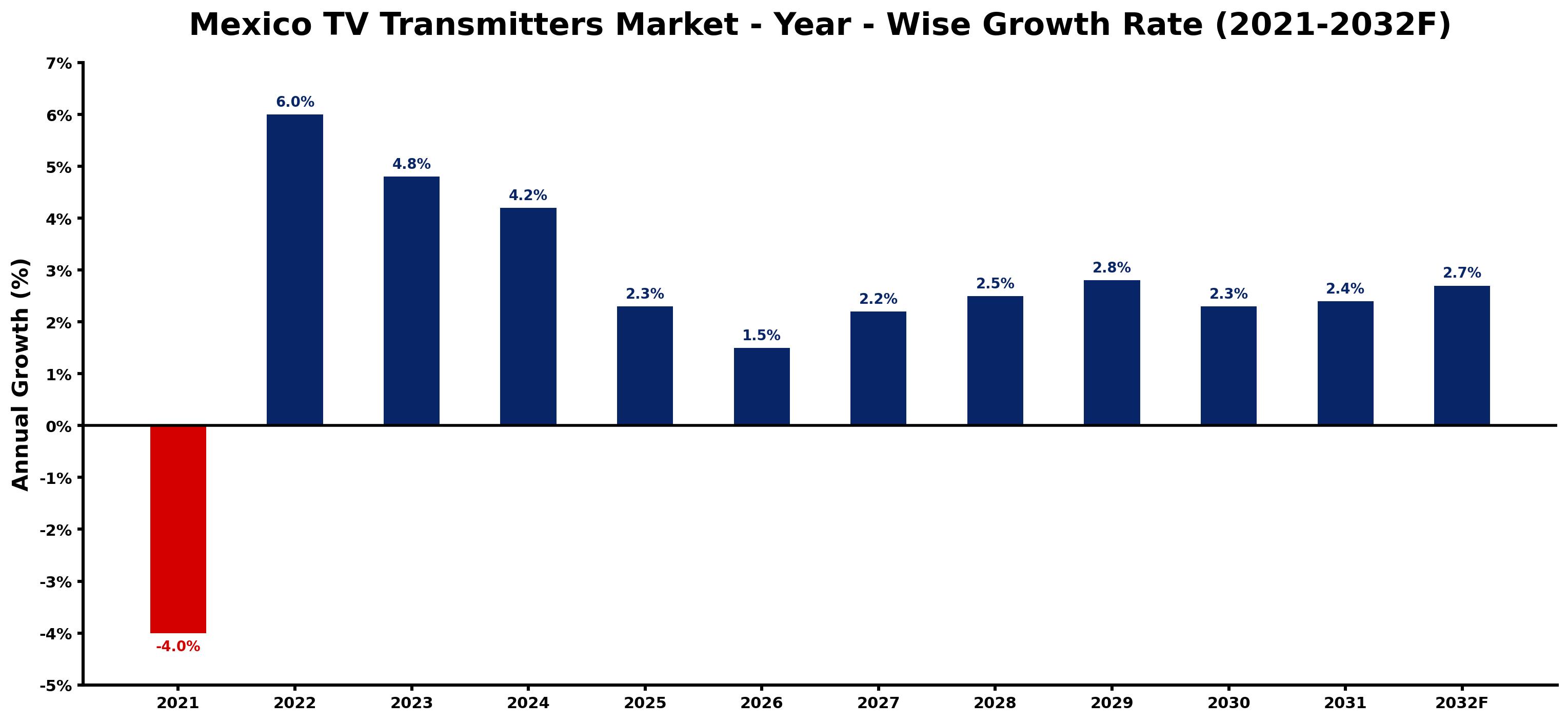
The table below presents the year‑wise growth rates along with the key drivers influencing the market
| Year | Growth Rate | Major Drivers |
| 2021 | -4.0% | Expansion of transportation and logistics networks |
| 2022 | 6.0% | Government infrastructure modernization initiatives |
| 2023 | 4.8% | Growing renewable energy integration projects |
| 2024 | 4.2% | Increasing industrial infrastructure investments |
| 2025 | 2.3% | Expansion of manufacturing activities |
| 2026 | 1.5% | Growing urbanization and commercial development |
| 2027 | 2.2% | Government infrastructure modernization initiatives |
| 2028 | 2.5% | Government infrastructure modernization initiatives |
| 2029 | 2.8% | Expansion of commercial construction activities |
| 2030 | 2.3% | Expansion of transportation and logistics networks |
| 2031 | 2.4% | Government infrastructure modernization initiatives |
| 2032 | 2.7% | Expansion of transportation and logistics networks |
Note - Market size estimations and growth projections presented in this report are based on 6Wresearch’s advanced forecasting approach, validated with industry datasets as of June 2026.
Mexico TV Transmitters Market Synopsis
The landscape of the Mexico TV Transmitters Market is undergoing a significant transformation as the country moves away from analog systems. This transition not only reflects a global trend but also underscores a national effort to modernize its media landscape. As broadcasters seek to deliver high-quality content, the demand for state-of-the-art transmitters is increasingly evident.
Regulatory changes and advancements in technology are pivotal in shaping the future of this market. The integration of new broadcasting standards necessitates robust infrastructure and innovative solutions, which presents both challenges and opportunities for manufacturers. As the media and entertainment sector expands, the importance of reliable and efficient transmission systems cannot be overstated.
Mexico TV Transmitters Market Key Takeaways
- The shift to digital broadcasting is a primary catalyst for market growth.
- High-definition and ultra-high-definition content demand is reshaping transmitter specifications.
- Government initiatives to enhance broadcasting infrastructure are driving investments.
- Technological advancements in signal transmission are creating new market opportunities.
- The market is characterized by a competitive landscape requiring continuous innovation.
Evaluation of Restraints in Mexico TV Transmitters Market
Despite the positive outlook for the Mexico TV Transmitters Market, several factors act as restraints to its potential. Transitioning from analog to digital broadcasting presents a variety of technical challenges, especially in adapting existing infrastructure to meet new standards. Moreover, manufacturers face pressure to keep pace with rapidly evolving technologies and broadcasting norms. The competitive landscape demands continual innovation, which can strain resources and complicate strategic planning for businesses aiming to maintain market relevance.
Mexico TV Transmitters Market Trends
Several trends are shaping the Mexico TV Transmitters Market as it adapts to new technologies and consumer preferences. The demand for high-definition and ultra-high-definition broadcasting is leading to the development of transmitters that offer enhanced capabilities, including improved signal processing and energy efficiency. Furthermore, advancements in cloud-based solutions and IP-based broadcasting are gaining traction, allowing for greater flexibility in content delivery.
Sustainability is also becoming a critical factor, with broadcasters increasingly prioritizing energy-efficient technologies in their operations. As environmental concerns rise, manufacturers who can provide eco-friendly solutions may find themselves with a competitive edge. The convergence of traditional broadcasting with internet technologies is further driving innovation in this space.
Mexico TV Transmitters Market Opportunities
The Mexico TV Transmitters Market offers substantial growth and investment opportunities, particularly for companies that can leverage new broadcasting technologies. The ongoing transition to digital and the demand for superior quality broadcasting present avenues for developing next-generation transmitters. Additionally, as government initiatives focus on improving broadcasting infrastructure, partnerships with public and private sectors can yield fruitful results. Investing in R&D for sustainable and efficient technologies also holds promise, as stakeholders look to align with global trends towards greener solutions.
Government Initiatives in the Mexico TV Transmitters Market
Government policies are significantly influencing the Mexico TV Transmitters Market. Initiatives aimed at supporting the transition to digital broadcasting include efforts in spectrum management and licensing, which are crucial for effective signal transmission. Additionally, public investment in broadcasting infrastructure upgrades is a key focus, as the government seeks to enhance the overall media ecosystem. These initiatives not only facilitate advancements in technology but also promote a more competitive market environment.
Future Insights of the Mexico TV Transmitters Market
Looking ahead to 2026-2032, the Mexico TV Transmitters Market is poised for steady growth, driven by ongoing digital advancements and shifts in consumer preferences towards high-quality content. The market is expected to evolve in tandem with international broadcasting standards, compelling manufacturers to innovate continuously. With increasing government support for infrastructure enhancements and the integration of new technologies, stakeholders should anticipate a dynamic and progressive market landscape.
Mexico TV Transmitters Market Latest Developments (May 2025 - June 2026)
Recent developments within the Mexico TV Transmitters Market indicate a robust focus on enhancing broadcasting capabilities. Industry participants are increasingly investing in next-generation technologies that align with emerging digital standards. Furthermore, there has been a notable uptick in collaborations aimed at upgrading existing infrastructure, highlighting the market's proactive response to evolving consumer demands. These movements are indicative of a collective effort to advance the quality and efficiency of television broadcasting in Mexico.
Mexico TV Transmitters Market - Key Attractiveness of the Report
- 10 Years of Market Numbers
- Historical Data Starting from 2022 to 2025
- Base Year: 2025
- Forecast Data until 2032
- Key Performance Indicators Impacting the Market
- Major Upcoming Developments and Projects
Key Highlights of the Report:
- Mexico TV Transmitters Market Outlook
- Market Size of Mexico TV Transmitters Market, 2025
- Forecast of Mexico TV Transmitters Market, 2032
- Historical Data and Forecast of Mexico TV Transmitters Revenues & Volume for the Period 2022-2032F
- Mexico TV Transmitters Market Trend Evolution
- Mexico TV Transmitters Market Drivers and Challenges
- Mexico TV Transmitters Price Trends
- Mexico TV Transmitters Porter's Five Forces
- Mexico TV Transmitters Industry Life Cycle
- Historical Data and Forecast of Mexico TV Transmitters Market Revenues & Volume By Component for the Period 2022-2032F
- Historical Data and Forecast of Mexico TV Transmitters Market Revenues & Volume By Transmitter Type for the Period 2022-2032F
- Historical Data and Forecast of Mexico TV Transmitters Market Revenues & Volume By Professional Services for the Period 2022-2032F
- Historical Data and Forecast of Mexico TV Transmitters Market Revenues & Volume By Distribution Channel for the Period 2022-2032F
- Historical Data and Forecast of Mexico TV Transmitters Market Revenues & Volume By Company Owned for the Period 2022-2032F
- Historical Data and Forecast of Mexico TV Transmitters Market Revenues & Volume By Third Party for the Period 2022-2032F
- Historical Data and Forecast of Mexico TV Transmitters Market Revenues & Volume By Application for the Period 2022-2032F
- Historical Data and Forecast of Mexico TV Transmitters Market Revenues & Volume By Small TV Station for the Period 2022-2032F
- Historical Data and Forecast of Mexico TV Transmitters Market Revenues & Volume By Large TV Station for the Period 2022-2032F
- Mexico TV Transmitters Import Export Trade Statistics
- Market Opportunity Assessment By Component
- Market Opportunity Assessment By Distribution Channel
- Market Opportunity Assessment By Application
- Mexico TV Transmitters Top Companies Market Share
- Mexico TV Transmitters Competitive Benchmarking By Technical and Operational Parameters
- Mexico TV Transmitters Company Profiles
- Mexico TV Transmitters Key Strategic Recommendations






































