Brazil Water Treatment Market Size Growth Rate
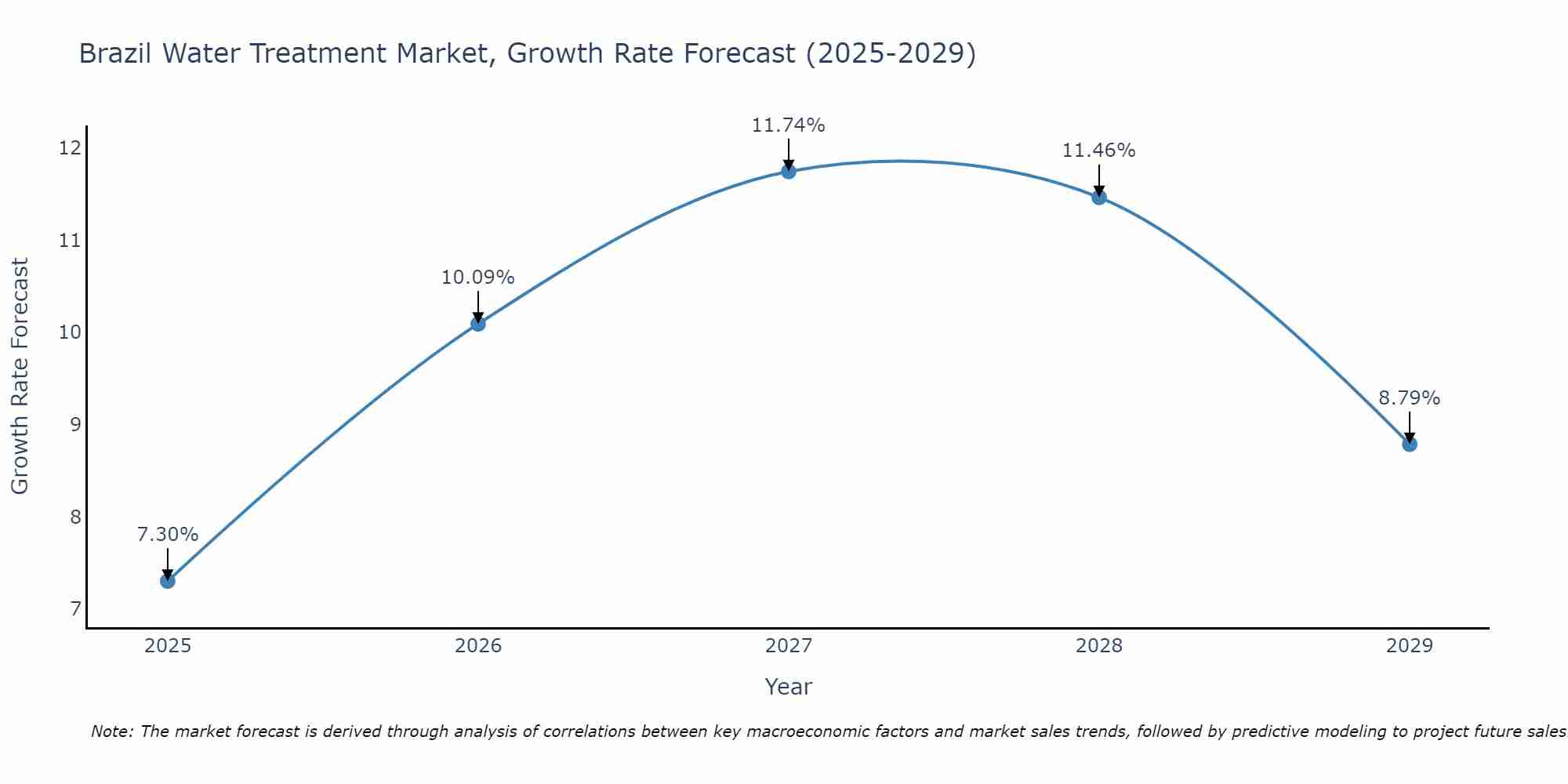
The Brazil Water Treatment Market is projected to witness mixed growth rate patterns during 2025 to 2029. The growth rate begins at 7.30% in 2025, climbs to a high of 11.74% in 2027, and moderates to 8.79% by 2029.
Brazil Water Treatment Market Synopsis
The Brazil water treatment market is expected to grow significantly in the forecast period between 2020 and 2026. This growth will be driven by increasing awareness about environmental protection, rising population, industrialization and urbanization, growing demand for safe drinking water from households and industry alike, government initiatives to improve wastewater management and treat sewage effectively. The growing prevalence of water-borne diseases has further emphasized the need for better access to clean drinking water as well as effective waste management solutions. Technological advancements including automated operations in existing plants are also driving sales of high-end equipment such as membrane systems, ultrafiltration units, reverse osmosis systems etc., which require skilled personnel to operate them properly thus lending support towards market development.
Major players operating in the Brazil Water Treatment Market include Veolia Environment S.A., Siemens AG (Veolia), DowDuPont Inc., Evoqua Water Technologies LLC (UQM Technologies Inc.), GE Renewable Energy (GE Power & Water), Hyflux Ltd., Kurita Water Industries Ltd., Pentair PLC, Suez SA, Xylem Inc.
Key Highlights of the Report:
- Brazil Water Treatment Market Outlook
- Market Size of Brazil Water Treatment Market, 2019
- Forecast of Brazil Water Treatment Market, 2026
- Historical Data and Forecast of Brazil Water Treatment Revenues & Volume for the Period 2016 - 2026
- Brazil Water Treatment Market Trend Evolution
- Brazil Water Treatment Market Drivers and Challenges
- Brazil Water Treatment Price Trends
- Brazil Water Treatment Porter's Five Forces
- Brazil Water Treatment Industry Life Cycle
- Historical Data and Forecast of Brazil Water Treatment Market Revenues & Volume By Types for the Period 2016 - 2026
- Historical Data and Forecast of Brazil Water Treatment Market Revenues & Volume By Distillation for the Period 2016 - 2026
- Historical Data and Forecast of Brazil Water Treatment Market Revenues & Volume By Filtration for the Period 2016 - 2026
- Historical Data and Forecast of Brazil Water Treatment Market Revenues & Volume By Disinfection for the Period 2016 - 2026
- Historical Data and Forecast of Brazil Water Treatment Market Revenues & Volume By Reverse Osmosis for the Period 2016 - 2026
- Historical Data and Forecast of Brazil Water Treatment Market Revenues & Volume By Applications for the Period 2016 - 2026
- Historical Data and Forecast of Brazil Water Treatment Market Revenues & Volume By Residential for the Period 2016 - 2026
- Historical Data and Forecast of Brazil Water Treatment Market Revenues & Volume By Non-Residential for the Period 2016 - 2026
- Historical Data and Forecast of Brazil Water Treatment Market Revenues & Volume By Installations for the Period 2016 - 2026
- Historical Data and Forecast of Brazil Water Treatment Market Revenues & Volume By Point Of Use for the Period 2016 - 2026
- Historical Data and Forecast of Brazil Water Treatment Market Revenues & Volume By Point Of Entry for the Period 2016 - 2026
- Brazil Water Treatment Import Export Trade Statistics
- Market Opportunity Assessment By Types
- Market Opportunity Assessment By Applications
- Market Opportunity Assessment By Installations
- Brazil Water Treatment Top Companies Market Share
- Brazil Water Treatment Competitive Benchmarking By Technical and Operational Parameters
- Brazil Water Treatment Company Profiles
- Brazil Water Treatment Key Strategic Recommendations






































