Peru Water Treatment Market Summary
The peru water treatment market was estimated at USD 304 Million in 2025 and is projected to reach USD 432 Million by 2032, growing at a CAGR of 6.3% from 2026 to 2032.
Peru Water Treatment Market Year-wise Growth Rate and Key Drivers
This graph highlights how the Peru Water Treatment Market has steadily grown over the past five years, supported by major growth factors.
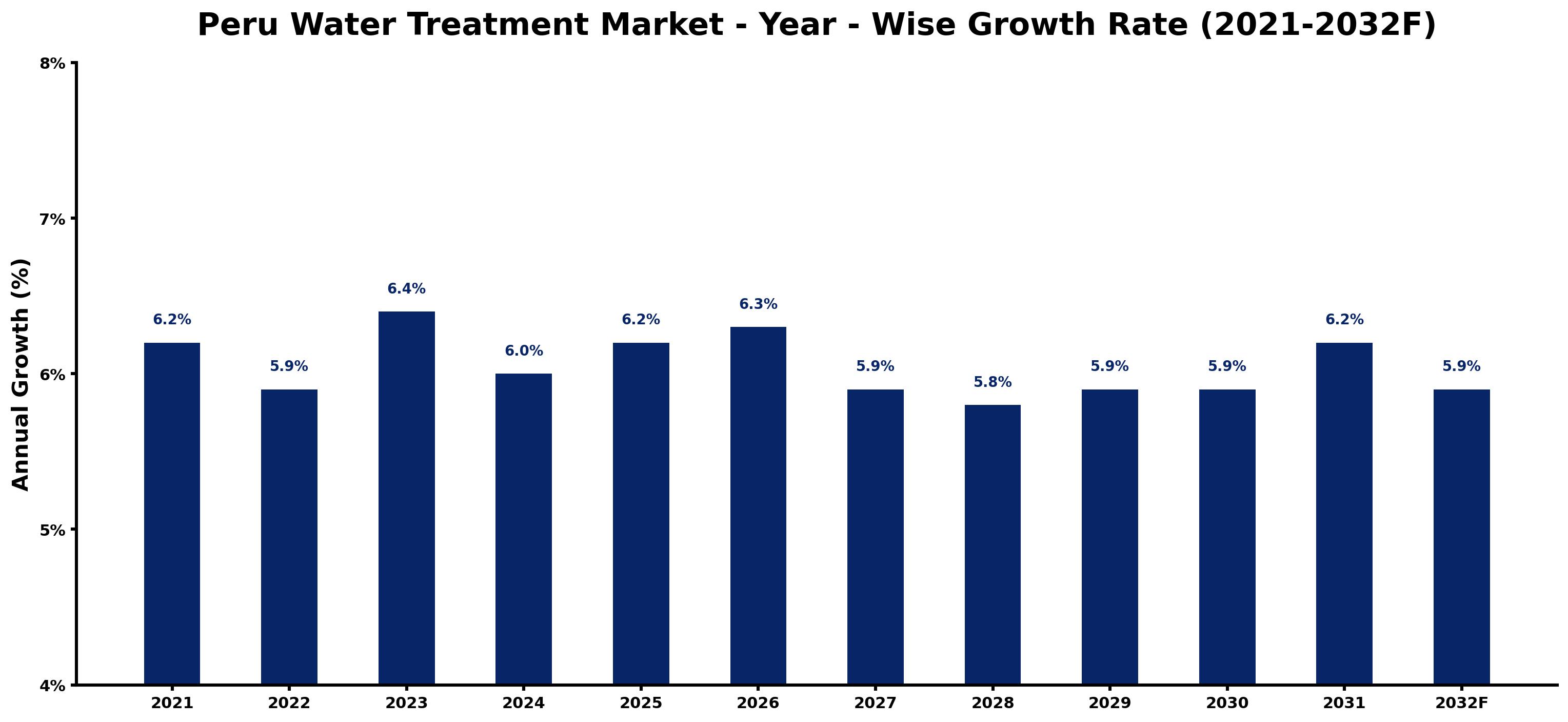
The table below presents the year wise growth rates along with the key drivers influencing the market
| Year | Growth Rate | Major Drivers |
| 2021 | 6.2% | Post-pandemic recovery led to increased investments in municipal water infrastructure projects. |
| 2022 | 5.9% | Consumer awareness about water quality spurred demand for innovative treatment technologies. |
| 2023 | 6.4% | Aging infrastructure issues prompted urgent repairs and upgrades in existing water systems. |
| 2024 | 6.0% | Emerging contamination concerns fueled the implementation of advanced filtration solutions. |
| 2025 | 6.2% | Private sector involvement in public-private partnerships reshaped the treatment landscape. |
| 2026 | 6.3% | Urban population growth intensified pressure on existing water supply and treatment facilities. |
| 2027 | 5.9% | Technological advancements in desalination made coastal water sources more viable for treatment. |
| 2028 | 5.8% | Investment in digital monitoring systems enhanced efficiency and reduced operational costs. |
| 2029 | 5.9% | Increasing climate variability drove interest in sustainable water management practices. |
| 2030 | 5.9% | Collaboration among local governments and NGOs improved resource allocation in rural areas. |
| 2031 | 6.2% | New standards for wastewater treatment emerged, pushing markets toward compliance and innovation. |
| 2032 | 5.9% | Consumer preference for green solutions accelerated the adoption of eco-friendly technologies. |
Note - Market size estimations and growth projections presented in this report are based on 6Wresearch's advanced forecasting approach, validated with industry datasets as of June 2026.
Peru Water Treatment Market Synopsis
The Peru Water Treatment Market is projected to reach 6.3% and witness significant growth during the forecast period (2026-2032). The market was valued at approximately USD 796 million in 2020, and it is anticipated to surge to USD 1,412 million by 2026, reflecting a compound annual growth rate (CAGR) of 9.6%. The surge in demand for treated and recycled water is largely driven by rapid urbanization and industrialization across the nation, necessitating enhanced water quality management solutions.
Peru Water Treatment Market Growth Drivers
Several key factors are influencing the growth trajectory of the Peru Water Treatment Market. These include:
- Increasing population density in urban areas has led to an escalated demand for potable water, highlighting the need for efficient water treatment technologies.
- A growing awareness of the health benefits associated with access to clean drinking water is driving consumers and businesses to prioritize water treatment solutions.
- Ongoing industrial activities necessitate effective wastewater management procedures, providing a substantial market for advanced treatment facilities.
- Government initiatives such as the National Plan for Reduction of Contamination and Losses (PNRCA) encourage sustainable resource usage, further propelling market growth.
- The availability of advanced technologies, particularly membrane filtration systems, has begun transforming the landscape of effective water treatment processes in Peru.
Peru Water Treatment Market Government Investment and Initiatives
Government investment and initiatives play a critical role in shaping the Peru Water Treatment Market. The government has increasingly recognized the importance of sustainable water management practices and has launched several initiatives aimed at improving water quality. Among these, the National Plan for Reduction of Contamination and Losses (PNRCA) stands out, as it emphasizes reducing pollution levels in water sources and promoting the efficient use of water resources.
Public spending on water infrastructure has seen a marked increase, with investments aimed at expanding access to clean water in rural and underserved urban areas. These investments are vital as a large segment of the population still lacks reliable access to potable water supplies. Additionally, the government collaborates with various international organizations to secure funding and expertise for water treatment projects, focusing on enhancing drinking water quality across diverse sectors.
Peru Water Treatment Market Trends and Opportunities
The trends in the Peru Water Treatment Market indicate a shift towards more innovative and sustainable solutions. One prominent trend is the increasing adoption of smart water management systems, which utilize real-time data analytics to optimize water treatment processes. This not only improves efficiency but also reduces operational costs.
There is also a noticeable trend towards the use of alternative energy sources in water treatment plants, promoting sustainability within the sector. These shifts present various opportunities for stakeholders to invest in modernized infrastructure and practices that align with global sustainability goals.
Peru Water Treatment Market Latest Developments (May 2025 - June 2026)
The period between May 2025 and June 2026 has seen significant developments in the Peru Water Treatment Market. Industry stakeholders have increasingly focused on transitioning towards more environmentally friendly treatment processes, aligning with global sustainability initiatives. This has led to investments in research and development aimed at creating efficient water treatment technologies that minimize environmental impact.
Collaborations between the public and private sectors have also intensified as they look to improve water infrastructure. These partnerships often leverage technological advancements to upgrade existing facilities, which is crucial for meeting the rising demand for treated water. Additionally, there has been a concerted effort to educate the public on the importance of water conservation and its impact on community health.
Peru Water Treatment Market - Key Attractiveness of the Report
- 10 Years of Market Numbers
- Historical Data Starting from 2022 to 2025
- Base Year: 2025
- Forecast Data until 2032
- Key Performance Indicators Impacting the Market
- Major Upcoming Developments and Projects
Key Highlights of the Report:
- Peru Water Treatment Market Outlook
- Market Size of Peru Water Treatment Market, 2025
- Forecast of Peru Water Treatment Market, 2032F
- Historical Data and Forecast of Peru Water Treatment Revenues & Volume for the Period 2022-2032F
- Peru Water Treatment Market Trend Evolution
- Peru Water Treatment Market Drivers and Challenges
- Peru Water Treatment Price Trends
- Peru Water Treatment Porter's Five Forces
- Peru Water Treatment Industry Life Cycle
- Historical Data and Forecast of Peru Water Treatment Market Revenues & Volume By Types for the Period 2022-2032F
- Historical Data and Forecast of Peru Water Treatment Market Revenues & Volume By Distillation? for the Period 2022-2032F
- Historical Data and Forecast of Peru Water Treatment Market Revenues & Volume By Filtration? for the Period 2022-2032F
- Historical Data and Forecast of Peru Water Treatment Market Revenues & Volume By Disinfection for the Period 2022-2032F
- Historical Data and Forecast of Peru Water Treatment Market Revenues & Volume By Reverse Osmosis for the Period 2022-2032F
- Historical Data and Forecast of Peru Water Treatment Market Revenues & Volume By Applications for the Period 2022-2032F
- Historical Data and Forecast of Peru Water Treatment Market Revenues & Volume By Residential? for the Period 2022-2032F
- Historical Data and Forecast of Peru Water Treatment Market Revenues & Volume By Non-Residential? for the Period 2022-2032F
- Historical Data and Forecast of Peru Water Treatment Market Revenues & Volume By Installations for the Period 2022-2032F
- Historical Data and Forecast of Peru Water Treatment Market Revenues & Volume By Point Of Use for the Period 2022-2032F
- Historical Data and Forecast of Peru Water Treatment Market Revenues & Volume By Point Of Entry for the Period 2022-2032F
- Peru Water Treatment Import Export Trade Statistics
- Market Opportunity Assessment By Types
- Market Opportunity Assessment By Applications
- Market Opportunity Assessment By Installations
- Peru Water Treatment Top Companies Market Share
- Peru Water Treatment Competitive Benchmarking By Technical and Operational Parameters
- Peru Water Treatment Company Profiles
- Peru Water Treatment Key Strategic Recommendations






































