Japan Water Treatment Market Size & Growth Rate
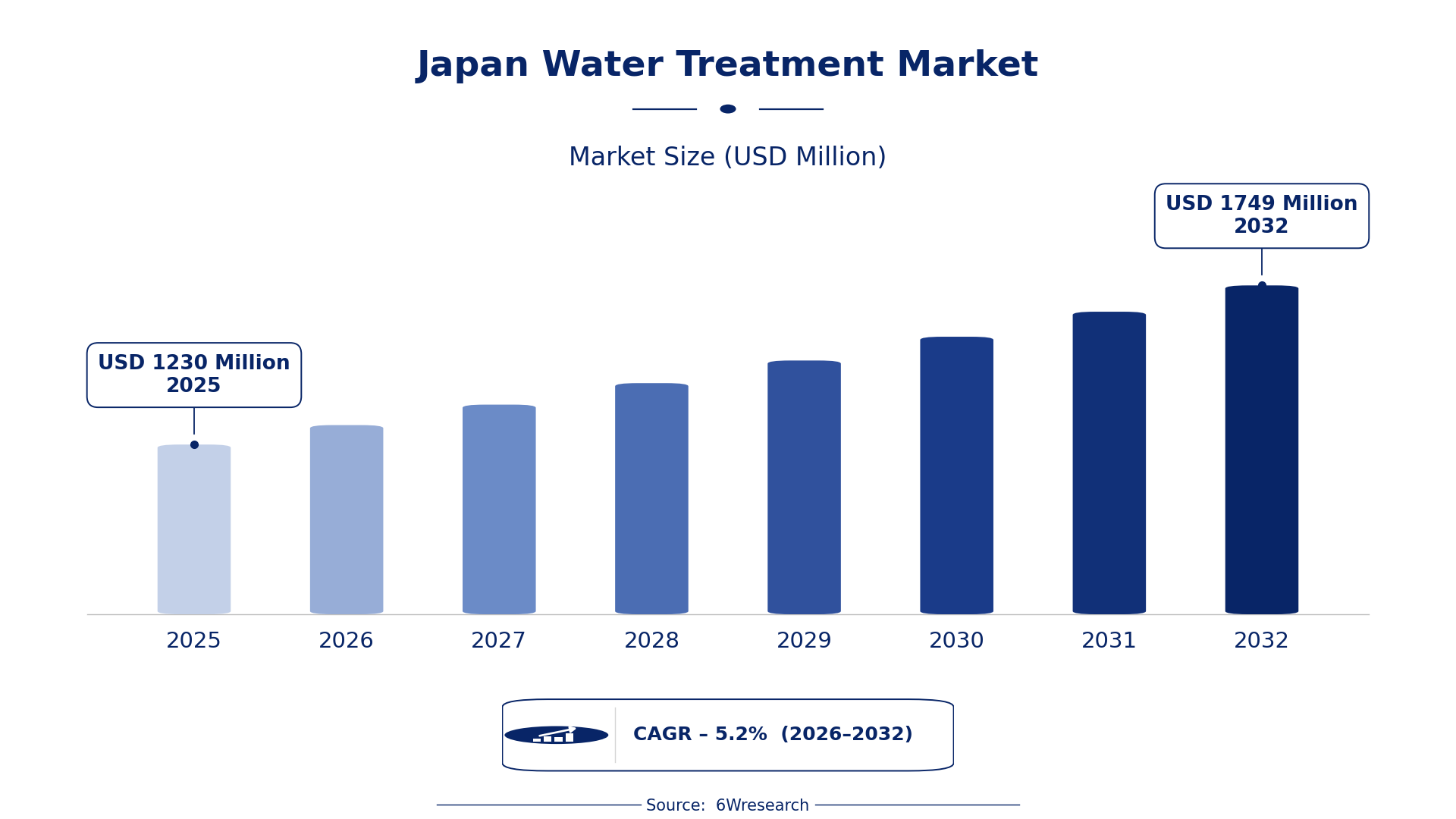
According to 6Wresearch internal database and industry insights, the Japan Water Treatment Market was valued at USD 1,230 Million in 2025 and is projected to reach USD 1,749 Million by 2032, growing at a CAGR of approximately 5.2% during 2026–2032.
Japan Water Treatment Market Highlights
| Report Metric | Details |
| Report Name | Japan Water Treatment Market (2026-2032) |
| Market Size 2025 | USD 1,230 Million |
| Market Size 2032 | USD 1,749 Million |
| Absolute Growth 2025–2032 | USD 519 Million |
| CAGR 2026–2032 | 5.2% |
| Peak Annual Growth | 6.0% in 2032 |
| Forecast Period | 2026–2032 |
| Historical Data | 2022–2025 |
| Base Year | 2025 |
| Leading Types, 2025 | Distillation (46% share) |
| Leading Applications, 2025 | Residential (67% share) |
| Leading Installations, 2025 | Point Of Use (55% share) |
| Fastest-Growing Types | Filtration (7.3% CAGR) |
| Fastest-Growing Applications | Non-Residential (6.8% CAGR) |
| Fastest-Growing Installations | Point Of Entry (6.6% CAGR) |
| Growing Sector | Residential water treatment |
| Key End Users | Residential users, municipal water supply systems, commercial facilities, industrial users |
Japan Water Treatment Market Year-wise Growth Rate and Key Drivers (2022–2032)
This graph illustrates the annual growth rates of the market from 2022 to 2032, highlighting a steady upward trajectory and projected market expansion over the forecast period.
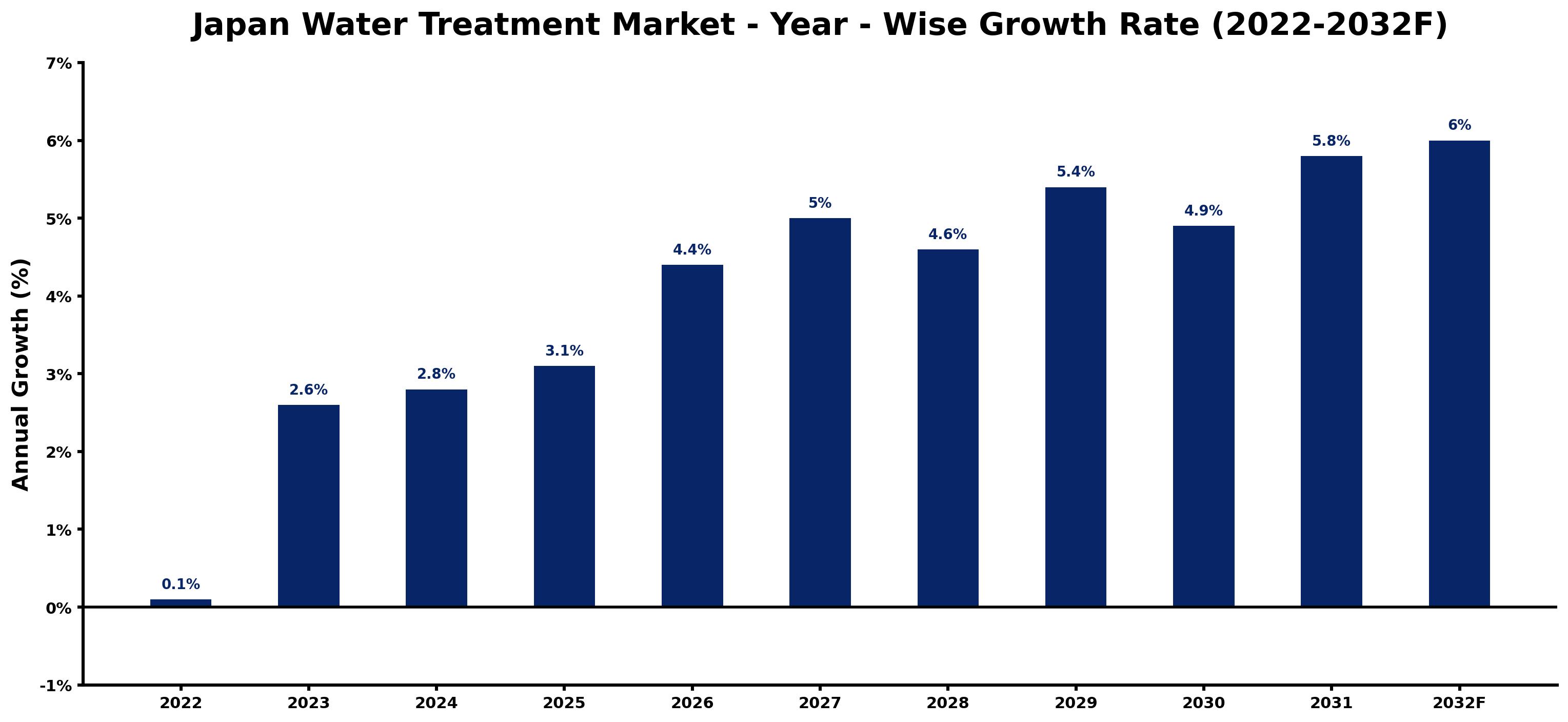
Year by year, the estimates below pair each growth rate with the development that shaped it.
| Year | Estimated Annual Growth (%) | Market Rationale |
| 2022 | 0.1 | The market showed minimal growth due to stable demand from existing water treatment facilities. |
| 2023 | 2.6 | Growth accelerated as urban areas increased investments in water purification technologies. |
| 2024 | 2.8 | Continued urbanisation and rising health awareness contributed to faster growth rates. |
| 2025 | 3.1 | The market reached its historical peak as residential demand for filtration systems surged. |
| 2026 | 4.4 | Demand is expected to rise as the government invests in upgrading infrastructure. |
| 2027 | 5.0 | Increased adoption of reverse osmosis systems in urban households will drive growth. |
| 2028 | 4.6 | Growth is expected to slow as market saturation in urban areas begins to impact new installations. |
| 2029 | 5.4 | The introduction of new disinfection technologies is projected to fuel renewed interest in water treatment. |
| 2030 | 4.9 | Growth is expected to slow again as competition intensifies among service providers in urban markets. |
| 2031 | 5.8 | Demand for residential systems is projected to rise as households seek improved water quality. |
| 2032 | 6.0 | The market is expected to peak as investments in sustainable water practices gain momentum. |
Note: Market size estimations and growth projections presented in this report are based on 6Wresearch's proprietary forecasting methodology, utilizing the latest available industry data, government publications, and primary research inputs.
Japan Water Treatment Market Synopsis
Water treatment encompasses processes such as filtration, disinfection, and reverse osmosis to ensure safe drinking water. The main buyers include residential users and municipal water supply systems. The Japan Water Treatment Market is expanding due to increased urbanisation, rising health awareness, and government investments in infrastructure upgrades. In 2023, funding was allocated for improving water quality monitoring, further driving demand for advanced treatment solutions and innovative technologies.
Market Dynamics Impact Analysis (2026–2032)
| Factor | Type | Impact | Primary Segment Affected |
| Increasing urbanisation leading to higher demand for residential water purification systems | Driver | High | Filtration |
| Government investments in upgrading aging water infrastructure | Driver | High | Disinfection |
| Growing interest in sustainable water practices among consumers | Opportunity | High | Reverse Osmosis |
| Rising health consciousness driving demand for safe drinking water | Opportunity | High | Point Of Use |
| High initial costs of advanced water treatment systems | Restraint | Medium | Filtration |
| Limited awareness of new technologies among consumers | Restraint | Medium | Disinfection |
| Competition among service providers leading to price wars | Challenge | High | Residential |
| Regulatory compliance costs for new installations | Challenge | Medium | Non-Residential |
Evaluation of Drivers in Japan Water Treatment Market (2026–2032)
The following drivers explain most of the expected growth.
| Drivers | Primary Segment Affected | Why It Matters (Evidence) |
| Rising urban population density | Filtration | As urban areas grow, the demand for efficient filtration systems increases to ensure safe drinking water. |
| Government funding for infrastructure upgrades | Disinfection | Recent allocations for water quality monitoring create a need for advanced disinfection methods. |
| Increased adoption of reverse osmosis | Reverse Osmosis | Urban households are increasingly installing reverse osmosis systems for effective water purification. |
| Health awareness campaigns | Point Of Use | Public health initiatives encourage consumers to invest in home water purification systems. |
| Technological advancements in water treatment | Disinfection | Innovations in disinfection technologies are driving demand for modern treatment solutions. |
Behind the steady rise in orders sits the increasing urban population density, which has led to a demand for efficient filtration systems, particularly in metropolitan areas. The adoption of reverse osmosis systems is rising as urban households seek effective purification solutions. Public health campaigns have influenced consumer behaviour, prompting investments in home water purification systems. Innovations in disinfection methods are driving demand, as consumers prefer modern solutions to ensure safe drinking water.
Evaluation of Restraints in Japan Water Treatment Market
Several factors work against faster growth; the main ones are summarised below.
| Market Restraint | Primary Segment Affected | Why It Matters (Evidence) |
| High initial costs of advanced filtration systems | Filtration | The expense of installing modern filtration systems can deter some residential users from upgrading. |
| Limited consumer awareness of new disinfection technologies | Disinfection | Many consumers lack knowledge about the benefits of newer disinfection methods, impacting adoption rates. |
| Regulatory compliance costs for new installations | Non-Residential | Businesses incur substantial costs to meet regulatory standards when installing new systems. |
| Market saturation in urban areas | Point Of Use | As urban markets become saturated, opportunities for new installations diminish. |
| Intense competition among service providers | Residential | Competition can lead to reduced profit margins and service quality, affecting providers' revenues. |
Japan Water Treatment Market Challenges
High competition among water treatment providers drives down prices, forcing suppliers to cut costs and impacting their profitability. This situation exists due to the large number of players in Japan, resulting in reduced revenues for producers. Technological advancements require continuous investment, which can delay project timelines for municipalities upgrading their systems. In 2023, the government allocated funds for infrastructure upgrades, but these projects can take years to complete, impacting service delivery for clinics. Supply chain disruptions can delay critical component deliveries, resulting in extended downtimes for hospitals relying on timely water treatment. Skills shortages in technical fields limit service providers' capacity to meet rising demand, causing potential service gaps for buyers seeking reliable solutions.
Trends in the Japan Water Treatment Market
The following changes are redrawing the Japan Water Treatment Market.
- Shift towards Advanced Filtration Technologies: The 2023 International Water Conference highlighted the shift towards advanced filtration technologies, with 30% of participants indicating plans to upgrade existing systems. This trend reflects a growing commitment to improving water quality standards.
- Transition from Traditional to UV Disinfection: Since 2023, there has been a notable transition from traditional disinfection methods to UV technology, with urban facilities reporting a 25% increase in UV system installations. This shift improves water safety and efficiency.
- Emergence of Smart Water Treatment Systems: Residential users are increasingly adopting smart water treatment systems, with 40% of new installations in urban areas featuring smart technology. This trend indicates a move towards more efficient and user-friendly solutions.
- Increased Focus on Sustainable Practices: The GX Basic Policy adopted in 2023 aims for JPY 150 trillion in public-private decarbonisation investment, promoting sustainable water treatment practices. This focus is reshaping the market.
Investment Opportunities in the Japan Water Treatment Market
Several openings in the Japan Water Treatment Market merit attention from investors.
- Partner with Local Authorities for Infrastructure Projects: Local governments are seeking partnerships for infrastructure upgrades, with JPY 50 billion allocated in 2023. Collaborating with municipal water supply systems can provide market access.
- Supply Advanced Water Treatment Systems to Urban Areas: Urban households are increasingly investing in advanced water treatment systems, with a projected 15% growth in demand. Suppliers can tap into this trend by offering effective solutions.
- Invest in Smart Water Treatment Technologies: The rise of smart water treatment systems presents opportunities for technology providers, particularly in urban centres. Entering this market through local partnerships can enhance competitiveness.
- Expand Point Of Use Solutions in Residential Markets: The growing popularity of Point Of Use systems in urban households, which account for 55% of new installations, offers an opportunity for suppliers to meet rising demand.
Government Initiatives in the Japan Water Treatment Market
The GX Basic Policy, adopted in 2023, aims to drive public-private decarbonisation investment of about JPY 150 trillion over the next decade. This measure builds on the Water Supply Act and Sewerage Act, which set standards for drinking-water quality and wastewater treatment, ensuring that water treatment providers align with modern sustainability goals.
The Ministry of Health, Labour and Welfare oversees the implementation of water quality regulations and funds initiatives to improve monitoring systems. In 2023, the ministry allocated JPY 10 billion for upgrading infrastructure, benefiting both producers and consumers by improving water safety standards.
Future Insight of the Japan Water Treatment Market
Investment in water treatment infrastructure will create substantial demand for advanced technologies by 2032, benefiting both buyers and suppliers. The government's commitment to upgrading aging systems will improve service delivery and water quality for consumers. New standards will emerge as the target to reduce water wastage by 20% by 2030 drives innovation. The growing adoption of UV disinfection technology will enhance safety in both commercial and residential sectors, providing buyers with more reliable systems. The average cost of residential water treatment systems will evolve, prompting suppliers to develop more durable solutions.
Market Segmentation Analysis
Japan Water Treatment Market report covers a detailed analysis of the following market segments:
By Types – Distillation Leads, Filtration Expected to Grow Fastest
According to Shubham Padhi, Research Analyst at 6Wresearch, the largest types category in 2025 was Distillation, at 46% of revenue. Distillation holds the largest share in Japan owing to its essential application in industries such as pharmaceuticals that demand high-purity water. This method is specifically employed in sectors where water quality is critical, ensuring adherence to stringent industry standards. Filtration is set to record the highest CAGR in this split, 7.3% over 2026–2032. Filtration is witnessing rapid growth as urban households increasingly seek effective solutions for improving water quality. The rising awareness of contaminants in drinking water is particularly propelling this trend in densely populated regions. Suppliers should focus on enhancing filtration technologies to meet the growing demands of residential consumers.
By Applications – Residential Leads, Non-Residential Expected to Grow Fastest
In 2025, Residential led the applications split with a 67% share. The residential segment leads the market as households necessitate dependable water purification systems for their daily needs. With an average household water consumption of 280 litres per day, the demand for efficient treatment solutions is critical. The quickest growth will come from Non-Residential, forecast to expand at a CAGR of 6.8% between 2026 and 2032. Non-residential applications are expanding swiftly, propelled by the rising demand for water treatment in commercial and industrial environments. This growth is particularly noticeable as businesses strive to meet rigorous water quality standards. Buyers in the non-residential sector should invest in modern water treatment solutions to ensure regulatory compliance and operational efficiency.
By Installations – Point Of Use Leads, Point Of Entry Expected to Grow Fastest
With 55% of installations revenue in 2025, Point Of Use was the largest category. Point of use systems lead the market as they are widely adopted in homes and offices for efficient water purification. Their prevalence is largely attributed to space limitations in urban environments, making them an ideal choice for many users. Over 2026–2032, Point Of Entry is expected to post the fastest growth, at a CAGR of 6.6%. Point of entry systems are growing quickly, particularly in larger setups that require comprehensive water treatment solutions. This trend highlights a movement towards integrated systems that enhance water quality from the source. Suppliers should consider developing point of entry solutions designed for larger facilities to capitalise on this expanding market.
Key Attractiveness of the Report
- 10 Years of Market Numbers
- Historical Data Starting from 2022 to 2025
- Base Year 2025
- Forecast Data until 2032
- Key Performance Indicators Impacting the Market
- Major Upcoming Developments and Projects
Key Highlights of the Report:
- Japan Water Treatment Market Outlook
- Market Size of Japan Water Treatment Market, 2025
- Forecast of Japan Water Treatment Market, 2032
- Historical Data and Forecast of Japan Water Treatment Revenues & Volume for the Period 2022-2032
- Japan Water Treatment Market Trend Evolution
- Japan Water Treatment Market Drivers and Challenges
- Japan Water Treatment Price Trends
- Japan Water Treatment Porter's Five Forces
- Japan Water Treatment Industry Life Cycle
- Historical Data and Forecast of Japan Water Treatment Market Revenues & Volume By Types for the Period 2022-2032
- Historical Data and Forecast of Japan Water Treatment Market Revenues & Volume By Distillation for the Period 2022-2032
- Historical Data and Forecast of Japan Water Treatment Market Revenues & Volume By Filtration for the Period 2022-2032
- Historical Data and Forecast of Japan Water Treatment Market Revenues & Volume By Disinfection for the Period 2022-2032
- Historical Data and Forecast of Japan Water Treatment Market Revenues & Volume By Reverse Osmosis for the Period 2022-2032
- Historical Data and Forecast of Japan Water Treatment Market Revenues & Volume By Applications for the Period 2022-2032
- Historical Data and Forecast of Japan Water Treatment Market Revenues & Volume By Residential for the Period 2022-2032
- Historical Data and Forecast of Japan Water Treatment Market Revenues & Volume By Non-Residential for the Period 2022-2032
- Historical Data and Forecast of Japan Water Treatment Market Revenues & Volume By Installations for the Period 2022-2032
- Historical Data and Forecast of Japan Water Treatment Market Revenues & Volume By Point Of Use for the Period 2022-2032
- Historical Data and Forecast of Japan Water Treatment Market Revenues & Volume By Point Of Entry for the Period 2022-2032
- Japan Water Treatment Import Export Trade Statistics
- Market Opportunity Assessment By Types
- Market Opportunity Assessment By Applications
- Market Opportunity Assessment By Installations
- Japan Water Treatment Top Companies Market Share
- Japan Water Treatment Competitive Benchmarking By Technical and Operational Parameters
- Japan Water Treatment Company Profiles
- Japan Water Treatment Key Strategic Recommendations
Market Covered
The study includes the following segmentation.
By Types
- Distillation
- Filtration
- Disinfection
- Reverse Osmosis
By Applications
- Residential
- Non-Residential
By Installations
- Point Of Use
- Point Of Entry






































