Thailand Water Treatment Market Growth Rate
According to 6Wresearch internal database and industry insights, the Thailand Water Treatment Market is projected to grow at a compound annual growth rate (CAGR) of 8.2% during the forecast period (2026–2032).
Thailand Water Treatment Market Year-wise Growth Rate and Key Drivers
This graph highlights how the Thailand Water Treatment Market has steadily grown over the past five years, supported by major growth factors.
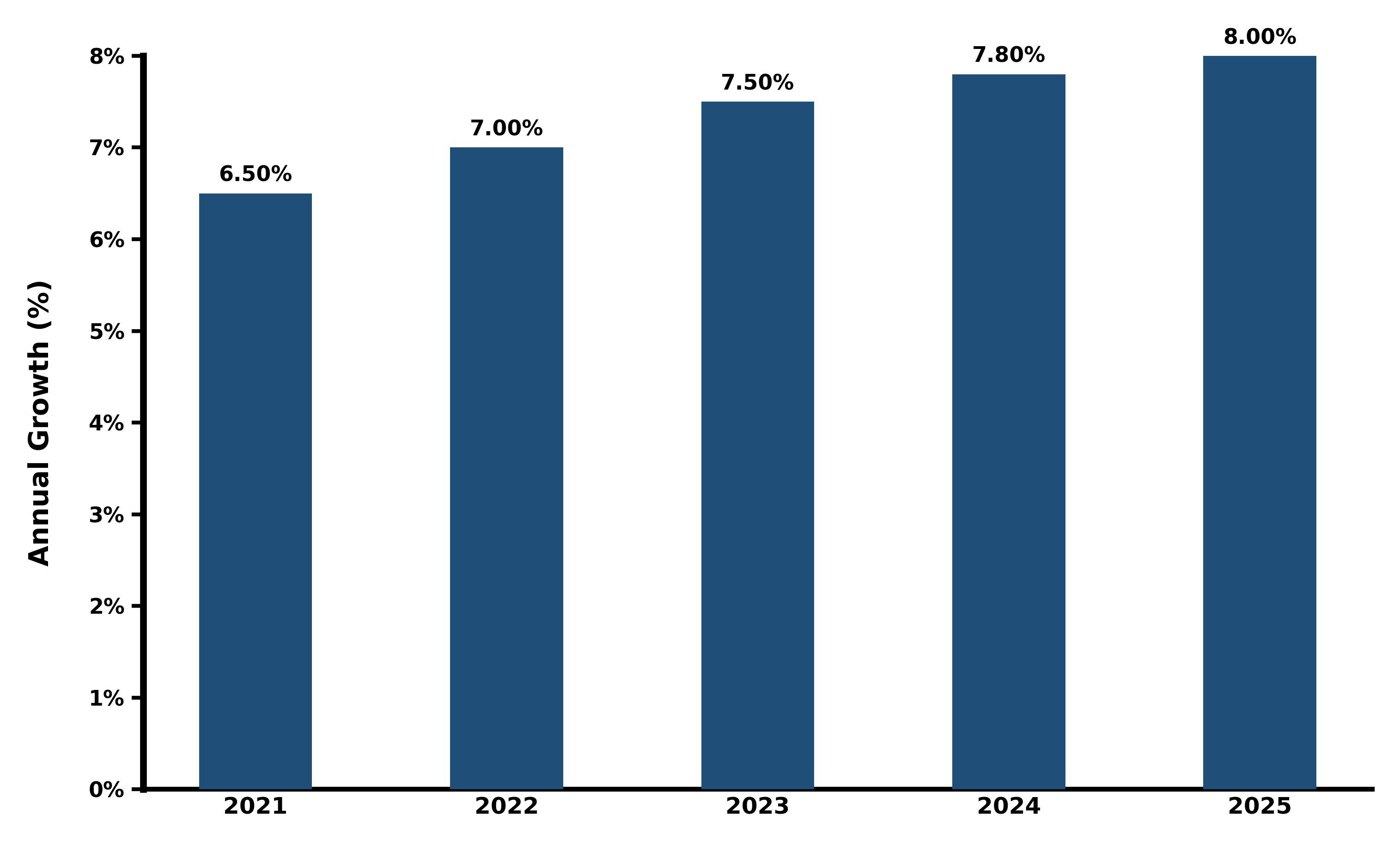
The table below presents the year‑wise growth rates along with the key drivers influencing the market
| Years | Estimated Annual Growth (%) | Growth Drivers |
| 2021 | 6.5% | Increased awareness of water pollution and the need for safe water. |
| 2022 | 7% | Growing demand for high-quality drinking water solutions. |
| 2023 | 7.5% | A rise in the expansion of infrastructure for water purification. |
| 2024 | 7.8% | Technological upgrades and the adoption of reverse osmosis and filtration systems. |
| 2025 | 8% | An increase in the demand from residential and non-residential sectors for sustainable water solutions. |
Topics Covered in the Thailand Water Treatment Market Report
The Thailand Water Treatment Market report thoroughly covers the market by Types, Applications, and Installations. The report provides detailed analysis of ongoing market trends, opportunities, high-growth areas, and market drivers that will help stakeholders devise and align strategies according to current and future market dynamics.
Thailand Water Treatment Market Highlights
| Report Name | Thailand Water Treatment Market |
| Forecast period | 2026–2032 |
| CAGR | 8.2% |
| Growing Sector | Water Treatment Solutions |
Thailand Water Treatment Market Synopsis
The Thailand Water Treatment Market growth is estimated to surge in the coming years as this growth is driven by rising water contamination concerns among population and stricter environmental regulations. Other drivers that are supporting this growth include growing demand from both residential and commercial sectors for clean and safe drinking water and the increased focus on sustainable water management solutions. Technological advancements in filtration, reverse osmosis, and disinfection processes are helping meet the demand for high-quality water treatment solutions.
Evaluation of Growth Drivers in the Thailand Water Treatment Market
Below mentioned are some prominent drivers and their influence on market dynamics:
| Drivers | Primary Segments Affected | Why it Matters |
| Urbanization and Population Growth | By Applications (Residential, Non-Residential) | Increasing urban populations increase demand for residential and industrial water solutions. |
| Environmental Regulations | By Types (Filtration, Reverse Osmosis, Disinfection) | Advanced treatment technologies are being adopted with stricter water quality standards. |
| Infrastructure Expansion | By Installations (Point of Use, Point of Entry) | Increased demand for modernized water infrastructure to meet growing needs. |
| Technology Advancements | By Types (Reverse Osmosis, Distillation) | There are innovations in filtration and RO systems, which improve water quality and efficiency. |
| Health and Safety Consciousness | By Applications (Residential) | Consumers are more conscious of water quality, fueling the demand for home water treatment. |
The Thailand Water Treatment Market is projected to grow at a CAGR of 8.2% during the forecast period (2026–2032). Here are some important factors that boost this growth: increasing awareness of having good-quality water, advancements in water purification technologies, and a growing demand for clean water solutions across various sectors, such as residential, commercial, and industrial. There are also rising concerns regarding water contamination, as well as a strong focus on sustainable water management, which is estimated to propel the Thailand Water Treatment Market growth.
Evaluation of Restraints in the Thailand Water Treatment Market
Below mentioned are some prominent restraints and their impact on the market dynamics:
| Challenges | Primary Segments Affected | Why it Matters |
| High Initial Investment Costs | By Installations (Point of Use, Point of Entry) | The capital-intensive nature of installing advanced water treatment systems may deter adoption. |
| Price Sensitivity | By Applications (Residential, Non-Residential) | Consumers who are price-sensitive may hesitate to adopt high-cost water treatment solutions. |
| Infrastructure Gaps in Rural Areas | By Installations (Point of Use, Point of Entry) | Due to limited infrastructure in rural areas, there can be a restriction in deploying advanced water treatment technologies. |
| Maintenance and Operational Costs | By Types (Reverse Osmosis, Filtration, Distillation) | High maintenance costs associated with advanced water treatment technologies can be a barrier for residential users and businesses. |
| Regulatory Compliance Costs | By Types (Reverse Osmosis, Disinfection, Filtration) | Stringent regulations for product safety and environmental compliance may increase manufacturing. |
Thailand Water Treatment Market Challenges
On the other side, the Thailand Water Treatment Market deals with numerous challenges that need to be addressed. These challenges include high initial investment costs and limited awareness that having quality water is important in rural areas. Price sensitivity among consumers restricts the adoption of high-cost water treatment solutions, which may affect the market growth. Overcoming these threats will require affordable, cost-efficient solutions and greater education about the importance of water treatment, particularly in underserved regions.
Thailand Water Treatment Market Trends
Below are some major trends that are influencing the growth of the Thailand Water Treatment Market:
- Rise in Demand for Sustainable Water Solutions: Consumers and businesses are increasingly looking for environmentally friendly water treatment solutions, which focus on more energy-efficient technologies.
- Growth in E-commerce for Water Treatment Products: With the rise of online retail platforms, consumers can easily access a wide range of water treatment products, from point-of-use systems to whole-house filtration units.
- Smart Water Treatment Solutions: There is a rising integration of IoT technology and real-time monitoring in water treatment systems, which allows for more efficient management, maintenance, and quality control of water treatment processes.
Investment Opportunities in the Thailand Water Treatment Market
Below mentioned are some key investment opportunities:
- Product Innovation: There is significant potential for making investment in the introduction of new and improved water treatment technologies, like advanced filtration systems, reverse osmosis (RO) units, and smart water management solutions, that cater to the increasing demand for clean and safe water.
- Expansion of Distribution Channels: There is an increasing investment in the expansion of retail and online distribution networks, which can increase the availability of water treatment systems across both urban and rural areas.
- Rural Water Treatment Solutions: Increasing need for clean water in rural regions, there is a growing opportunity to introduce affordable and effective water treatment solutions that are specifically tailored for rural communities.
Top 5 Leading Players in the Thailand Water Treatment Market
Here is a list of prominent players leading the Thailand Water Treatment Market:
1. ITT Thailand Company Limited
| Company Name | ITT Thailand Company Limited |
| Established Year | 1949 |
| Headquarters | Bangkok, Thailand |
| Official Website | Click Here |
ITT Thailand offers a comprehensive range of water treatment solutions, including filtration systems and industrial water management technologies, catering to both residential and industrial sectors.
2. Siemens Limited Thailand
| Company Name | Siemens Limited Thailand |
| Established Year | 1892 |
| Headquarters | Bangkok, Thailand |
| Official Website | Click Here |
Siemens provides innovative water treatment technologies, focusing on automation, smart water management, and energy-efficient solutions for municipal and industrial water treatment.
3. Veolia Thailand
| Company Name | Veolia Thailand |
| Established Year | 1853 |
| Headquarters | Bangkok, Thailand |
| Official Website | Click Here |
Veolia offers water treatment, wastewater management, and waste management solutions, focusing on sustainability and efficiency in water usage across industries and municipalities.
4. Pentair Thailand
| Company Name | Pentair Thailand |
| Established Year | 1966 |
| Headquarters | Bangkok, Thailand |
| Official Website | Click Here |
Pentair specializes in water filtration, purification, and treatment systems for residential, commercial, and industrial applications, with a focus on sustainable and clean water solutions.
5. Kurita Water Industries Ltd.
| Company Name | Kurita Water Industries Ltd. |
| Established Year | 1949 |
| Headquarters | Bangkok, Thailand |
| Official Website | - |
Kurita provides water treatment chemicals, equipment, and maintenance services for industrial applications, with expertise in creating solutions that enhance water quality and efficiency.
Government Ruless Introduced in the Thailand Water Treatment Market
As per Thailand government data, some key regulations are introduced that are aimed at ensuring water quality and environmental protection. Such key example is the National Environmental Quality Act (NEQA) mandates standards for surface water, groundwater, and wastewater discharge, which need industries to adopt appropriate treatment technologies to prevent contamination. Besides that, Thailand imposes effluent standards for industrial wastewater, which define allowable limits for contaminants like suspended solids, BOD, and heavy metals, driving industries to implement advanced water treatment solutions.
Future Insights of the Thailand Water Treatment Market
The Thailand Water Treatment Market share is estimated to increase in the coming years, which is driven by some major trends and factors. Such as regulatory focus on water quality and wastewater management and the growing public awareness around health, safety, and environmental sustainability. Along with these, here are some other major drivers that will boost the demand for advanced treatment solutions across industries and municipalities include rapid urbanization and infrastructure development, like upgrading aging water networks in the country.
Market Segmentation Analysis
The report offers a comprehensive study of the following market segments and their leading categories:
By Types – Filtration and Reverse Osmosis to Lead the Market
According to Harshita, Senior Research Analyst, 6Wresearch, Filtration and reverse osmosis are the leading treatment types, driven by their ability to effectively remove contaminants and provide clean, safe water for both residential and commercial use.
By Applications – Residential and Non-Residential Water Treatment
Both residential and non-residential sectors are driving market growth, with residential customers seeking high-quality drinking water solutions and non-residential sectors focusing on compliance and operational efficiency.
By Installations – Point of Use and Point of Entry to Lead the Market
Point of Use systems are leading in the residential sector due to their convenience and affordability, while Point of Entry systems are more commonly used in larger facilities and commercial buildings to treat all water entering the premises.
Key attractiveness of the Report
- 10 Years Market Numbers.
- Historical Data Starting from 2022 to 2025.
- Base Year: 2025.
- Forecast Data until 2032.
- Key Performance Indicators Impacting the Market.
- Major Upcoming Developments and Projects.
Key Highlights of the Report:
- Thailand Water Treatment Market Outlook
- Market Size of Thailand Water Treatment Market, 2025
- Forecast of Thailand Water Treatment Market, 2032
- Historical Data and Forecast of Thailand Water Treatment Revenues & Volume for the Period 2022 - 2032
- Thailand Water Treatment Market Trend Evolution
- Thailand Water Treatment Market Drivers and Challenges
- Thailand Water Treatment Price Trends
- Thailand Water Treatment Porter's Five Forces
- Thailand Water Treatment Industry Life Cycle
- Historical Data and Forecast of Thailand Water Treatment Market Revenues & Volume By Types for the Period 2022 - 2032
- Historical Data and Forecast of Thailand Water Treatment Market Revenues & Volume By Distillation? for the Period 2022 - 2032
- Historical Data and Forecast of Thailand Water Treatment Market Revenues & Volume By Filtration? for the Period 2022 - 2032
- Historical Data and Forecast of Thailand Water Treatment Market Revenues & Volume By Disinfection for the Period 2022 - 2032
- Historical Data and Forecast of Thailand Water Treatment Market Revenues & Volume By Reverse Osmosis for the Period 2022 - 2032
- Historical Data and Forecast of Thailand Water Treatment Market Revenues & Volume By Applications for the Period 2022 - 2032
- Historical Data and Forecast of Thailand Water Treatment Market Revenues & Volume By Residential? for the Period 2022 - 2032
- Historical Data and Forecast of Thailand Water Treatment Market Revenues & Volume By Non-Residential? for the Period 2022 - 2032
- Historical Data and Forecast of Thailand Water Treatment Market Revenues & Volume By Installations for the Period 2022 - 2032
- Historical Data and Forecast of Thailand Water Treatment Market Revenues & Volume By Point Of Use for the Period 2022 - 2032
- Historical Data and Forecast of Thailand Water Treatment Market Revenues & Volume By Point Of Entry for the Period 2022 - 2032
- Thailand Water Treatment Import Export Trade Statistics
- Market Opportunity Assessment By Types
- Market Opportunity Assessment By Applications
- Market Opportunity Assessment By Installations
- Thailand Water Treatment Top Companies Market Share
- Thailand Water Treatment Competitive Benchmarking By Technical and Operational Parameters
- Thailand Water Treatment Company Profiles
- Thailand Water Treatment Key Strategic Recommendations
Markets Covered
The report offers a comprehensive study of the following market segments:
By Types
- Distillation
- Filtration
- Disinfection
- Reverse Osmosis
By Applications
- Residential
- Non-Residential
By Installations
- Point Of Use
- Point Of Entry






































