Brazil Wooden Toys Market Size, Share & Growth Rate
The Brazil Wooden Toys Market was estimated at USD 215 Million in 2025 and is projected to reach USD 256 Million by 2032, growing at a CAGR of 2.5% from 2026 to 2032. This growth trajectory is primarily driven by an increasing preference for sustainable products among parents and caregivers who prioritize eco-friendly toys. Moreover, the heightened awareness of the adverse environmental effects of plastic toys is prompting a shift towards natural materials, which enhances the appeal of wooden toys in the Brazilian market.
Brazil Wooden Toys Market Year-wise Growth Rate and Key Drivers
This graph highlights how the Brazil Wooden Toys Market has steadily grown over the years, supported by major growth factors.
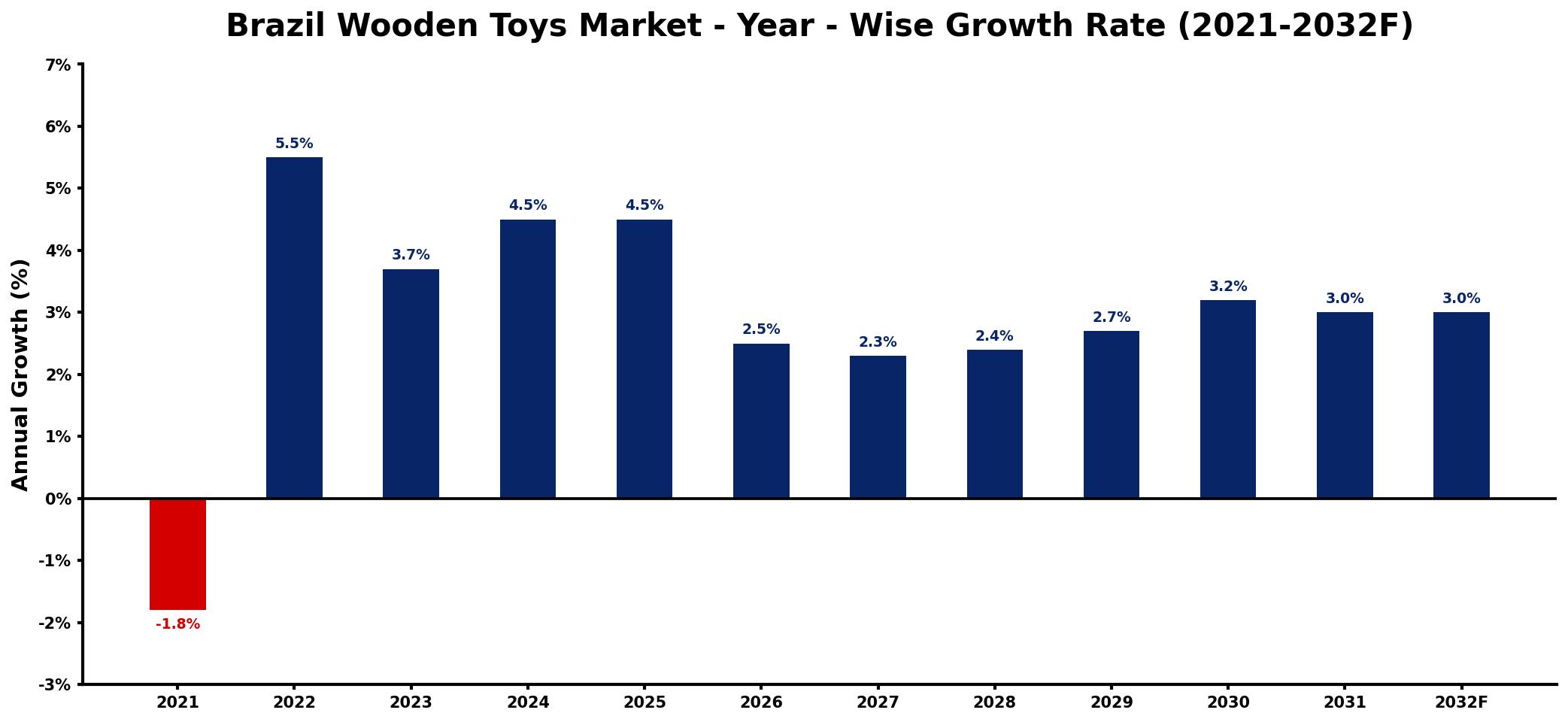
The table below presents the year‑wise growth rates along with the key drivers influencing the market
| Year | Growth Rate | Major Drivers |
| 2021 | -1.8% | Shifts in consumer spending patterns |
| 2022 | 5.5% | Growth in eco-friendly product demand |
| 2023 | 3.7% | Expansion of online retail channels |
| 2024 | 4.5% | Increase in sustainable manufacturing practices |
| 2025 | 4.5% | Rise in family-oriented activities |
| 2026 | 2.5% | Boost in educational product investments |
| 2027 | 2.3% | Growing interest in artisanal craftsmanship |
| 2028 | 2.4% | improved raw material availability |
| 2029 | 2.7% | enhanced product quality standards |
| 2030 | 3.2% | Surge in parental investment trends |
| 2031 | 3.0% | improved processing technologies adoption |
| 2032 | 3.0% | growing downstream application demand |
Note: Market size estimations and growth projections presented in this report are based on 6Wresearch's proprietary forecasting methodology, utilizing the latest available industry data, government publications, and primary research inputs.
Brazil Wooden Toys Market Synopsis
In recent years, the Brazil Wooden Toys Market has gained momentum due to an expanding consumer base that values sustainability and child development. However, as the market evolves, it faces competition from electronic and plastic alternatives that may detract from wooden toys' share. As manufacturers continue to innovate and respond to eco-conscious trends, the outlook remains positive.
The market's future is increasingly focused on enhancing educational value while ensuring safety standards are met. As regulations around toy safety become more stringent, manufacturers are likely to invest more in quality production processes. This, in turn, positions the wooden toys sector favorably as a unique alternative to conventional toy offerings.
Brazil Wooden Toys Market Key Takeaways
- The market for wooden toys in Brazil is experiencing growth driven by consumer preference for sustainable and eco-friendly products.
- Heightened awareness regarding the environmental impact of plastic toys is boosting demand for high-quality wooden options.
- Challenges from electronic and plastic toys necessitate a focus on safety and educational value in product offerings.
- Government policies supporting safety regulations in toy manufacturing are likely to enhance market growth.
- Emerging trends such as personalization and artisanal craftsmanship are expected to further stimulate the market.
Evaluation of Restraints in Brazil Wooden Toys Market
Despite its growth potential, the Brazil Wooden Toys Market faces several restraints that could limit its expansion. The most significant challenge comes from the pervasive popularity of electronic and plastic toys, which often overshadow the traditional appeal of wooden products. Additionally, economic fluctuations affecting disposable income can deter consumers from purchasing non-essential items, such as toys. Manufacturers must also continually address safety concerns associated with wooden toys, ensuring that they meet the latest regulatory standards to compete effectively.
Brazil Wooden Toys Market Trends
Several current and emerging trends are shaping the Brazil Wooden Toys Market. The demand for educational toys that promote imaginative play is on the rise, as parents seek products that contribute positively to child development. Furthermore, personalization in wooden toys is gaining traction, allowing for unique offerings that resonate with consumers. Sustainability continues to be a significant driver, with an increasing number of manufacturers adopting eco-friendly production practices, appealing to the environmentally-conscious buyer.
Brazil Wooden Toys Market Opportunities
Opportunities for growth in the Brazil Wooden Toys Market lie in expanding distribution channels and enhancing product visibility. E-commerce platforms offer a promising avenue for reaching a broader audience, particularly as online shopping continues to flourish. Additionally, collaborating with educational institutions can create demand for wooden toys as learning tools, thereby positioning them as essential rather than discretionary purchases.
Government Initiatives in the Brazil Wooden Toys Market
The Brazilian government is actively supporting the toy industry through the implementation of regulatory standards aimed at ensuring safety and quality. This includes certification processes for wooden toys, which are becoming increasingly important as parents look for assurances regarding product safety. Additionally, initiatives promoting sustainable practices in toy manufacturing are likely to enhance the market's appeal, encouraging both manufacturers and consumers to prioritize eco-friendly options.
Future Insights of the Brazil Wooden Toys Market
Looking ahead to 2026-2032, the Brazil Wooden Toys Market is set to flourish amidst growing consumer consciousness around sustainability and child development. Manufacturers who adapt to the shifting landscape and address the challenges posed by competitors are likely to succeed. As government regulations tighten and consumer preferences evolve, a focus on quality, safety, and educational value will become paramount, ensuring that wooden toys maintain their relevance in a competitive market.
Brazil Wooden Toys Market Latest Developments (2025 - 2026)
In the most recent months, the Brazil Wooden Toys Market has seen a notable trend toward innovative designs that emphasize both aesthetics and educational benefits. As manufacturers respond to consumer demand for sustainable practices, there has been an increase in the use of recycled materials. Furthermore, collaborations with educational programs are becoming more common, as stakeholders seek to integrate wooden toys into early childhood learning frameworks, thereby reinforcing their value beyond mere play.
Brazil Wooden Toys Market - Key Attractiveness of the Report
- 10 Years of Market Numbers
- Historical Data Starting from 2022 to 2025
- Base Year: 2025
- Forecast Data until 2032
- Key Performance Indicators Impacting the Market
- Major Upcoming Developments and Projects
Key Highlights of the Report:
- Brazil Wooden Toys Market Outlook
- Market Size of Brazil Wooden Toys Market, 2025
- Forecast of Brazil Wooden Toys Market, 2032
- Historical Data and Forecast of Brazil Wooden Toys Revenues & Volume for the Period 2022-2032F
- Brazil Wooden Toys Market Trend Evolution
- Brazil Wooden Toys Market Drivers and Challenges
- Brazil Wooden Toys Price Trends
- Brazil Wooden Toys Porter's Five Forces
- Brazil Wooden Toys Industry Life Cycle
- Historical Data and Forecast of Brazil Wooden Toys Market Revenues & Volume By Product Type for the Period 2022-2032F
- Historical Data and Forecast of Brazil Wooden Toys Market Revenues & Volume By Educational Toys for the Period 2022-2032F
- Historical Data and Forecast of Brazil Wooden Toys Market Revenues & Volume By Construction Toys for the Period 2022-2032F
- Historical Data and Forecast of Brazil Wooden Toys Market Revenues & Volume By Musical Toys for the Period 2022-2032F
- Historical Data and Forecast of Brazil Wooden Toys Market Revenues & Volume By Game Toys for the Period 2022-2032F
- Historical Data and Forecast of Brazil Wooden Toys Market Revenues & Volume By Dolls & Miniatures for the Period 2022-2032F
- Historical Data and Forecast of Brazil Wooden Toys Market Revenues & Volume By Automotive Toys for the Period 2022-2032F
- Historical Data and Forecast of Brazil Wooden Toys Market Revenues & Volume By Pretend Play Toys for the Period 2022-2032F
- Historical Data and Forecast of Brazil Wooden Toys Market Revenues & Volume By Wood Type for the Period 2022-2032F
- Historical Data and Forecast of Brazil Wooden Toys Market Revenues & Volume By Softwood for the Period 2022-2032F
- Historical Data and Forecast of Brazil Wooden Toys Market Revenues & Volume By Hardwood for the Period 2022-2032F
- Historical Data and Forecast of Brazil Wooden Toys Market Revenues & Volume By Age Group for the Period 2022-2032F
- Historical Data and Forecast of Brazil Wooden Toys Market Revenues & Volume By Below 1 Year for the Period 2022-2032F
- Historical Data and Forecast of Brazil Wooden Toys Market Revenues & Volume By Age 1-3 for the Period 2022-2032F
- Historical Data and Forecast of Brazil Wooden Toys Market Revenues & Volume By Age 3-5 for the Period 2022-2032F
- Historical Data and Forecast of Brazil Wooden Toys Market Revenues & Volume By Age 5-12 for the Period 2022-2032F
- Historical Data and Forecast of Brazil Wooden Toys Market Revenues & Volume By Age 12+ for the Period 2022-2032F
- Historical Data and Forecast of Brazil Wooden Toys Market Revenues & Volume By Distribution Channel for the Period 2022-2032F
- Historical Data and Forecast of Brazil Wooden Toys Market Revenues & Volume By Online for the Period 2022-2032F
- Historical Data and Forecast of Brazil Wooden Toys Market Revenues & Volume By Offline for the Period 2022-2032F
- Brazil Wooden Toys Import Export Trade Statistics
- Market Opportunity Assessment By Product Type
- Market Opportunity Assessment By Wood Type
- Market Opportunity Assessment By Age Group
- Market Opportunity Assessment By Distribution Channel
- Brazil Wooden Toys Top Companies Market Share
- Brazil Wooden Toys Competitive Benchmarking By Technical and Operational Parameters
- Brazil Wooden Toys Company Profiles
- Brazil Wooden Toys Key Strategic Recommendations






































