Brazil Worldwide Rolling Stock Wheel Market Size, Share & Growth Rate
The Brazil Worldwide Rolling Stock Wheel Market was estimated at USD 362 Million in 2025 and is projected to reach USD 432 Million by 2032, growing at a CAGR of 2.6% from 2026 to 2032. This growth trajectory can be attributed to Brazil's ongoing investments in railway infrastructure, aimed at enhancing both passenger and freight transport efficiency. Additionally, advancements in wheel manufacturing technologies and a concerted focus on safety and reliability further bolster demand.
Brazil Worldwide Rolling Stock Wheel Market Year-wise Growth Rate and Key Drivers
This graph highlights how the Brazil Worldwide Rolling Stock Wheel Market has steadily grown over the years, supported by major growth factors.
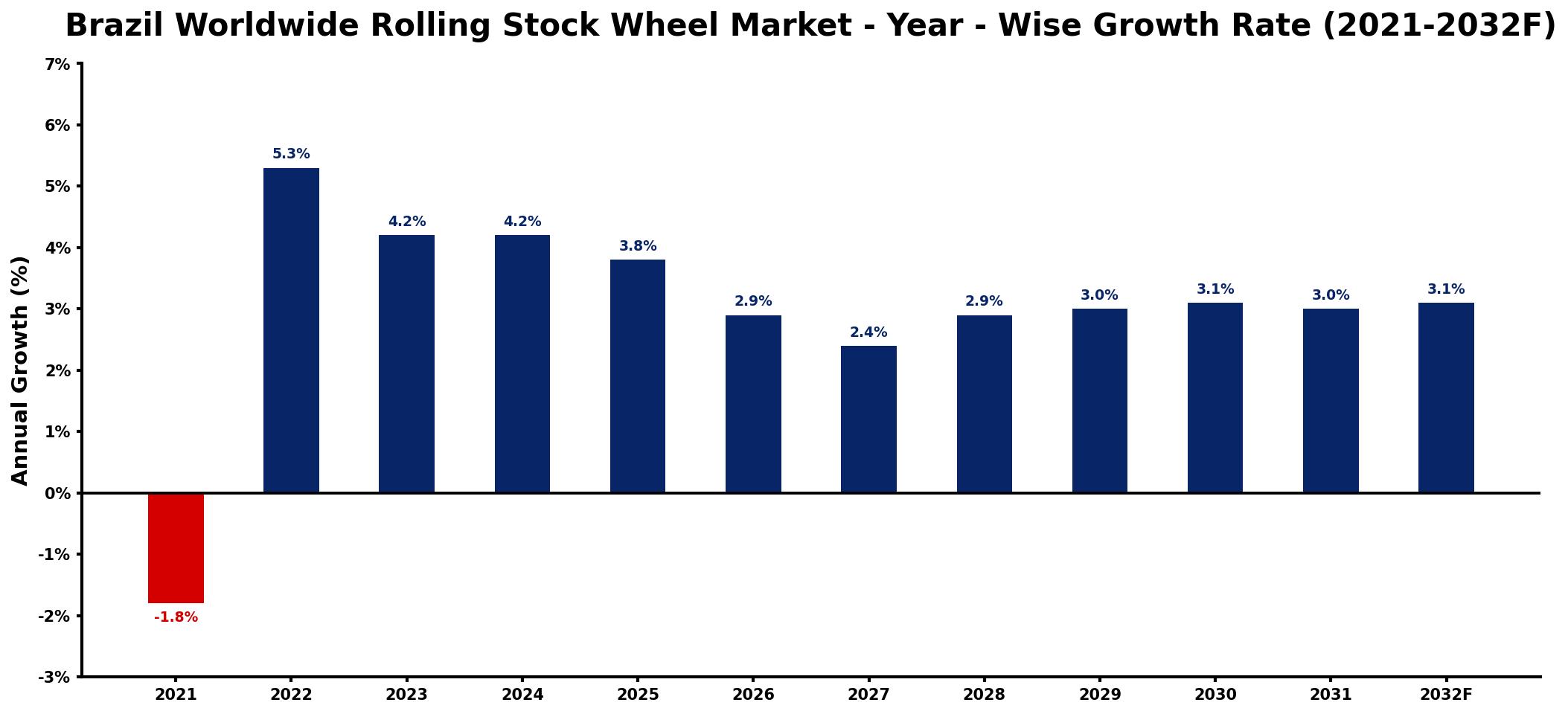
The table below presents the year‑wise growth rates along with the key drivers influencing the market
| Year | Growth Rate | Major Drivers |
| 2021 | -1.8% | Decreased industrial production activities |
| 2022 | 5.3% | Increased infrastructure development projects |
| 2023 | 4.2% | Growing urban transit initiatives |
| 2024 | 4.2% | Expansion of rail networks |
| 2025 | 3.8% | Investment in high-speed rail |
| 2026 | 2.9% | Rise in sustainable transport solutions |
| 2027 | 2.4% | Enhanced public transportation investments |
| 2028 | 2.9% | Technological advancements in manufacturing |
| 2029 | 3.0% | Strengthened global supply chains |
| 2030 | 3.1% | Increased demand for freight services |
| 2031 | 3.0% | Growth in commuter rail services |
| 2032 | 3.1% | Emergence of smart transportation systems |
Note: Market size estimations and growth projections presented in this report are based on 6Wresearch's proprietary forecasting methodology, utilizing the latest available industry data, government publications, and primary research inputs.
Brazil Worldwide Rolling Stock Wheel Market Synopsis
The Brazil Worldwide Rolling Stock Wheel Market is witnessing robust expansion driven by the modernization of railway networks across the country. With the increasing need for high-speed and heavy-duty rail solutions, the market is evolving to accommodate advanced materials and technologies that promise enhanced performance and safety.
In Brazil, rolling stock wheels are essential for ensuring the smooth operation of various train types, from urban transit systems to long-distance freight services. As the government and private stakeholders prioritize railway enhancements, this market is positioned for steady growth, reflecting broader trends in transportation infrastructure investment.
Brazil Worldwide Rolling Stock Wheel Market Key Takeaways
- The market is projected to grow from USD 362 Million in 2025 to USD 432 Million by 2032.
- Focus on safety and performance is driving the demand for advanced rolling stock wheels.
- Modernization of railway systems remains a key growth driver in the market.
- Regulatory frameworks emphasize quality standards and international compliance.
- Challenges in maintaining compatibility across various railway systems persist.
Evaluation of Restraints in Brazil Worldwide Rolling Stock Wheel Market
Despite its growth potential, the Brazil Worldwide Rolling Stock Wheel Market faces notable restraints. One significant barrier is the necessity for stringent quality standards, which can complicate manufacturing and maintenance processes. Moreover, the diversity of Brazil's railway systems creates compatibility issues, posing challenges for operators looking to standardize components. Addressing these hurdles will require ongoing collaboration among stakeholders to develop universally accepted specifications that meet the needs of a broad spectrum of railway operators.
Brazil Worldwide Rolling Stock Wheel Market Trends
Current trends in the Brazil Worldwide Rolling Stock Wheel Market highlight a growing preference for wheels that incorporate cutting-edge materials such as composites and lightweight metals. This shift aligns with the demand for greater efficiency and lower operational costs. Additionally, the increasing implementation of IoT technology in rail systems is paving the way for smarter, more connected rolling stock wheels that can provide real-time performance data, thus enhancing safety and maintenance practices.
Brazil Worldwide Rolling Stock Wheel Market Opportunities
Significant growth opportunities lie in the expansion of Brazil's intercity rail networks and urban transit systems. Investment in high-speed rail projects creates a demand for specialized rolling stock wheels that can withstand greater stresses while enhancing passenger comfort. Furthermore, as environmental regulations tighten, manufacturers who can innovate with sustainable materials and processes will find a competitive edge in this evolving marketplace.
Government Initiatives in the Brazil Worldwide Rolling Stock Wheel Market
The Brazilian government is actively promoting the modernization and expansion of its railway infrastructure, emphasizing safety and efficiency. Initiatives aimed at improving public transportation systems include public funding for rail upgrades, alongside policies that encourage adherence to international quality standards. Through these measures, the government is fostering a more reliable railway environment that is poised to benefit rolling stock wheel manufacturers and operators alike.
Future Insights of the Brazil Worldwide Rolling Stock Wheel Market
Looking ahead to 2026-2032, the Brazil Worldwide Rolling Stock Wheel Market is set to witness transformative advancements. The ongoing push for infrastructure improvement is expected to catalyze further innovations in wheel design and materials, directly impacting performance and safety metrics. Additionally, as Brazil aims to bolster its position within regional trade networks, the demand for efficient freight transport solutions will likely amplify, placing rolling stock wheels at the forefront of these developments.
Brazil Worldwide Rolling Stock Wheel Market Latest Developments (2025 - 2026)
Recent industry developments indicate a heightened focus on integrating advanced technology into rolling stock wheels, particularly with the implementation of smart sensors for real-time monitoring. Furthermore, manufacturers are increasingly exploring partnerships to enhance R&D efforts, seeking to innovate in materials that offer weight reduction without compromising strength. This proactive approach reflects the industry's commitment to meeting the evolving needs of Brazilian railways.
Brazil Worldwide Rolling Stock Wheel Market - Key Attractiveness of the Report
- 10 Years of Market Numbers
- Historical Data Starting from 2022 to 2025
- Base Year: 2025
- Forecast Data until 2032
- Key Performance Indicators Impacting the Market
- Major Upcoming Developments and Projects
Key Highlights of the Report:
- Brazil Worldwide Rolling Stock Wheel Market Outlook
- Market Size of Brazil Worldwide Rolling Stock Wheel Market, 2025
- Forecast of Brazil Worldwide Rolling Stock Wheel Market, 2032
- Historical Data and Forecast of Brazil Worldwide Rolling Stock Wheel Revenues & Volume for the Period 2022-2032F
- Brazil Worldwide Rolling Stock Wheel Market Trend Evolution
- Brazil Worldwide Rolling Stock Wheel Market Drivers and Challenges
- Brazil Worldwide Rolling Stock Wheel Price Trends
- Brazil Worldwide Rolling Stock Wheel Porter's Five Forces
- Brazil Worldwide Rolling Stock Wheel Industry Life Cycle
- Historical Data and Forecast of Brazil Worldwide Rolling Stock Wheel Market Revenues & Volume By Product Type for the Period 2022-2032F
- Historical Data and Forecast of Brazil Worldwide Rolling Stock Wheel Market Revenues & Volume By Casting for the Period 2022-2032F
- Historical Data and Forecast of Brazil Worldwide Rolling Stock Wheel Market Revenues & Volume By Forged for the Period 2022-2032F
- Historical Data and Forecast of Brazil Worldwide Rolling Stock Wheel Market Revenues & Volume By Applications for the Period 2022-2032F
- Historical Data and Forecast of Brazil Worldwide Rolling Stock Wheel Market Revenues & Volume By High Speed for the Period 2022-2032F
- Historical Data and Forecast of Brazil Worldwide Rolling Stock Wheel Market Revenues & Volume By Freight Wagons for the Period 2022-2032F
- Historical Data and Forecast of Brazil Worldwide Rolling Stock Wheel Market Revenues & Volume By Passenger Wagons for the Period 2022-2032F
- Historical Data and Forecast of Brazil Worldwide Rolling Stock Wheel Market Revenues & Volume By Locos for the Period 2022-2032F
- Brazil Worldwide Rolling Stock Wheel Import Export Trade Statistics
- Market Opportunity Assessment By Product Type
- Market Opportunity Assessment By Applications
- Brazil Worldwide Rolling Stock Wheel Top Companies Market Share
- Brazil Worldwide Rolling Stock Wheel Competitive Benchmarking By Technical and Operational Parameters
- Brazil Worldwide Rolling Stock Wheel Company Profiles
- Brazil Worldwide Rolling Stock Wheel Key Strategic Recommendations






































