Brunei Construction Plastics Market: Top 5 Importing Countries and Market Competition (HHI) Analysis
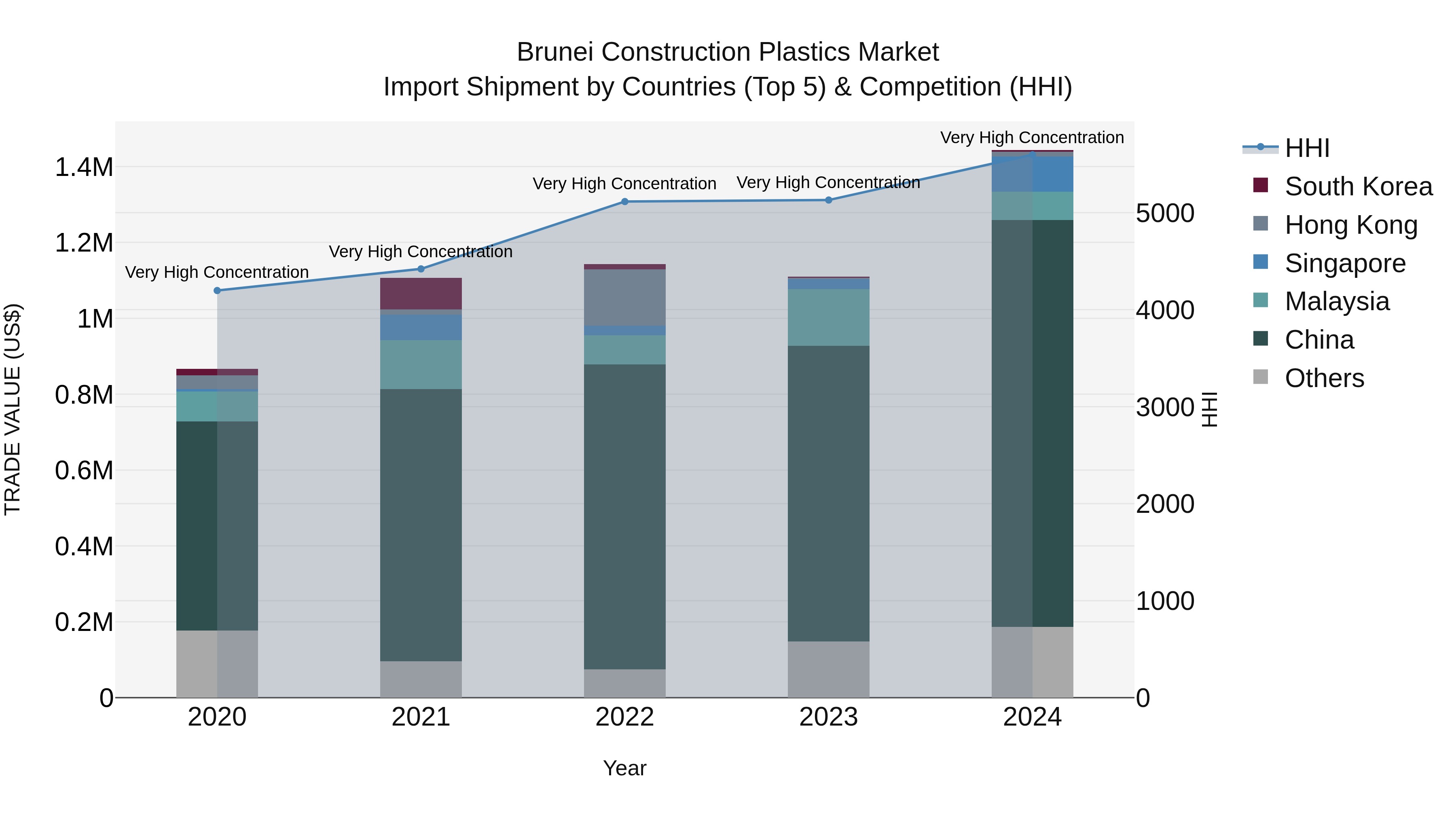
The construction plastics import market in Brunei saw significant growth in 2024, with top exporters being China, Singapore, Malaysia, USA, and UK. The high Herfindahl-Hirschman Index (HHI) indicates a concentrated market. With a strong compound annual growth rate (CAGR) of 13.59% from 2020-2024 and an impressive growth rate of 30.1% from 2023-2024, the sector shows promise for continued expansion. Brunei reliance on these key exporters highlights the importance of monitoring global trends and maintaining strong trade relationships to sustain growth in the construction plastics import market.
Brunei Construction Plastics Market Overview
The Brunei Construction Plastics Market is on the rise as the use of plastic materials in construction becomes more widespread. Plastics are favored for their versatility, durability, and cost-effectiveness, finding applications in piping, insulation, roofing, and more. The market is also influenced by the growing emphasis on lightweight and energy-efficient construction solutions.
Drivers of the market
The growth of the construction plastics market in Brunei is driven by the increasing use of plastics in construction applications due to their durability, lightweight, and cost-effectiveness. The demand for energy-efficient and environmentally friendly building materials is also boosting the market. Furthermore, innovations in plastic composites and their use in green building practices are contributing to the market`s growth.
Challenges of the market
The Brunei construction plastics market faces challenges due to increasing environmental concerns and regulations aimed at reducing plastic use in construction. The market is also constrained by the high cost of importing specialized plastic materials, which limits their adoption in local projects. Additionally, the lack of local recycling infrastructure for construction plastics poses a sustainability challenge, potentially increasing waste management costs.
Government Policy of the market
Brunei`s government has introduced regulations that promote the use of recyclable and eco-friendly plastics in construction. These policies are part of the nation`s commitment to reducing plastic waste and promoting sustainability.
Key Highlights of the Report:
- Brunei Construction Plastics Market Outlook
- Market Size of Brunei Construction Plastics Market, 2024
- Forecast of Brunei Construction Plastics Market, 2031
- Historical Data and Forecast of Brunei Construction Plastics Revenues & Volume for the Period 2021-2031
- Brunei Construction Plastics Market Trend Evolution
- Brunei Construction Plastics Market Drivers and Challenges
- Brunei Construction Plastics Price Trends
- Brunei Construction Plastics Porter`s Five Forces
- Brunei Construction Plastics Industry Life Cycle
- Historical Data and Forecast of Brunei Construction Plastics Market Revenues & Volume By Type for the Period 2021-2031
- Historical Data and Forecast of Brunei Construction Plastics Market Revenues & Volume By Pvc for the Period 2021-2031
- Historical Data and Forecast of Brunei Construction Plastics Market Revenues & Volume By Polyurethane for the Period 2021-2031
- Historical Data and Forecast of Brunei Construction Plastics Market Revenues & Volume By Polypropylene for the Period 2021-2031
- Historical Data and Forecast of Brunei Construction Plastics Market Revenues & Volume By Polyethylene for the Period 2021-2031
- Historical Data and Forecast of Brunei Construction Plastics Market Revenues & Volume By Application for the Period 2021-2031
- Historical Data and Forecast of Brunei Construction Plastics Market Revenues & Volume By Window for the Period 2021-2031
- Historical Data and Forecast of Brunei Construction Plastics Market Revenues & Volume By Roofing for the Period 2021-2031
- Historical Data and Forecast of Brunei Construction Plastics Market Revenues & Volume By Flooring for the Period 2021-2031
- Historical Data and Forecast of Brunei Construction Plastics Market Revenues & Volume By Insulation for the Period 2021-2031
- Historical Data and Forecast of Brunei Construction Plastics Market Revenues & Volume By Piping for the Period 2021-2031
- Brunei Construction Plastics Import Export Trade Statistics
- Market Opportunity Assessment By Type
- Market Opportunity Assessment By Application
- Brunei Construction Plastics Top Companies Market Share
- Brunei Construction Plastics Competitive Benchmarking By Technical and Operational Parameters
- Brunei Construction Plastics Company Profiles
- Brunei Construction Plastics Key Strategic Recommendations






































