Bulgaria Acetonitrile Market Size (2020-2030)
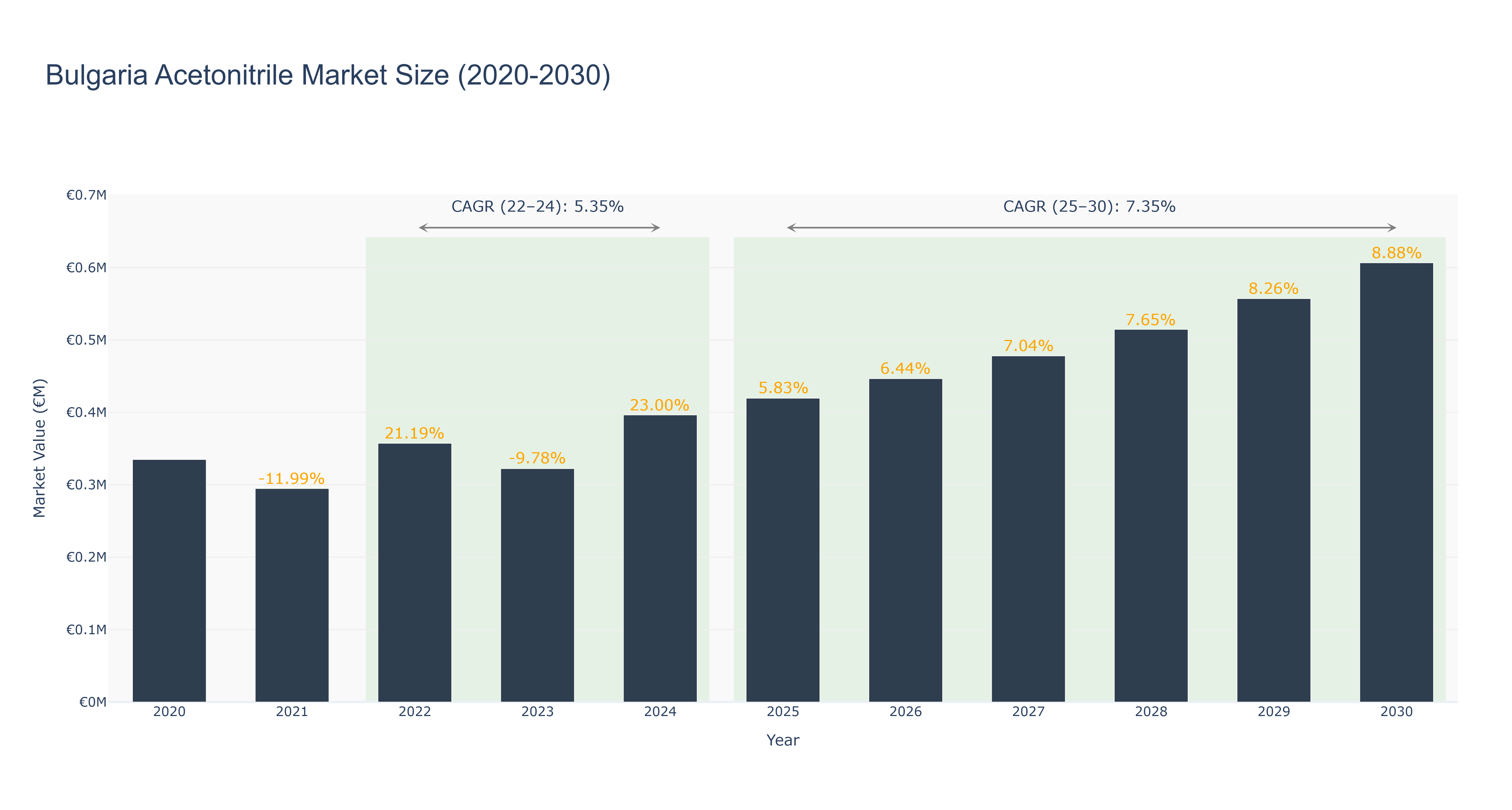
The Bulgaria Acetonitrile Market demonstrated notable fluctuations in market size between 2020 and 2024, peaking at €357.20 thousand in 2022 before experiencing a decline to €322.27 thousand in 2023, driven by global supply chain disruptions and changes in demand dynamics. The actual market experienced a compound annual growth rate (CAGR) of 5.35% from 2022 to 2024, indicating a recovery trend as it is projected to reach €396.40 thousand by 2024. Looking ahead, the forecast from 2025 to 2030 shows a more robust CAGR of 7.35%, with market size expected to grow steadily, reaching €606.49 thousand by 2030. This growth is likely fueled by increasing applications of acetonitrile in pharmaceuticals and agrochemicals, alongside advancements in manufacturing processes. Continued investment in production facilities and innovation will further enhance market potential, positioning Bulgaria as a key player in the acetonitrile sector.
Bulgaria Acetonitrile Market: Production & Trade Performance (2019-2025)
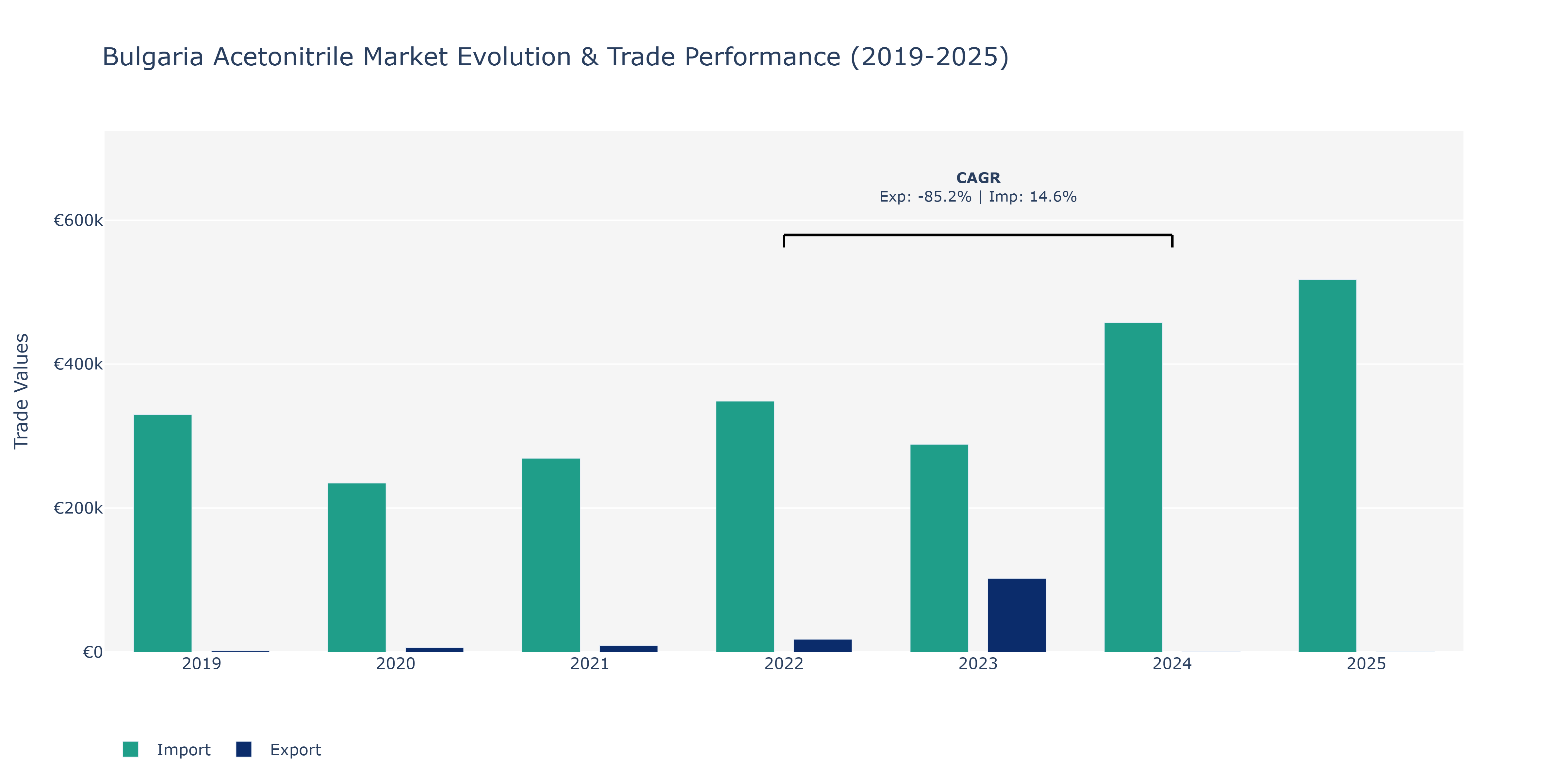
The Bulgaria Acetonitrile Market witnessed notable fluctuations in both Exports and Imports from 2019 to 2025. Exports surged from €1.6 thousand in 2019 to €102.27 thousand in 2023, marking a substantial increase driven by potentially increased demand for acetonitrile or improved production capacities within the country. However, there was a sharp decline to €391 thousand in 2024, which may reflect temporary market conditions or regulatory challenges impacting export activities. In 2025, exports slightly recovered to around €293 thousand. On the Imports side, a consistent upward trend was observed from €329.87 thousand in 2019 to a peak of €517.36 thousand in 2025. This growth trajectory could signify growing domestic consumption or the need for raw materials in Bulgaria's industrial processes, possibly driven by economic expansion or technological advancements in relevant sectors. Such fluctuations in trade volumes could also be influenced by global market dynamics, geopolitical factors, or evolving industry regulations affecting the acetonitrile sector.
Key Highlights of the Report:
- Bulgaria Acetonitrile Market Outlook
- Market Size of Bulgaria Acetonitrile Market, 2025
- Forecast of Bulgaria Acetonitrile Market, 2032
- Historical Data and Forecast of Bulgaria Acetonitrile Revenues & Volume for the Period 2022 - 2032F
- Bulgaria Acetonitrile Market Trend Evolution
- Bulgaria Acetonitrile Market Drivers and Challenges
- Bulgaria Acetonitrile Price Trends
- Bulgaria Acetonitrile Porter`s Five Forces
- Bulgaria Acetonitrile Industry Life Cycle
- Historical Data and Forecast of Bulgaria Acetonitrile Market Revenues & Volume By Type for the Period 2022 - 2032F
- Historical Data and Forecast of Bulgaria Acetonitrile Market Revenues & Volume By Derivative for the Period 2022 - 2032F
- Historical Data and Forecast of Bulgaria Acetonitrile Market Revenues & Volume By Solvent for the Period 2022 - 2032F
- Historical Data and Forecast of Bulgaria Acetonitrile Market Revenues & Volume By Application for the Period 2022 - 2032F
- Historical Data and Forecast of Bulgaria Acetonitrile Market Revenues & Volume By Pharmaceutical for the Period 2022 - 2032F
- Historical Data and Forecast of Bulgaria Acetonitrile Market Revenues & Volume By Analytical Industry for the Period 2022 - 2032F
- Historical Data and Forecast of Bulgaria Acetonitrile Market Revenues & Volume By Agrochemical for the Period 2022 - 2032F
- Historical Data and Forecast of Bulgaria Acetonitrile Market Revenues & Volume By Extraction for the Period 2022 - 2032F
- Bulgaria Acetonitrile Import Export Trade Statistics
- Market Opportunity Assessment By Type
- Market Opportunity Assessment By Application
- Bulgaria Acetonitrile Top Companies Market Share
- Bulgaria Acetonitrile Competitive Benchmarking By Technical and Operational Parameters
- Bulgaria Acetonitrile Company Profiles
- Bulgaria Acetonitrile Key Strategic Recommendations






































