Bulgaria Canned Tuna Market Top 5 Importing Countries and Market Competition (HHI) Analysis
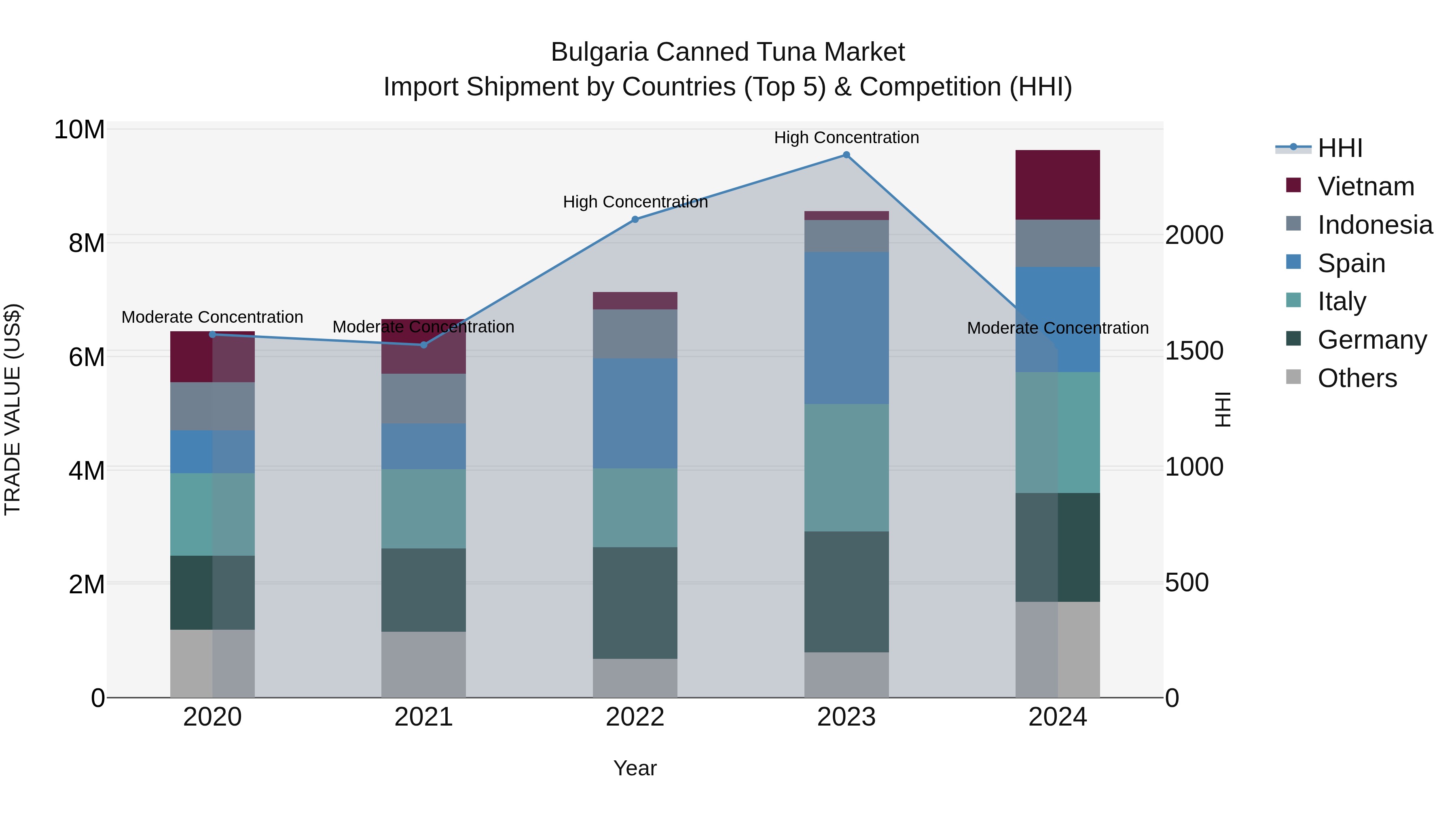
The canned tuna import Market Top 5 Importing Countries and Market Competition (HHI) Analysis in Bulgaria experienced a shift in concentration levels from high to moderate in 2024, indicating a more diversified import landscape. The top exporting countries such as Italy, Germany, Spain, Vietnam, and Indonesia continue to play a significant role in supplying canned tuna to Bulgaria. With a robust compound annual growth rate (CAGR) of 10.56% from 2020 to 2024 and a notable growth rate of 12.55% in 2024, the Market Top 5 Importing Countries and Market Competition (HHI) Analysis shows promising opportunities for both importers and suppliers in the canned tuna industry.
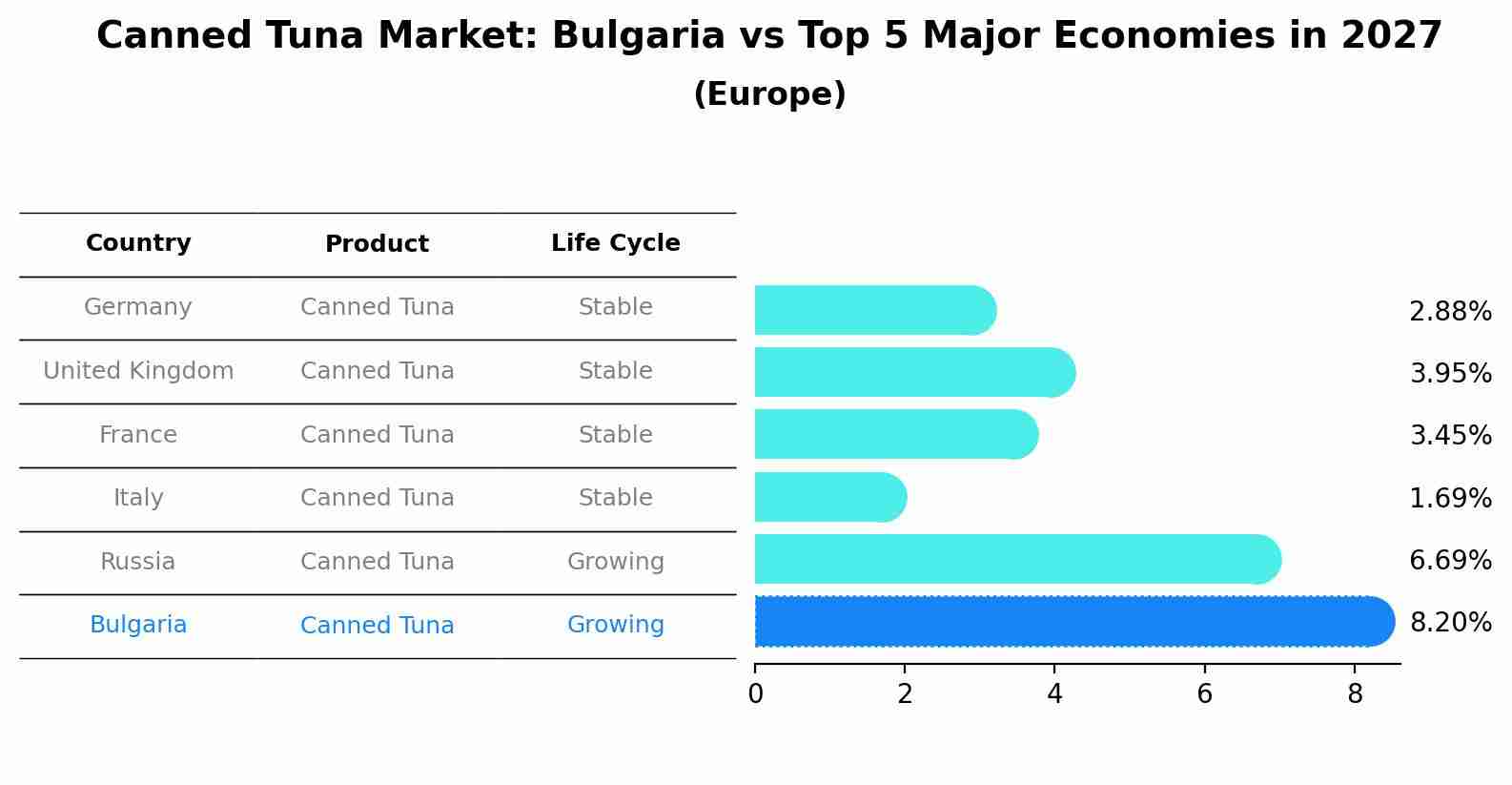
Canned Tuna Market: Bulgaria vs Top 5 Major Economies in 2027 (Europe)
The Canned Tuna market in Bulgaria is projected to grow at a growing growth rate of 8.20% by 2027, within the Europe region led by Germany, along with other countries like United Kingdom, France, Italy and Russia, collectively shaping a dynamic and evolving market environment driven by innovation and increasing adoption of emerging technologies.
Bulgaria Canned Tuna Market Overview
Canned tuna is a significant segment of the canned seafood market in Bulgaria. It is widely consumed due to its convenience, affordability, and nutritional value. The market sees steady demand, particularly for products that offer quality, sustainability, and traceability, as consumers become more aware of environmental concerns related to overfishing.
Drivers of the market
The canned tuna market in Bulgaria is driven by the demand for a convenient and nutritious protein source. Canned tuna is a popular choice for consumers seeking ready-to-eat seafood products with a long shelf life. The rising awareness of health benefits associated with tuna consumption and the increasing use of canned tuna in various dishes support the market`s growth.
Challenges of the market
The Bulgaria Canned Tuna Market is challenged by concerns over the sustainability of tuna stocks, as overfishing can impact supply. Additionally, the market faces competition from alternative protein sources, which can limit demand for canned tuna. Fluctuations in raw material prices and availability also pose challenges to the market.
Government Policy of the market
Regulations for the canned tuna market in Bulgaria focus on ensuring product safety and quality. The government enforces standards for tuna processing, packaging, and labeling to ensure that products are safe, accurately labeled, and free from contaminants.
Key Highlights of the Report:
- Bulgaria Canned Tuna Market Outlook
- Market Size of Bulgaria Canned Tuna Market, 2024
- Forecast of Bulgaria Canned Tuna Market, 2031
- Historical Data and Forecast of Bulgaria Canned Tuna Revenues & Volume for the Period 2021-2031
- Bulgaria Canned Tuna Market Trend Evolution
- Bulgaria Canned Tuna Market Drivers and Challenges
- Bulgaria Canned Tuna Price Trends
- Bulgaria Canned Tuna Porter`s Five Forces
- Bulgaria Canned Tuna Industry Life Cycle
- Historical Data and Forecast of Bulgaria Canned Tuna Market Revenues & Volume By Product for the Period 2021-2031
- Historical Data and Forecast of Bulgaria Canned Tuna Market Revenues & Volume By Skipjack for the Period 2021-2031
- Historical Data and Forecast of Bulgaria Canned Tuna Market Revenues & Volume By Yellowfin for the Period 2021-2031
- Historical Data and Forecast of Bulgaria Canned Tuna Market Revenues & Volume By Others for the Period 2021-2031
- Historical Data and Forecast of Bulgaria Canned Tuna Market Revenues & Volume By Distribution Channel for the Period 2021-2031
- Historical Data and Forecast of Bulgaria Canned Tuna Market Revenues & Volume By Hypermarket & Supermarket for the Period 2021-2031
- Historical Data and Forecast of Bulgaria Canned Tuna Market Revenues & Volume By Specialty Stores for the Period 2021-2031
- Historical Data and Forecast of Bulgaria Canned Tuna Market Revenues & Volume By Online for the Period 2021-2031
- Bulgaria Canned Tuna Import Export Trade Statistics
- Market Opportunity Assessment By Product
- Market Opportunity Assessment By Distribution Channel
- Bulgaria Canned Tuna Top Companies Market Share
- Bulgaria Canned Tuna Competitive Benchmarking By Technical and Operational Parameters
- Bulgaria Canned Tuna Company Profiles
- Bulgaria Canned Tuna Key Strategic Recommendations






































