Bulgaria Naphtha Market Top 5 Importing Countries and Market Competition (HHI) Analysis
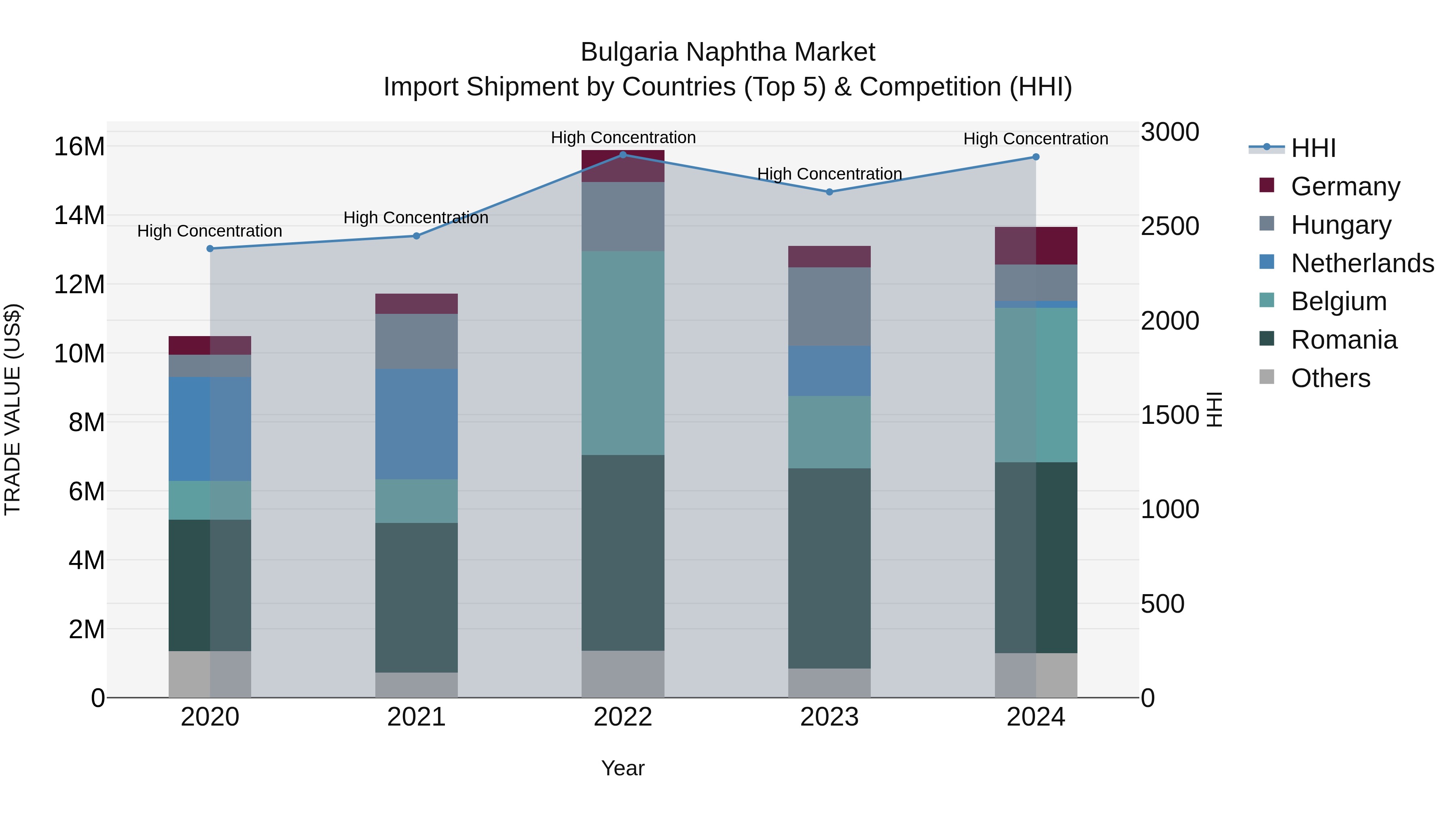
Bulgaria`s naphtha import Market Top 5 Importing Countries and Market Competition (HHI) Analysis in 2024 continued to be dominated by key suppliers such as Romania, Belgium, Germany, Hungary, and Turkey. With a high concentration level indicated by the HHI, these countries maintained a strong foothold in the Bulgarian Market Top 5 Importing Countries and Market Competition (HHI) Analysis . The compound annual growth rate (CAGR) from 2020 to 2024 stood at a healthy 6.83%, reflecting sustained demand. Additionally, the growth rate from 2023 to 2024 was recorded at 4.23%, indicating a positive trajectory for naphtha imports into Bulgaria.
Bulgaria Naphtha Market Synopsis
The Bulgaria Naphtha Market is experiencing steady growth due to the rising demand for petrochemical products in the country. Naphtha is primarily used as a feedstock in the production of ethylene and other chemical compounds, making it a crucial component in the manufacturing sector. The market is influenced by factors such as global crude oil prices, supply and demand dynamics, and regulatory policies. Key players in the Bulgaria Naphtha Market include refineries, petrochemical companies, and trading firms. Market participants are focusing on strategic partnerships, technological advancements, and product innovations to gain a competitive edge. However, challenges such as fluctuating raw material prices and environmental concerns regarding naphtha usage pose potential constraints to market growth in the coming years.
Bulgaria Naphtha Market Trends
The Bulgaria Naphtha Market is experiencing steady growth driven by increasing demand from the petrochemical industry for use in the production of plastics, resins, and solvents. The country`s strategic location as a gateway to both European and international markets presents opportunities for expansion and export. Additionally, the growing trend towards cleaner and more sustainable energy sources is leading to the development of innovative technologies for naphtha refining and utilization, opening up avenues for investment in renewable naphtha production. Collaboration with key stakeholders in the energy sector and the adoption of advanced refining processes are key strategies for companies looking to capitalize on the evolving market dynamics in Bulgaria.
Bulgaria Naphtha Market Challenges
In the Bulgaria Naphtha Market, there are several challenges that industry players encounter. One significant challenge is the volatility of global crude oil prices, as naphtha is a product derived from crude oil refining. Fluctuations in oil prices can directly impact the cost of naphtha production and influence market dynamics. Additionally, competition from alternative feedstocks and energy sources, such as natural gas and renewable energy, poses a threat to the demand for naphtha. Regulatory changes and environmental concerns related to the use of naphtha as a feedstock in petrochemical and fuel production also present challenges for market participants. Adapting to these shifting market conditions and maintaining competitiveness in the face of these challenges is crucial for stakeholders in the Bulgaria Naphtha Market.
Bulgaria Naphtha Market Investment Opportunities
The Bulgaria Naphtha Market is primarily driven by factors such as the growing demand for petrochemical products, particularly in the plastics and chemicals industry. The increasing use of naphtha as a feedstock for steam crackers to produce ethylene and other key chemical intermediates is fueling the market growth. Additionally, the expanding refinery sector in Bulgaria and the broader Eastern European region is boosting the demand for naphtha as a key raw material for gasoline and diesel production. Furthermore, the availability of abundant shale gas resources and the development of new naphtha cracking technologies are expected to further drive the Bulgaria Naphtha Market in the coming years.
Bulgaria Naphtha Market Government Polices
The Bulgarian government has implemented various policies related to the naphtha market, primarily focusing on energy security and environmental sustainability. In recent years, Bulgaria has aimed to diversify its energy sources by promoting investments in alternative energy technologies while also supporting the development of the oil and gas sector. The government has imposed regulations to ensure the safe handling and transportation of naphtha to mitigate environmental risks. Additionally, Bulgaria is actively participating in regional and international agreements to enhance energy cooperation and reduce greenhouse gas emissions. Overall, the government`s policies in the naphtha market reflect a balanced approach that emphasizes both economic growth and environmental protection.
Bulgaria Naphtha Market Future Outlook
The future outlook for the Bulgaria Naphtha Market appears to be positive, driven by various factors such as increasing demand from the petrochemical industry, growing usage in the production of gasoline and as a feedstock for the production of various chemicals. Additionally, the development of new technologies and processes for naphtha refining and utilization is expected to further bolster market growth. However, challenges such as fluctuating crude oil prices, evolving regulatory landscape, and competition from alternative energy sources may impact market dynamics. Overall, steady economic growth, industrial expansion, and investments in infrastructure are likely to contribute to the continued expansion of the Bulgaria Naphtha Market in the coming years.
Key Highlights of the Report:
- Bulgaria Naphtha Market Outlook
- Market Size of Bulgaria Naphtha Market, 2024
- Forecast of Bulgaria Naphtha Market, 2031
- Historical Data and Forecast of Bulgaria Naphtha Revenues & Volume for the Period 2021- 2031
- Bulgaria Naphtha Market Trend Evolution
- Bulgaria Naphtha Market Drivers and Challenges
- Bulgaria Naphtha Price Trends
- Bulgaria Naphtha Porter's Five Forces
- Bulgaria Naphtha Industry Life Cycle
- Historical Data and Forecast of Bulgaria Naphtha Market Revenues & Volume By Application for the Period 2021- 2031
- Historical Data and Forecast of Bulgaria Naphtha Market Revenues & Volume By Chemicals for the Period 2021- 2031
- Historical Data and Forecast of Bulgaria Naphtha Market Revenues & Volume By Energy/Fuel for the Period 2021- 2031
- Historical Data and Forecast of Bulgaria Naphtha Market Revenues & Volume By Others for the Period 2021- 2031
- Bulgaria Naphtha Import Export Trade Statistics
- Market Opportunity Assessment By Application
- Bulgaria Naphtha Top Companies Market Share
- Bulgaria Naphtha Competitive Benchmarking By Technical and Operational Parameters
- Bulgaria Naphtha Company Profiles
- Bulgaria Naphtha Key Strategic Recommendations






































