Bulgaria Natural Fragrance Market Top 5 Importing Countries and Market Competition (HHI) Analysis
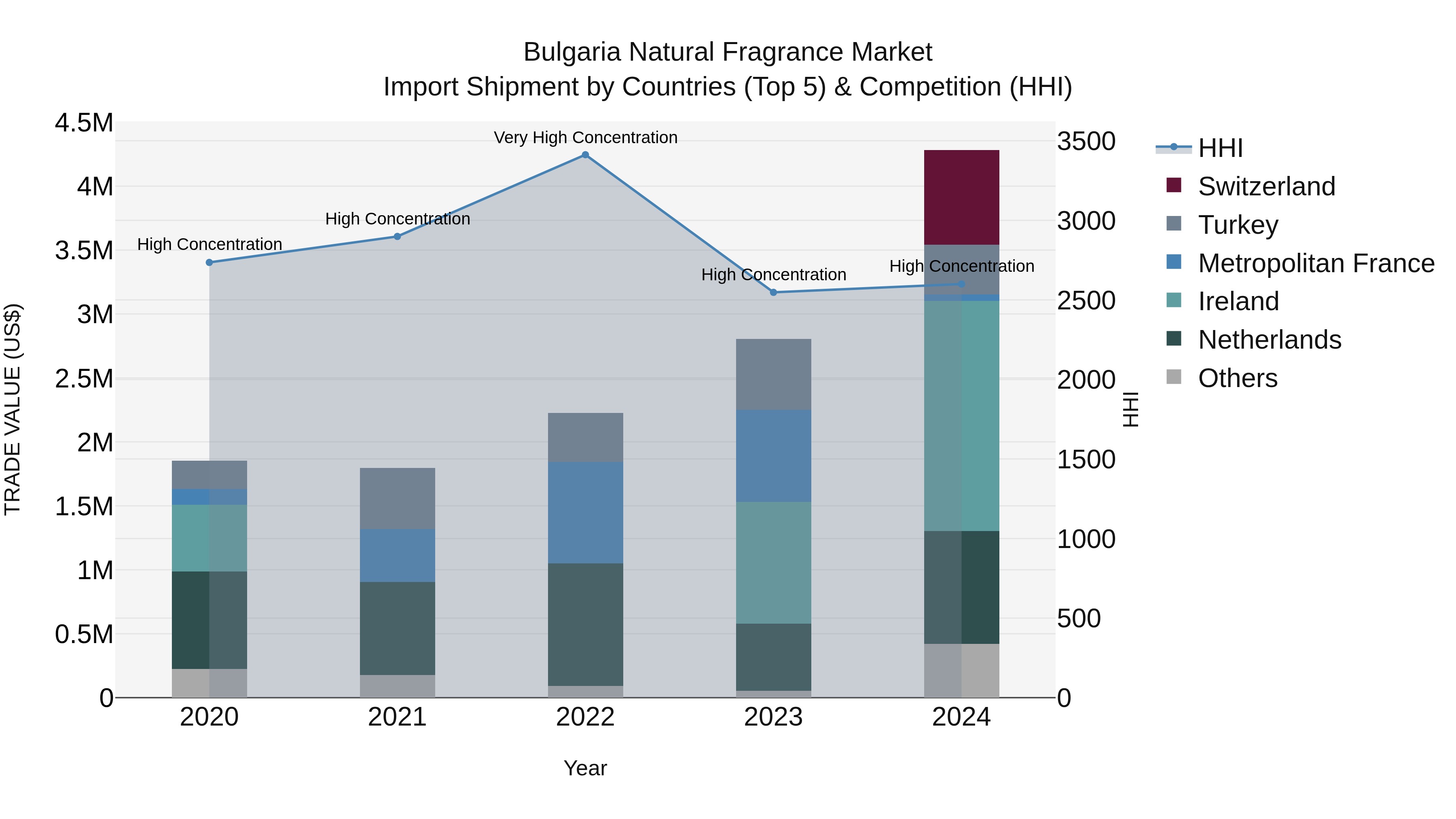
Bulgaria`s natural fragrance import Market Top 5 Importing Countries and Market Competition (HHI) Analysis continues to thrive, with significant growth indicated by a high CAGR of 23.31% from 2020 to 2024. The top exporting countries to Bulgaria in 2024 include Ireland, Netherlands, Switzerland, Turkey, and Bulgaria itself, showcasing a diverse range of sources. The high Herfindahl-Hirschman Index (HHI) concentration in 2024 suggests a competitive Market Top 5 Importing Countries and Market Competition (HHI) Analysis landscape. Notably, the remarkable growth rate of 52.67% from 2023 to 2024 indicates a surge in demand for natural fragrances in Bulgaria, presenting lucrative opportunities for Market Top 5 Importing Countries and Market Competition (HHI) Analysis players.
Bulgaria Natural Fragrance Market Overview
The natural fragrance market in Bulgaria is expanding as consumers seek eco-friendly and sustainable alternatives to synthetic fragrances. Natural fragrances, derived from plant-based sources, are used in personal care products, perfumes, and home fragrances. The market growth is driven by the increasing demand for products that align with natural and organic lifestyle choices.
Drivers of the market
The natural fragrance market in Bulgaria is growing as consumers increasingly seek eco-friendly and sustainable products. Natural fragrances, derived from plant-based sources, are gaining popularity in personal care, cosmetics, and home care products, driving market demand.
Challenges of the market
The natural fragrance market in Bulgaria faces challenges related to ingredient sourcing and product differentiation. Natural fragrances are derived from plant and animal sources, requiring careful sourcing and handling of ingredients. Companies must focus on developing unique and high-quality natural fragrances while managing supply chain challenges and addressing consumer preferences.
Government Policy of the market
The natural fragrance market in Bulgaria benefits from government policies that support the development and use of natural fragrance products. The government provides incentives for businesses involved in natural fragrance production, focusing on improving product quality, enhancing sustainability, and supporting market growth. Policies aim to promote the use of natural ingredients in fragrance products and encourage the adoption of eco-friendly practices.
Key Highlights of the Report:
- Bulgaria Natural Fragrance Market Outlook
- Market Size of Bulgaria Natural Fragrance Market, 2024
- Forecast of Bulgaria Natural Fragrance Market, 2031
- Historical Data and Forecast of Bulgaria Natural Fragrance Revenues & Volume for the Period 2021-2031
- Bulgaria Natural Fragrance Market Trend Evolution
- Bulgaria Natural Fragrance Market Drivers and Challenges
- Bulgaria Natural Fragrance Price Trends
- Bulgaria Natural Fragrance Porter`s Five Forces
- Bulgaria Natural Fragrance Industry Life Cycle
- Historical Data and Forecast of Bulgaria Natural Fragrance Market Revenues & Volume By Ingredient for the Period 2021-2031
- Historical Data and Forecast of Bulgaria Natural Fragrance Market Revenues & Volume By Essential Oils for the Period 2021-2031
- Historical Data and Forecast of Bulgaria Natural Fragrance Market Revenues & Volume By Natural Extracts for the Period 2021-2031
- Historical Data and Forecast of Bulgaria Natural Fragrance Market Revenues & Volume By Type for the Period 2021-2031
- Historical Data and Forecast of Bulgaria Natural Fragrance Market Revenues & Volume By Top note for the Period 2021-2031
- Historical Data and Forecast of Bulgaria Natural Fragrance Market Revenues & Volume By Middle Note for the Period 2021-2031
- Historical Data and Forecast of Bulgaria Natural Fragrance Market Revenues & Volume By Base Note for the Period 2021-2031
- Historical Data and Forecast of Bulgaria Natural Fragrance Market Revenues & Volume By Application for the Period 2021-2031
- Historical Data and Forecast of Bulgaria Natural Fragrance Market Revenues & Volume By Fine Fragrances for the Period 2021-2031
- Historical Data and Forecast of Bulgaria Natural Fragrance Market Revenues & Volume By Personal Care & Cosmetics for the Period 2021-2031
- Historical Data and Forecast of Bulgaria Natural Fragrance Market Revenues & Volume By Household Care for the Period 2021-2031
- Bulgaria Natural Fragrance Import Export Trade Statistics
- Market Opportunity Assessment By Ingredient
- Market Opportunity Assessment By Type
- Market Opportunity Assessment By Application
- Bulgaria Natural Fragrance Top Companies Market Share
- Bulgaria Natural Fragrance Competitive Benchmarking By Technical and Operational Parameters
- Bulgaria Natural Fragrance Company Profiles
- Bulgaria Natural Fragrance Key Strategic Recommendations






































