Burkina Faso Data Classification Market Top 5 Importing Countries and Market Competition (HHI) Analysis
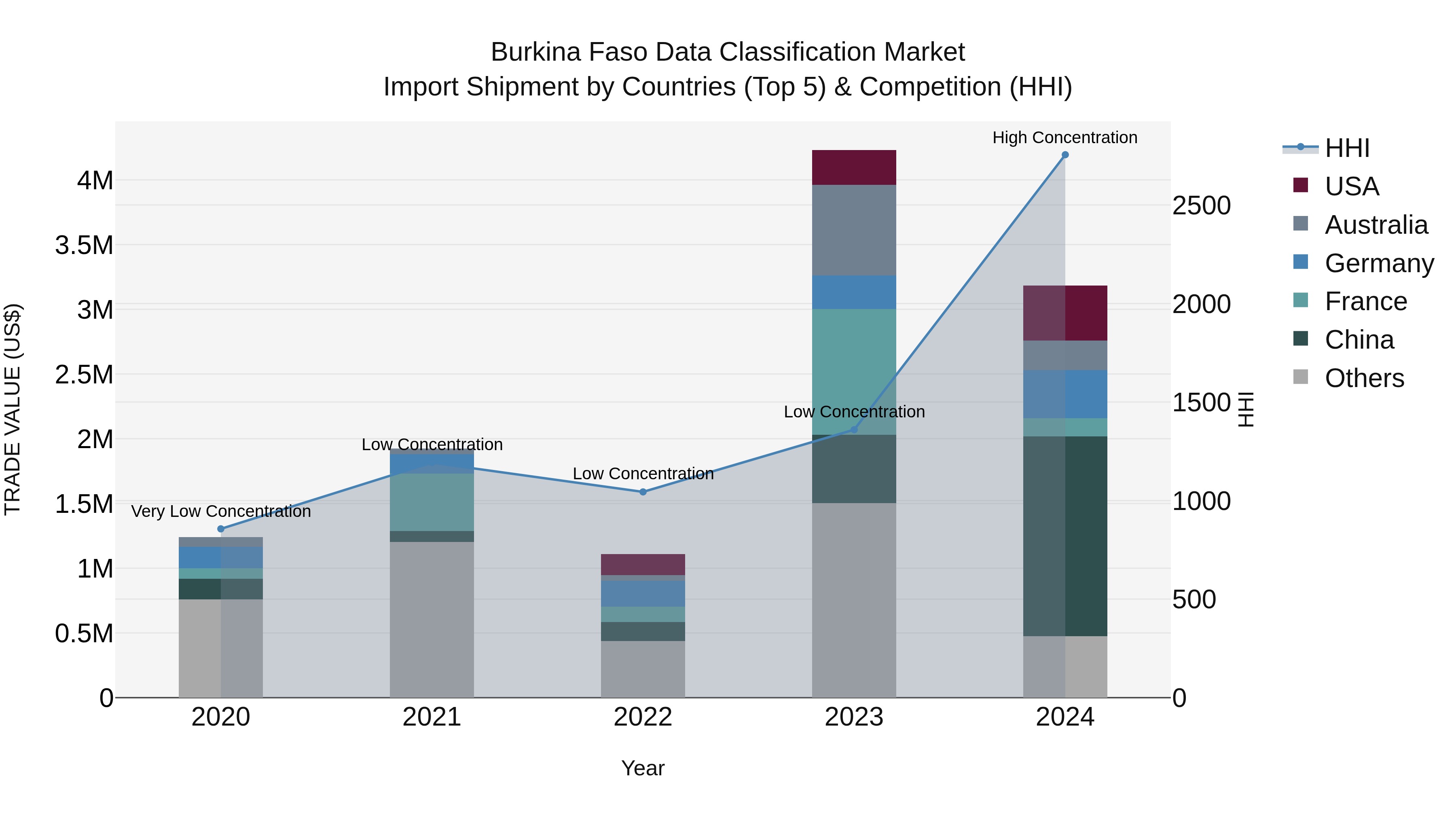
The import shipment data for Burkina Faso in 2024 reveals a significant shift in market dynamics. Top exporting countries such as China, USA, and Germany continue to dominate, while Australia and France also play significant roles. The rise in Herfindahl-Hirschman Index (HHI) from low to high concentration indicates a more consolidated market. Despite a high Compound Annual Growth Rate (CAGR) of 26.56% from 2020 to 2024, the negative growth rate of -24.73% from 2023 to 2024 signals recent challenges impacting the import market in Burkina Faso.
Burkina Faso Data Classification Market Overview
The Data Classification Market in Burkina Faso is becoming more relevant as organizations recognize the importance of managing their data effectively. Data classification helps in organizing and protecting sensitive information, and the market is expected to grow as data management practices improve.
Drivers of the market
The data classification market in Burkina Faso is driven by the growing need for organizations to manage and protect their sensitive data. With increasing regulatory requirements and the rise in data breaches, businesses are focusing on implementing data classification solutions to ensure that critical information is properly categorized and secured. The adoption of data governance frameworks and the need for compliance with data protection laws are key factors driving the growth of this market.
Challenges of the market
The data classification market in Burkina Faso faces significant challenges, particularly due to the lack of awareness and understanding of data classification practices among local businesses. Many organizations do not have formal data classification policies in place, which can lead to inefficiencies and increased risks of data breaches. Additionally, the high cost of implementing data classification solutions can be a barrier for many companies, particularly in a market where budget constraints are common. The market also suffers from a lack of skilled professionals who can effectively manage data classification projects, leading to potential inefficiencies and increased operational costs.
Government Policy of the market
The Burkinabe government has implemented policies to improve data classification and management practices. These policies focus on establishing standards and procedures for data classification to enhance data security and accessibility. The aim is to support efficient data management and protect sensitive information.
Key Highlights of the Report:
- Burkina Faso Data Classification Market Outlook
- Market Size of Burkina Faso Data Classification Market, 2024
- Forecast of Burkina Faso Data Classification Market, 2031
- Historical Data and Forecast of Burkina Faso Data Classification Revenues & Volume for the Period 2021-2031
- Burkina Faso Data Classification Market Trend Evolution
- Burkina Faso Data Classification Market Drivers and Challenges
- Burkina Faso Data Classification Price Trends
- Burkina Faso Data Classification Porter`s Five Forces
- Burkina Faso Data Classification Industry Life Cycle
- Historical Data and Forecast of Burkina Faso Data Classification Market Revenues & Volume By Component for the Period 2021-2031
- Historical Data and Forecast of Burkina Faso Data Classification Market Revenues & Volume By Solutions (Standalone and Integrated) for the Period 2021-2031
- Historical Data and Forecast of Burkina Faso Data Classification Market Revenues & Volume By Services for the Period 2021-2031
- Historical Data and Forecast of Burkina Faso Data Classification Market Revenues & Volume By Application for the Period 2021-2031
- Historical Data and Forecast of Burkina Faso Data Classification Market Revenues & Volume By Access Control for the Period 2021-2031
- Historical Data and Forecast of Burkina Faso Data Classification Market Revenues & Volume By GRC for the Period 2021-2031
- Historical Data and Forecast of Burkina Faso Data Classification Market Revenues & Volume By Web for the Period 2021-2031
- Historical Data and Forecast of Burkina Faso Data Classification Market Revenues & Volume By Mobile & Email Protection for the Period 2021-2031
- Historical Data and Forecast of Burkina Faso Data Classification Market Revenues & Volume By Centralized Management for the Period 2021-2031
- Historical Data and Forecast of Burkina Faso Data Classification Market Revenues & Volume By Methodology for the Period 2021-2031
- Historical Data and Forecast of Burkina Faso Data Classification Market Revenues & Volume By Content-based Classification for the Period 2021-2031
- Historical Data and Forecast of Burkina Faso Data Classification Market Revenues & Volume By Context-based Classification for the Period 2021-2031
- Historical Data and Forecast of Burkina Faso Data Classification Market Revenues & Volume By User-based Classification for the Period 2021-2031
- Historical Data and Forecast of Burkina Faso Data Classification Market Revenues & Volume By Vertical for the Period 2021-2031
- Historical Data and Forecast of Burkina Faso Data Classification Market Revenues & Volume By BFSI for the Period 2021-2031
- Historical Data and Forecast of Burkina Faso Data Classification Market Revenues & Volume By Healthcare and Lifesciences for the Period 2021-2031
- Historical Data and Forecast of Burkina Faso Data Classification Market Revenues & Volume By Government and Defense for the Period 2021-2031
- Historical Data and Forecast of Burkina Faso Data Classification Market Revenues & Volume By Education for the Period 2021-2031
- Historical Data and Forecast of Burkina Faso Data Classification Market Revenues & Volume By Telecom for the Period 2021-2031
- Historical Data and Forecast of Burkina Faso Data Classification Market Revenues & Volume By Media and Entertainment for the Period 2021-2031
- Historical Data and Forecast of Burkina Faso Data Classification Market Revenues & Volume By Others (Retail and Ecommerce, Manufacturing, and Energy and Utilities) for the Period 2021-2031
- Burkina Faso Data Classification Import Export Trade Statistics
- Market Opportunity Assessment By Component
- Market Opportunity Assessment By Application
- Market Opportunity Assessment By Methodology
- Market Opportunity Assessment By Vertical
- Burkina Faso Data Classification Top Companies Market Share
- Burkina Faso Data Classification Competitive Benchmarking By Technical and Operational Parameters
- Burkina Faso Data Classification Company Profiles
- Burkina Faso Data Classification Key Strategic Recommendations






































