Burkina Faso Industrial Vacuum Cleaner Market Top 5 Importing Countries and Market Competition (HHI) Analysis
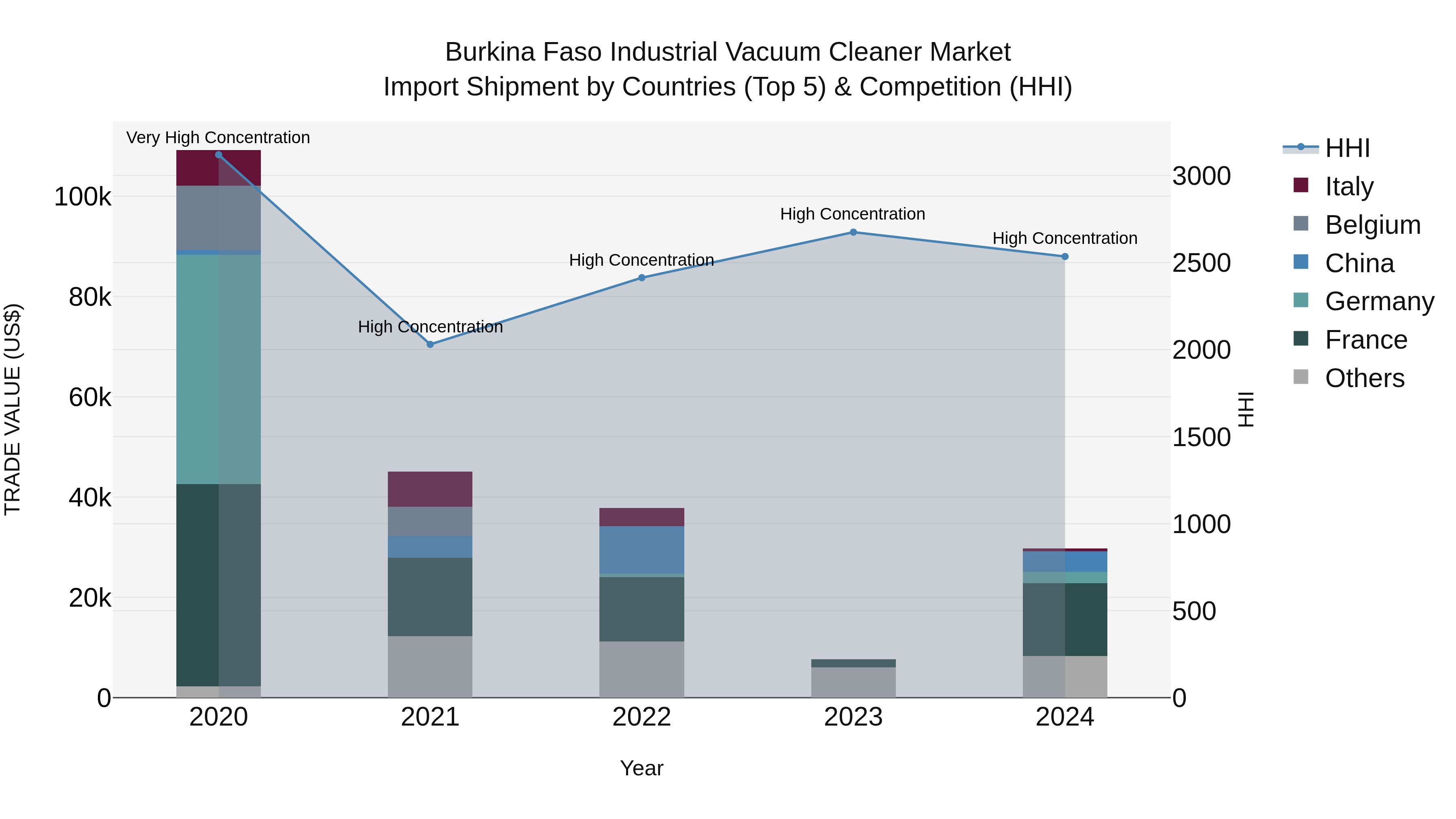
Burkina Faso`s industrial vacuum cleaner import market saw significant growth in 2024, with top exporting countries being France, China, South Africa, USA, and Germany. The market concentration remained high, indicating strong competition among the key players. Despite a negative CAGR from 2020-24, the industry experienced a remarkable growth rate of 288.5% from 2023-24, suggesting a surge in demand for industrial vacuum cleaners in Burkina Faso. This data highlights the evolving landscape of the industrial cleaning sector in the country and presents opportunities for both local and international manufacturers to capitalize on this growth.
Burkina Faso Industrial Vacuum Cleaner Market Overview
The industrial vacuum cleaner market in Burkina Faso is developing as industries seek efficient cleaning solutions for large-scale operations. Industrial vacuum cleaners are used for removing dust, debris, and liquids in various environments. The market is supported by the need for effective cleaning and maintenance in industrial settings. Challenges include the high cost of vacuum cleaners and the need for regular maintenance and support.
Drivers of the market
The industrial vacuum cleaner market in Burkina Faso is driven by the need for effective cleaning solutions in industrial and commercial environments. Industrial vacuum cleaners are used for removing dust, debris, and contaminants from workspaces and equipment. The growth in industrial activities and the focus on maintaining clean and safe environments are contributing to market expansion.
Challenges of the market
The industrial vacuum cleaner market in Burkina Faso encounters several challenges, such as high costs associated with importing advanced vacuum cleaners and a lack of local manufacturing facilities. The market also suffers from inadequate infrastructure for distribution and maintenance, as well as a shortage of skilled technicians. Enhancing local production capabilities, improving distribution networks, and investing in technical support are crucial for overcoming these challenges and supporting market development.
Government Policy of the market
Policies related to the industrial vacuum cleaner market in Burkina Faso focus on improving efficiency and supporting local manufacturing. The government may offer subsidies for technology development, support research and development, and implement regulations to ensure the effectiveness of vacuum cleaning solutions.
Key Highlights of the Report:
- Burkina Faso Industrial Vacuum Cleaner Market Outlook
- Market Size of Burkina Faso Industrial Vacuum Cleaner Market, 2024
- Forecast of Burkina Faso Industrial Vacuum Cleaner Market, 2031
- Historical Data and Forecast of Burkina Faso Industrial Vacuum Cleaner Revenues & Volume for the Period 2021-2031
- Burkina Faso Industrial Vacuum Cleaner Market Trend Evolution
- Burkina Faso Industrial Vacuum Cleaner Market Drivers and Challenges
- Burkina Faso Industrial Vacuum Cleaner Price Trends
- Burkina Faso Industrial Vacuum Cleaner Porter`s Five Forces
- Burkina Faso Industrial Vacuum Cleaner Industry Life Cycle
- Historical Data and Forecast of Burkina Faso Industrial Vacuum Cleaner Market Revenues & Volume By Type for the Period 2021-2031
- Historical Data and Forecast of Burkina Faso Industrial Vacuum Cleaner Market Revenues & Volume By Dry for the Period 2021-2031
- Historical Data and Forecast of Burkina Faso Industrial Vacuum Cleaner Market Revenues & Volume By Wet & Dry for the Period 2021-2031
- Historical Data and Forecast of Burkina Faso Industrial Vacuum Cleaner Market Revenues & Volume By Power Source for the Period 2021-2031
- Historical Data and Forecast of Burkina Faso Industrial Vacuum Cleaner Market Revenues & Volume By Electric for the Period 2021-2031
- Historical Data and Forecast of Burkina Faso Industrial Vacuum Cleaner Market Revenues & Volume By Pneumatic for the Period 2021-2031
- Historical Data and Forecast of Burkina Faso Industrial Vacuum Cleaner Market Revenues & Volume By Industry for the Period 2021-2031
- Historical Data and Forecast of Burkina Faso Industrial Vacuum Cleaner Market Revenues & Volume By Food & Beverages for the Period 2021-2031
- Historical Data and Forecast of Burkina Faso Industrial Vacuum Cleaner Market Revenues & Volume By Metalworking for the Period 2021-2031
- Historical Data and Forecast of Burkina Faso Industrial Vacuum Cleaner Market Revenues & Volume By Pharmaceuticals for the Period 2021-2031
- Historical Data and Forecast of Burkina Faso Industrial Vacuum Cleaner Market Revenues & Volume By Manufacturing for the Period 2021-2031
- Historical Data and Forecast of Burkina Faso Industrial Vacuum Cleaner Market Revenues & Volume By Building & Construction for the Period 2021-2031
- Historical Data and Forecast of Burkina Faso Industrial Vacuum Cleaner Market Revenues & Volume By Others for the Period 2021-2031
- Burkina Faso Industrial Vacuum Cleaner Import Export Trade Statistics
- Market Opportunity Assessment By Type
- Market Opportunity Assessment By Power Source
- Market Opportunity Assessment By Industry
- Burkina Faso Industrial Vacuum Cleaner Top Companies Market Share
- Burkina Faso Industrial Vacuum Cleaner Competitive Benchmarking By Technical and Operational Parameters
- Burkina Faso Industrial Vacuum Cleaner Company Profiles
- Burkina Faso Industrial Vacuum Cleaner Key Strategic Recommendations






































