Burkina Faso Iodine Market Top 5 Importing Countries and Market Competition (HHI) Analysis
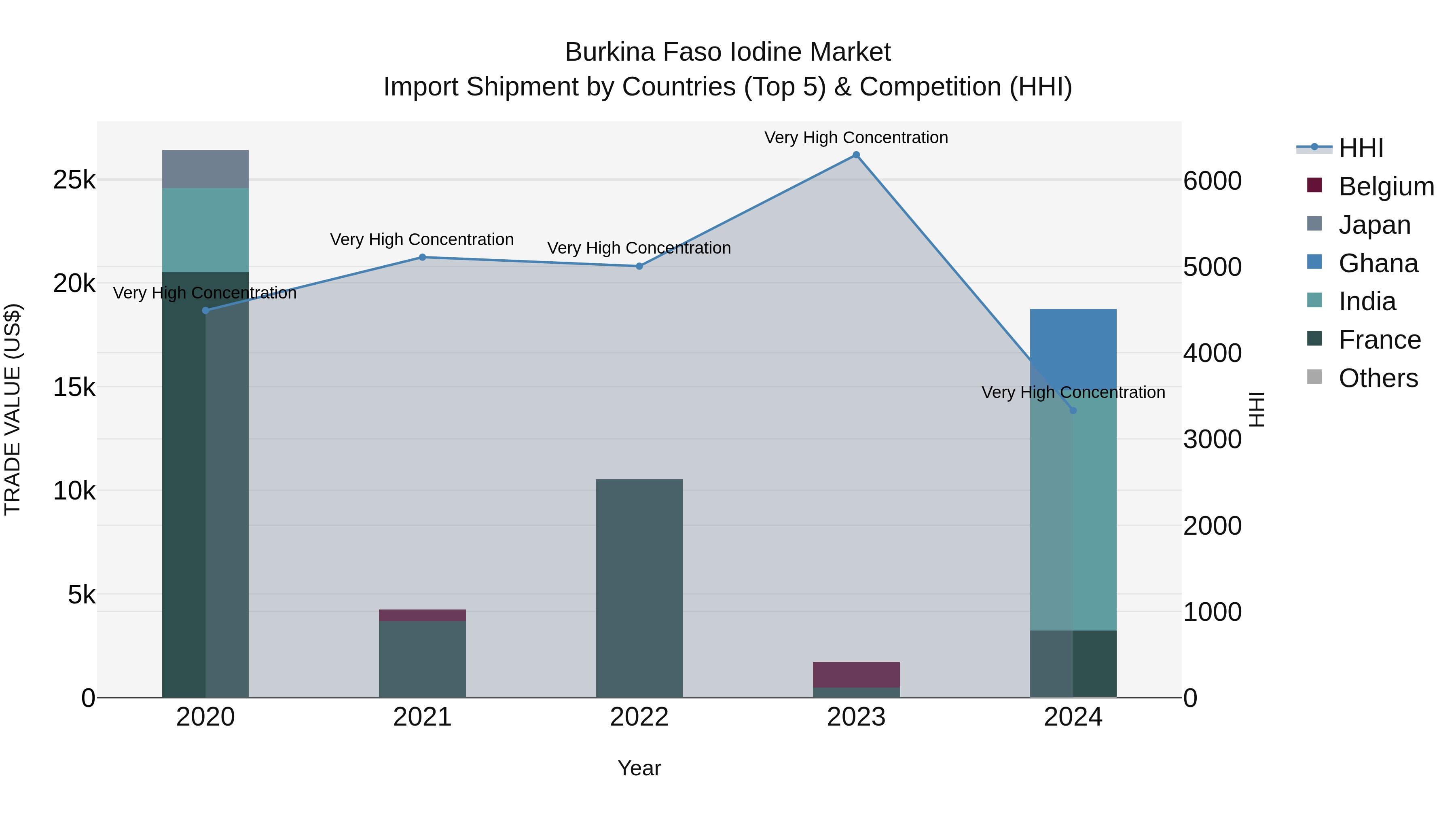
In 2024, Burkina Faso continued to rely heavily on iodine imports, with top exporters being India, Ghana, France, UK, and Belgium. The high Herfindahl-Hirschman Index (HHI) indicates significant market concentration. Despite a negative compound annual growth rate (CAGR) from 2020 to 2024 at -8.21%, there was a notable surge in growth from 2023 to 2024 at 989.69%. This suggests a potential shift in market dynamics or increased demand for iodine in Burkina Faso during that period. Stakeholders should closely monitor these trends for strategic decision-making.
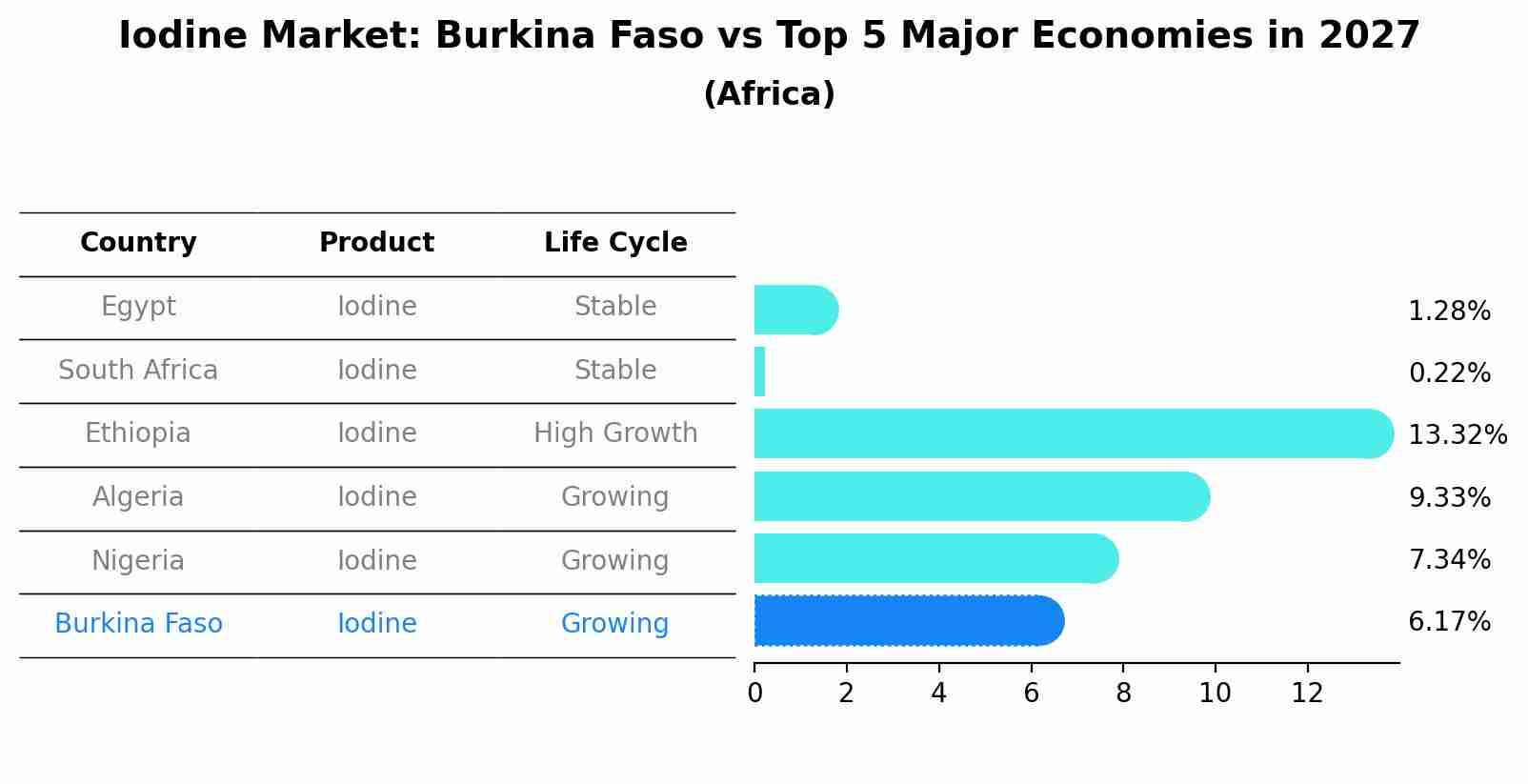
Iodine Market: Burkina Faso vs Top 5 Major Economies in 2027 (Africa)
Burkina Faso's Iodine market is anticipated to experience a growing growth rate of 6.17% by 2027, reflecting trends observed in the largest economy Egypt, followed by South Africa, Ethiopia, Algeria and Nigeria.
Burkina Faso Iodine Market Overview
The iodine market in Burkina Faso is linked to the healthcare and pharmaceutical industries, where iodine is used in various applications, including disinfectants, nutritional supplements, and medical imaging. The market is expected to grow as demand for healthcare products increases, though it is constrained by the limited availability of raw materials and the high cost of imported iodine.
Drivers of the market
The iodine market is driven by its applications in pharmaceuticals, disinfectants, and industrial processes. The growing need for iodine-based products, advancements in extraction technologies, and increasing health awareness contribute to market growth. Additionally, rising demand for iodized salt and iodine in healthcare applications supports market expansion.
Challenges of the market
Challenges in the iodine market in Burkina Faso include limited local production and high import costs. There is also a need for better distribution networks and supply chain management to ensure consistent availability. Additionally, raising awareness about the importance of iodine in public health and addressing the issues related to its proper usage are crucial for market growth.
Government Policy of the market
Burkina Fasos policies for the iodine market focus on ensuring the availability and quality of iodine for health and industrial applications. The government may provide incentives for local production, support research into new iodine applications, and implement regulations to ensure the safety and effectiveness of iodine products.
Key Highlights of the Report:
- Burkina Faso Iodine Market Outlook
- Market Size of Burkina Faso Iodine Market, 2024
- Forecast of Burkina Faso Iodine Market, 2031
- Historical Data and Forecast of Burkina Faso Iodine Revenues & Volume for the Period 2021-2031
- Burkina Faso Iodine Market Trend Evolution
- Burkina Faso Iodine Market Drivers and Challenges
- Burkina Faso Iodine Price Trends
- Burkina Faso Iodine Porter`s Five Forces
- Burkina Faso Iodine Industry Life Cycle
- Historical Data and Forecast of Burkina Faso Iodine Market Revenues & Volume By Source for the Period 2021-2031
- Historical Data and Forecast of Burkina Faso Iodine Market Revenues & Volume By Caliche Ore for the Period 2021-2031
- Historical Data and Forecast of Burkina Faso Iodine Market Revenues & Volume By Underground Brines for the Period 2021-2031
- Historical Data and Forecast of Burkina Faso Iodine Market Revenues & Volume By Recycling for the Period 2021-2031
- Historical Data and Forecast of Burkina Faso Iodine Market Revenues & Volume By Seaweeds for the Period 2021-2031
- Historical Data and Forecast of Burkina Faso Iodine Market Revenues & Volume By Form for the Period 2021-2031
- Historical Data and Forecast of Burkina Faso Iodine Market Revenues & Volume By Organic Compounds for the Period 2021-2031
- Historical Data and Forecast of Burkina Faso Iodine Market Revenues & Volume By Inorganic Salts & Complexes for the Period 2021-2031
- Historical Data and Forecast of Burkina Faso Iodine Market Revenues & Volume By Elemental & Isotopes for the Period 2021-2031
- Historical Data and Forecast of Burkina Faso Iodine Market Revenues & Volume By Application for the Period 2021-2031
- Historical Data and Forecast of Burkina Faso Iodine Market Revenues & Volume By X-Ray Contrast Media for the Period 2021-2031
- Historical Data and Forecast of Burkina Faso Iodine Market Revenues & Volume By Pharmaceuticals for the Period 2021-2031
- Historical Data and Forecast of Burkina Faso Iodine Market Revenues & Volume By Optical Polarizing Films for the Period 2021-2031
- Historical Data and Forecast of Burkina Faso Iodine Market Revenues & Volume By Catalyst in Polymer Processing for the Period 2021-2031
- Historical Data and Forecast of Burkina Faso Iodine Market Revenues & Volume By Animal Feed for the Period 2021-2031
- Historical Data and Forecast of Burkina Faso Iodine Market Revenues & Volume By Fluorochemicals for the Period 2021-2031
- Historical Data and Forecast of Burkina Faso Iodine Market Revenues & Volume By Human Nutrition for the Period 2021-2031
- Historical Data and Forecast of Burkina Faso Iodine Market Revenues & Volume By Othersfor the Period 2021-2031
- Burkina Faso Iodine Import Export Trade Statistics
- Market Opportunity Assessment By Source
- Market Opportunity Assessment By Form
- Market Opportunity Assessment By Application
- Burkina Faso Iodine Top Companies Market Share
- Burkina Faso Iodine Competitive Benchmarking By Technical and Operational Parameters
- Burkina Faso Iodine Company Profiles
- Burkina Faso Iodine Key Strategic Recommendations






































