Burkina Faso Molasses Market Top 5 Importing Countries and Market Competition (HHI) Analysis
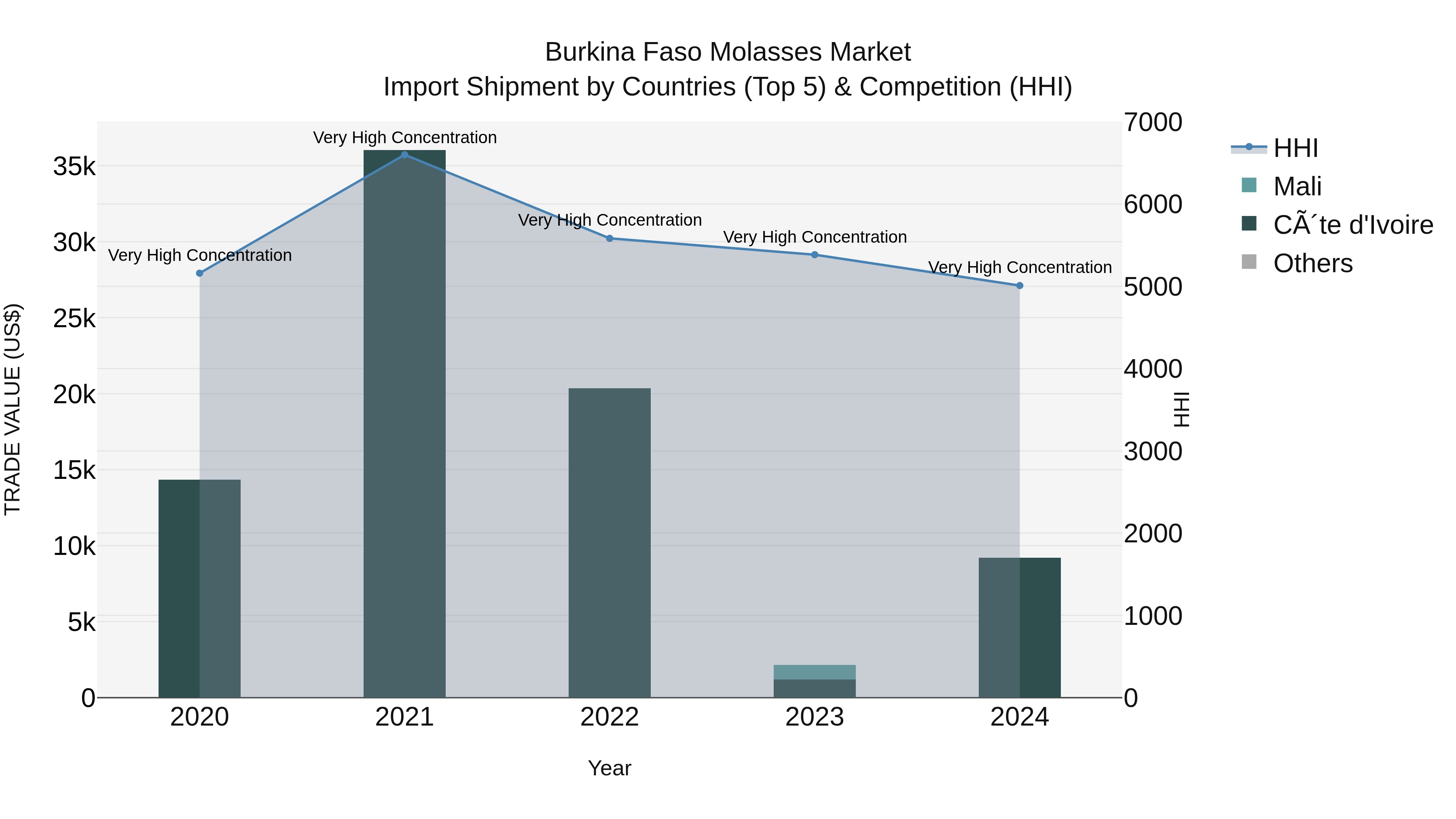
Burkina Faso`s molasses import market experienced significant growth in 2024, with top exporters being Côte d`Ivoire and Mali. The market remained highly concentrated, with a high Herfindahl-Hirschman Index (HHI). Despite a negative compound annual growth rate (CAGR) from 2020 to 2024, there was a remarkable growth rate in 2024, indicating a potential shift in the market dynamics. This suggests a changing landscape in Burkina Faso`s molasses import market, with opportunities for both exporters and importers to capitalize on this evolving trend.
Burkina Faso Molasses Market Overview
The molasses market in Burkina Faso is part of the broader food and beverage sector, focusing on this by-product of sugar production. Molasses is used in various applications, including as a sweetener in food products and as a feed ingredient in agriculture. The market is influenced by the sugar industry and demand for alternative sweeteners.
Drivers of the market
The growth of the Burkina Faso Molasses Market is driven by the increasing demand for molasses in various applications, including food and beverages, animal feed, and biofuel production. Molasses, a byproduct of sugar production, is valued for its nutritional content and as a cost-effective ingredient in various formulations. The market is also supported by the expansion of the sugar industry and the rising focus on sustainable agricultural practices.
Challenges of the market
The molasses market in Burkina Faso struggles with challenges related to limited production capacity and infrastructure. Molasses, a byproduct of sugar production, requires efficient processing and storage facilities. The market faces constraints due to inadequate local processing infrastructure and the need for investment in modern equipment. Additionally, fluctuations in sugar production can impact the availability and price of molasses.
Government Policy of the market
The molasses market in Burkina Faso is influenced by government policies that support the agricultural and food processing sectors. The government provides incentives for the local production and use of molasses. Policies focus on enhancing agricultural productivity and supporting the development of food processing industries.
Key Highlights of the Report:
- Burkina Faso Molasses Market Outlook
- Market Size of Burkina Faso Molasses Market, 2024
- Forecast of Burkina Faso Molasses Market, 2031
- Historical Data and Forecast of Burkina Faso Molasses Revenues & Volume for the Period 2021-2031
- Burkina Faso Molasses Market Trend Evolution
- Burkina Faso Molasses Market Drivers and Challenges
- Burkina Faso Molasses Price Trends
- Burkina Faso Molasses Porter`s Five Forces
- Burkina Faso Molasses Industry Life Cycle
- Historical Data and Forecast of Burkina Faso Molasses Market Revenues & Volume By Source for the Period 2021-2031
- Historical Data and Forecast of Burkina Faso Molasses Market Revenues & Volume By Sugarcane for the Period 2021-2031
- Historical Data and Forecast of Burkina Faso Molasses Market Revenues & Volume By Sugarbeet for the Period 2021-2031
- Historical Data and Forecast of Burkina Faso Molasses Market Revenues & Volume By Type for the Period 2021-2031
- Historical Data and Forecast of Burkina Faso Molasses Market Revenues & Volume By Regular Molasses for the Period 2021-2031
- Historical Data and Forecast of Burkina Faso Molasses Market Revenues & Volume By Blackstrap Molasses for the Period 2021-2031
- Historical Data and Forecast of Burkina Faso Molasses Market Revenues & Volume By Nature for the Period 2021-2031
- Historical Data and Forecast of Burkina Faso Molasses Market Revenues & Volume By Organic for the Period 2021-2031
- Historical Data and Forecast of Burkina Faso Molasses Market Revenues & Volume By Conventional for the Period 2021-2031
- Historical Data and Forecast of Burkina Faso Molasses Market Revenues & Volume By End-Use for the Period 2021-2031
- Historical Data and Forecast of Burkina Faso Molasses Market Revenues & Volume By Industrial for the Period 2021-2031
- Historical Data and Forecast of Burkina Faso Molasses Market Revenues & Volume By Commercial for the Period 2021-2031
- Historical Data and Forecast of Burkina Faso Molasses Market Revenues & Volume By Household for the Period 2021-2031
- Historical Data and Forecast of Burkina Faso Molasses Market Revenues & Volume By Sales Channel for the Period 2021-2031
- Historical Data and Forecast of Burkina Faso Molasses Market Revenues & Volume By Direct for the Period 2021-2031
- Historical Data and Forecast of Burkina Faso Molasses Market Revenues & Volume By Indirect for the Period 2021-2031
- Burkina Faso Molasses Import Export Trade Statistics
- Market Opportunity Assessment By Source
- Market Opportunity Assessment By Type
- Market Opportunity Assessment By Nature
- Market Opportunity Assessment By End-Use
- Market Opportunity Assessment By Sales Channel
- Burkina Faso Molasses Top Companies Market Share
- Burkina Faso Molasses Competitive Benchmarking By Technical and Operational Parameters
- Burkina Faso Molasses Company Profiles
- Burkina Faso Molasses Key Strategic Recommendations






































