Russia Molasses Market Size, Share & Growth Rate
The Russia Molasses Market was estimated at USD 198 Million in 2025 and is projected to reach USD 216 Million by 2032, growing at a CAGR of 1.3% from 2026 to 2032. This steady growth can be attributed to the increasing utilization of molasses across diverse sectors, including agriculture and fermentation, driven by a rising consumer awareness of its nutritional value. Furthermore, the escalating demand for alcohol production as a cost-effective fermentation feedstock is propelling market expansion.
Russia Molasses Market Year-wise Growth Rate and Key Drivers
This graph highlights how the Russia Molasses Market has steadily grown over the years, supported by major growth factors.
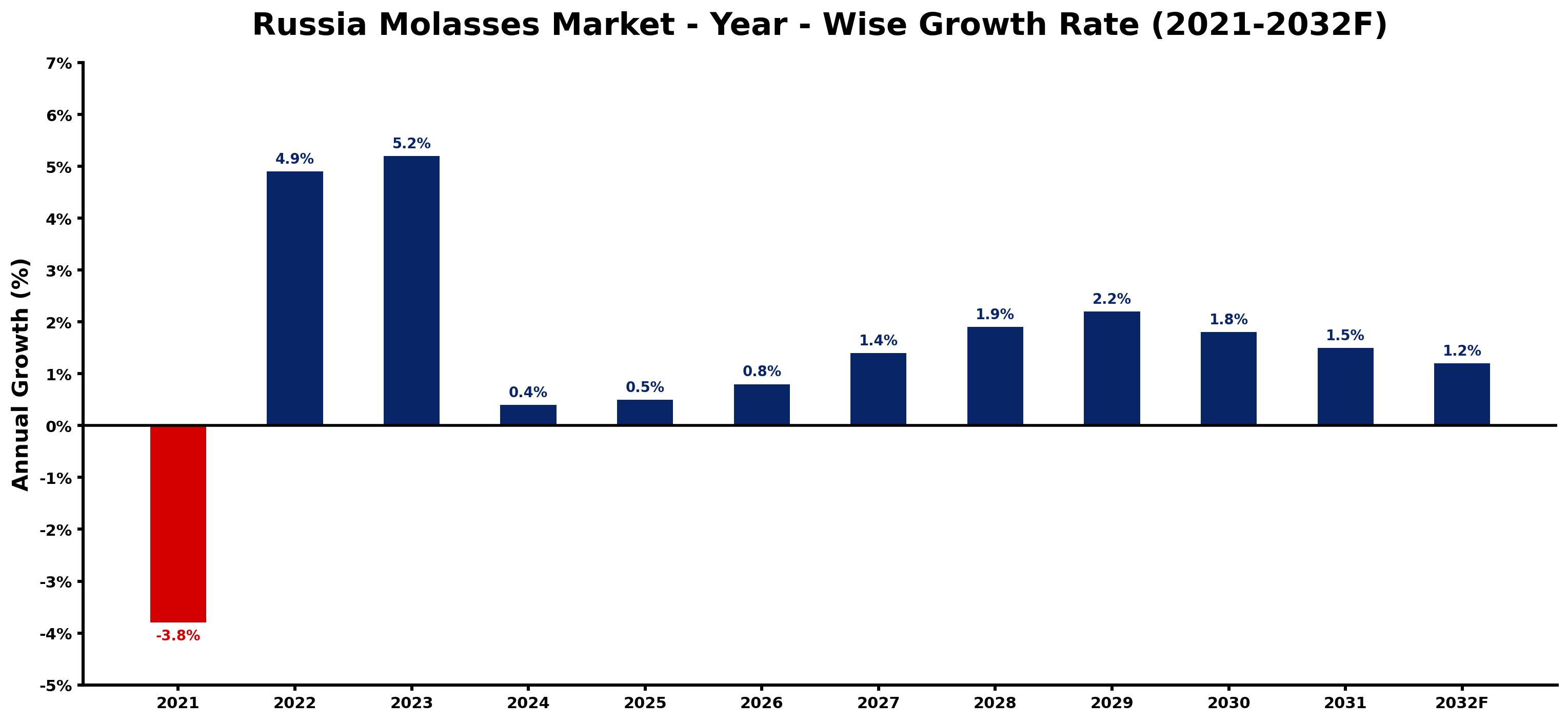
The table below presents the year‑wise growth rates along with the key drivers influencing the market
| Year | Growth Rate | Major Drivers |
| 2021 | -3.8% | Expansion of transportation and logistics networks |
| 2022 | 4.9% | Expansion of manufacturing activities |
| 2023 | 5.2% | Rapid growth in telecom and data center sectors |
| 2024 | 0.4% | Government infrastructure modernization initiatives |
| 2025 | 0.5% | Government infrastructure modernization initiatives |
| 2026 | 0.8% | Expansion of transportation and logistics networks |
| 2027 | 1.4% | Growing renewable energy integration projects |
| 2028 | 1.9% | Rising electricity demand across industries |
| 2029 | 2.2% | Increasing smart city development projects |
| 2030 | 1.8% | Growing renewable energy integration projects |
| 2031 | 1.5% | Expansion of transportation and logistics networks |
| 2032 | 1.2% | Expansion of transportation and logistics networks |
Note - Market size estimations and growth projections presented in this report are based on 6Wresearch’s advanced forecasting approach, validated with industry datasets as of June 2026.
Russia Molasses Market Synopsis
In recent years, the Russia Molasses Market has gained significant momentum, primarily driven by its growing applications in animal feed and alcohol production. This is a notable shift from a traditionally stagnant market, indicating a paradigm shift in consumption patterns and industry focus. As consumer and industry demands evolve, the market is poised for further expansion, with an emphasis on sustainability and innovation.
Looking ahead, the landscape of the Russia Molasses Market is expected to transform with the growing interest in sustainable practices and the exploration of new applications. As investment flows into production modernization and infrastructure enhancement, the market is set to capitalize on emerging trends and consumer preferences, ensuring its resilience and growth in the years to come.
Russia Molasses Market Key Takeaways
- The market is witnessing increased demand in the agriculture sector as a nutrient-rich feed additive.
- Alcohol production continues to be a key growth driver for molasses usage.
- Investment in infrastructure is essential for meeting the rising demand in various industries.
- Government policies are designed to support local producers while ensuring product quality.
- The market is increasingly focusing on sustainability and innovation to attract a broader consumer base.
Evaluation of Restraints in Russia Molasses Market
Despite its potential, the Russia Molasses Market faces several restraints that can impede its growth. One of the primary concerns is the volatility in sugar prices, which can directly affect the production costs and pricing of molasses. Additionally, the restricted availability of key raw materials, particularly sugar beet and sugarcane, can lead to supply constraints. Regulatory challenges also pose significant hurdles, as frequent changes in policies can disrupt market operations. As players navigate these challenges, it is imperative to maintain a robust supply chain and remain proactive in addressing regulatory shifts.
Russia Molasses Market Trends
The Russia Molasses Market is currently witnessing a notable trend towards the use of molasses as a valuable feed additive for livestock. This stems from the rising demand for high-quality animal products and an increasing focus on animal nutrition. Additionally, there is a growing interest in utilizing molasses for biofuel production, as it offers a more sustainable alternative compared to traditional feedstocks. Investments in production techniques and technology are becoming essential as stakeholders seek to innovate and improve efficiency in this evolving market landscape.
Russia Molasses Market Opportunities
Investors can find significant opportunities within the Russia Molasses Market through various channels. Expanding and modernizing production facilities can enhance operational efficiency and output, thereby meeting the increasing market demand. Moreover, there is potential for research and development initiatives to explore innovative applications of molasses in sectors like pharmaceuticals and biofuels. Additionally, bolstering marketing and distribution channels will be crucial in tapping into the growing interest in molasses from the food and beverage sector.
Government Initiatives in the Russia Molasses Market
The Russian government plays a vital role in shaping the landscape of the Molasses Market through various policies and initiatives. Measures including tariffs and quotas on molasses imports aim to protect domestic producers while ensuring food security. Regulatory frameworks are in place to monitor the safety and quality of molasses products, emphasizing consumer health. Furthermore, the government provides support programs and subsidies to foster the growth of local molasses producers, ensuring competitiveness in both domestic and international markets.
Future Insights of the Russia Molasses Market
The future outlook for the Russia Molasses Market is promising, with several key factors driving its trajectory. An increasing demand for molasses as a cost-effective ingredient in animal feed is anticipated to enhance market growth. The ongoing expansion of the food and beverage sector will further boost the consumption of molasses as a sweetening agent. Additionally, advancements in production techniques and growing investments in agriculture indicate a favorable environment for sustained growth from 2026 to 2032.
Russia Molasses Market Latest Developments (May 2025 - June 2026)
In the past year, the Russia Molasses Market has seen a strategic pivot towards modernization and increased efficiency in production processes. Companies are increasingly adopting innovative technologies to streamline operations and enhance product quality. Alongside this, there is a growing focus on sustainability, with initiatives aimed at sourcing raw materials responsibly and reducing environmental impacts. This trend is likely to shape the future of the market as stakeholders prioritize eco-friendly practices.
Russia Molasses Market - Key Attractiveness of the Report
- 10 Years of Market Numbers
- Historical Data Starting from 2022 to 2025
- Base Year: 2025
- Forecast Data until 2032
- Key Performance Indicators Impacting the Market
- Major Upcoming Developments and Projects
Key Highlights of the Report:
- Russia Molasses? Market Outlook
- Market Size of Russia Molasses? Market, 2025
- Forecast of Russia Molasses? Market, 2032
- Historical Data and Forecast of Russia Molasses? Revenues & Volume for the Period 2022-2032F
- Russia Molasses? Market Trend Evolution
- Russia Molasses? Market Drivers and Challenges
- Russia Molasses? Price Trends
- Russia Molasses? Porter's Five Forces
- Russia Molasses? Industry Life Cycle
- Historical Data and Forecast of Russia Molasses? Market Revenues & Volume By Source for the Period 2022-2032F
- Historical Data and Forecast of Russia Molasses? Market Revenues & Volume By Sugarcane for the Period 2022-2032F
- Historical Data and Forecast of Russia Molasses? Market Revenues & Volume By Sugarbeet for the Period 2022-2032F
- Historical Data and Forecast of Russia Molasses? Market Revenues & Volume By Type for the Period 2022-2032F
- Historical Data and Forecast of Russia Molasses? Market Revenues & Volume By Regular Molasses for the Period 2022-2032F
- Historical Data and Forecast of Russia Molasses? Market Revenues & Volume By Blackstrap Molasses for the Period 2022-2032F
- Historical Data and Forecast of Russia Molasses? Market Revenues & Volume By Nature for the Period 2022-2032F
- Historical Data and Forecast of Russia Molasses? Market Revenues & Volume By Organic for the Period 2022-2032F
- Historical Data and Forecast of Russia Molasses? Market Revenues & Volume By Conventional for the Period 2022-2032F
- Historical Data and Forecast of Russia Molasses? Market Revenues & Volume By End-Use for the Period 2022-2032F
- Historical Data and Forecast of Russia Molasses? Market Revenues & Volume By Industrial? for the Period 2022-2032F
- Historical Data and Forecast of Russia Molasses? Market Revenues & Volume By Commercial for the Period 2022-2032F
- Historical Data and Forecast of Russia Molasses? Market Revenues & Volume By Household for the Period 2022-2032F
- Historical Data and Forecast of Russia Molasses? Market Revenues & Volume By Sales Channel for the Period 2022-2032F
- Historical Data and Forecast of Russia Molasses? Market Revenues & Volume By Direct for the Period 2022-2032F
- Historical Data and Forecast of Russia Molasses? Market Revenues & Volume By Indirect for the Period 2022-2032F
- Russia Molasses? Import Export Trade Statistics
- Market Opportunity Assessment By Source
- Market Opportunity Assessment By Type
- Market Opportunity Assessment By Nature
- Market Opportunity Assessment By End-Use
- Market Opportunity Assessment By Sales Channel
- Russia Molasses? Top Companies Market Share
- Russia Molasses? Competitive Benchmarking By Technical and Operational Parameters
- Russia Molasses? Company Profiles
- Russia Molasses? Key Strategic Recommendations






































