Ghana Molasses Market Size, Share & Growth Rate
The Ghana Molasses Market was estimated at USD 333 Million in 2025 and is projected to reach USD 445 Million by 2032, growing at a CAGR of 4.2% from 2026 to 2032. This growth trajectory is primarily fueled by the escalating demand from the animal feed and alcoholic beverage industries. As consumers gravitate towards natural sweeteners and healthy alternatives, molasses is increasingly perceived as a viable option, further driving market expansion.
Ghana Molasses Market Year-wise Growth Rate and Key Drivers
This graph highlights how the Ghana Molasses Market has steadily grown over the years, supported by major growth factors.
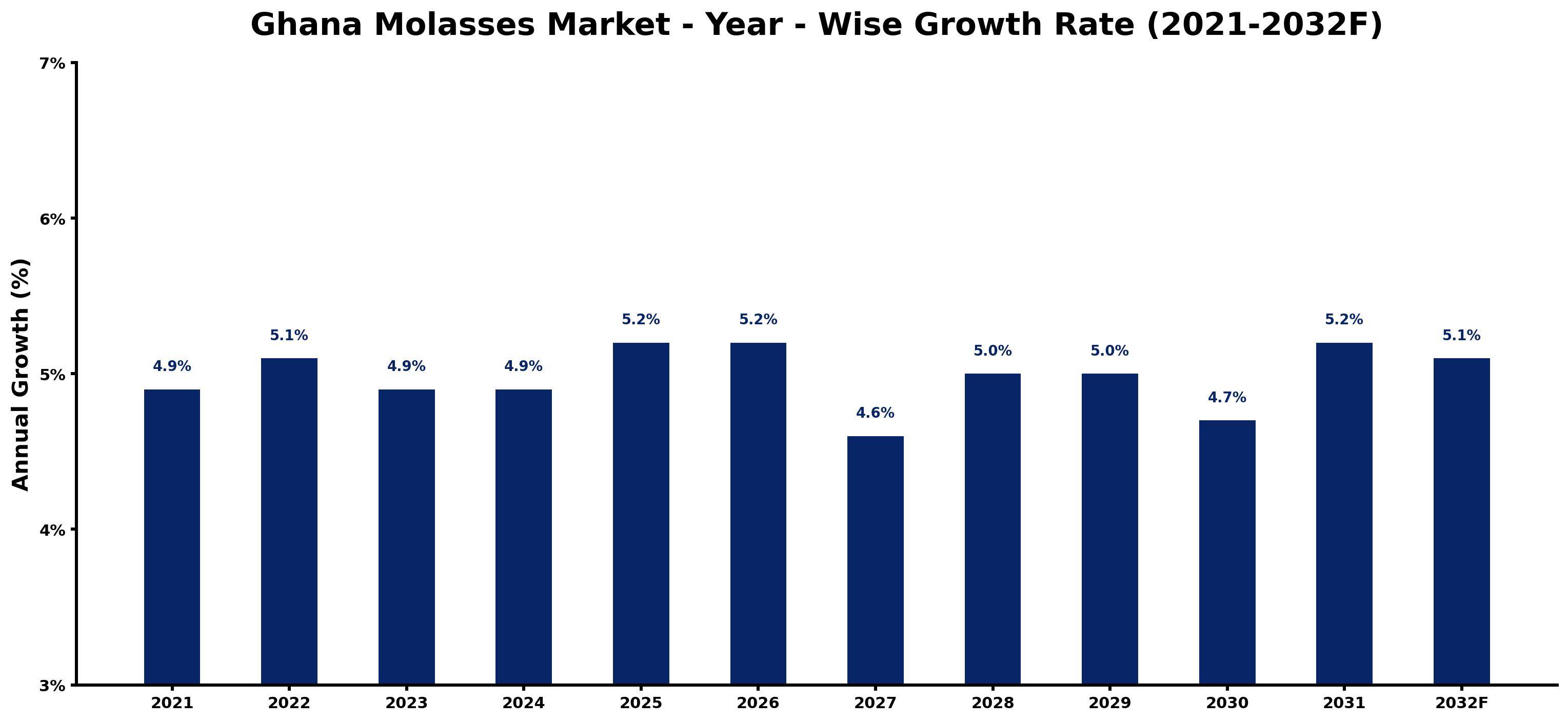
The table below presents the year‑wise growth rates along with the key drivers influencing the market
| Year | Growth Rate | Major Drivers |
| 2021 | 4.9% | Increasing industrial automation investments |
| 2022 | 5.1% | Expansion of manufacturing activities |
| 2023 | 4.9% | Increasing adoption of advanced technologies |
| 2024 | 4.9% | Government infrastructure modernization initiatives |
| 2025 | 5.2% | Expansion of manufacturing activities |
| 2026 | 5.2% | Rising electricity demand across industries |
| 2027 | 4.6% | Expansion of commercial construction activities |
| 2028 | 5.0% | Rising electricity demand across industries |
| 2029 | 5.0% | Rising electricity demand across industries |
| 2030 | 4.7% | Expansion of transportation and logistics networks |
| 2031 | 5.2% | Increasing industrial automation investments |
| 2032 | 5.1% | Expansion of commercial construction activities |
Note - Market size estimations and growth projections presented in this report are based on 6Wresearch's advanced forecasting approach, validated with industry datasets as of June 2026.
Ghana Molasses Market Synopsis
The burgeoning interest in molasses as a natural sweetener and flavor enhancer is the strongest force shaping the Ghana Molasses Market currently. This shift is not only reflective of changing consumer preferences but also aligns with a broader trend towards organic and non-GMO products that resonate with health-conscious buyers.
Simultaneously, the agricultural sector's expansion in Ghana is fostering favorable conditions for molasses production. Government initiatives aimed at promoting sugar cane cultivation are playing a crucial role in supporting the molasses supply chain, thus ensuring a steady flow into various industries.
Ghana Molasses Market Key Takeaways
- The Ghana Molasses Market is projected to grow steadily, driven by rising demand from multiple sectors.
- Molasses is gaining traction as a natural sweetener, positioning itself against synthetic alternatives.
- The agricultural expansion in Ghana is enhancing the molasses supply chain and its overall market stability.
- Investment opportunities abound in the alcohol and beverage sectors as molasses becomes increasingly popular.
- Government support for agricultural initiatives is vital to sustaining market growth and development.
Evaluation of Restraints in Ghana Molasses Market
Despite the promising growth prospects, the Ghana Molasses Market faces some notable restraints. Chief among them is the inconsistency in molasses supply, directly tied to the fluctuating availability of sugarcane. This volatility creates challenges in pricing, impacting market stability and production predictability. Additionally, infrastructural inadequacies hamper efficient transportation and distribution, thereby limiting market penetration and accessibility. Moreover, there remains a significant gap in consumer and business awareness regarding the advantages and applications of molasses, which could otherwise drive demand. Addressing these hurdles is crucial for unlocking the market's full potential.
Ghana Molasses Market Trends
The Ghana Molasses Market is currently witnessing a shift towards organic and sustainably sourced molasses products, mirroring global consumer trends. Increased health consciousness is propelling the use of molasses not just in traditional applications but also as a sought-after ingredient in food and beverage innovation. Furthermore, the rise of alternative energy solutions has sparked interest in molasses as a potential feedstock for biofuels, creating new avenues for market diversification and growth.
Ghana Molasses Market Opportunities
Significant opportunities for investment in the Ghana Molasses Market lie within the alcohol and beverage sector, where molasses is essential for producing rum and whiskey. As the demand for healthier sweetening options rises, there's potential for expanding into new applications, including functional foods and beverages. Furthermore, the ongoing diversification of sugar cane cultivation opens avenues for innovative agricultural practices that can enhance molasses production efficiency and quality.
Government Initiatives in the Ghana Molasses Market
While there are no specific policies directly addressing the molasses market, Ghana's agricultural policies have a significant impact on its development. The government's initiatives include subsidies for farmers, extension services aimed at improving farming practices, and infrastructure investment to bolster the agricultural sector as a whole. These overarching strategies indirectly benefit molasses producers by enhancing sugarcane cultivation and processing capabilities.
Future Insights of the Ghana Molasses Market
The future of the Ghana Molasses Market appears bright, buoyed by increasing demand across key industries including food and beverage, animal feed, and biofuels. The growing preference for organic products and natural sweeteners is expected to continue driving market growth. Additionally, as government initiatives to support agriculture take root, the molasses sector stands to benefit significantly. With a favorable combination of market dynamics and evolving consumer preferences, the outlook for the Ghana Molasses Market remains optimistic through 2032.
Ghana Molasses Market Latest Developments (May 2025 - June 2026)
Recent developments in the Ghana Molasses Market indicate a growing focus on enhancing production efficiency and quality through technological advancements. The sector is experiencing increased collaboration between agricultural stakeholders and manufacturers, aimed at streamlining the supply chain. Moreover, consumer interest in natural sweeteners is driving product innovation, with companies exploring new formulations and applications for molasses in various culinary products.
Ghana Molasses Market - Key Attractiveness of the Report
- 10 Years of Market Numbers
- Historical Data Starting from 2022 to 2025
- Base Year: 2025
- Forecast Data until 2032
- Key Performance Indicators Impacting the Market
- Major Upcoming Developments and Projects
Key Highlights of the Report:
- Ghana Molasses? Market Outlook
- Market Size of Ghana Molasses? Market, 2025
- Forecast of Ghana Molasses? Market, 2032
- Historical Data and Forecast of Ghana Molasses? Revenues & Volume for the Period 2022-2032F
- Ghana Molasses? Market Trend Evolution
- Ghana Molasses? Market Drivers and Challenges
- Ghana Molasses? Price Trends
- Ghana Molasses? Porter's Five Forces
- Ghana Molasses? Industry Life Cycle
- Historical Data and Forecast of Ghana Molasses? Market Revenues & Volume By Source for the Period 2022-2032F
- Historical Data and Forecast of Ghana Molasses? Market Revenues & Volume By Sugarcane for the Period 2022-2032F
- Historical Data and Forecast of Ghana Molasses? Market Revenues & Volume By Sugarbeet for the Period 2022-2032F
- Historical Data and Forecast of Ghana Molasses? Market Revenues & Volume By Type for the Period 2022-2032F
- Historical Data and Forecast of Ghana Molasses? Market Revenues & Volume By Regular Molasses for the Period 2022-2032F
- Historical Data and Forecast of Ghana Molasses? Market Revenues & Volume By Blackstrap Molasses for the Period 2022-2032F
- Historical Data and Forecast of Ghana Molasses? Market Revenues & Volume By Nature for the Period 2022-2032F
- Historical Data and Forecast of Ghana Molasses? Market Revenues & Volume By Organic for the Period 2022-2032F
- Historical Data and Forecast of Ghana Molasses? Market Revenues & Volume By Conventional for the Period 2022-2032F
- Historical Data and Forecast of Ghana Molasses? Market Revenues & Volume By End-Use for the Period 2022-2032F
- Historical Data and Forecast of Ghana Molasses? Market Revenues & Volume By Industrial? for the Period 2022-2032F
- Historical Data and Forecast of Ghana Molasses? Market Revenues & Volume By Commercial for the Period 2022-2032F
- Historical Data and Forecast of Ghana Molasses? Market Revenues & Volume By Household for the Period 2022-2032F
- Historical Data and Forecast of Ghana Molasses? Market Revenues & Volume By Sales Channel for the Period 2022-2032F
- Historical Data and Forecast of Ghana Molasses? Market Revenues & Volume By Direct for the Period 2022-2032F
- Historical Data and Forecast of Ghana Molasses? Market Revenues & Volume By Indirect for the Period 2022-2032F
- Ghana Molasses? Import Export Trade Statistics
- Market Opportunity Assessment By Source
- Market Opportunity Assessment By Type
- Market Opportunity Assessment By Nature
- Market Opportunity Assessment By End-Use
- Market Opportunity Assessment By Sales Channel
- Ghana Molasses? Top Companies Market Share
- Ghana Molasses? Competitive Benchmarking By Technical and Operational Parameters
- Ghana Molasses? Company Profiles
- Ghana Molasses? Key Strategic Recommendations






































