Burkina Faso Processed Food Market Top 5 Importing Countries and Market Competition (HHI) Analysis
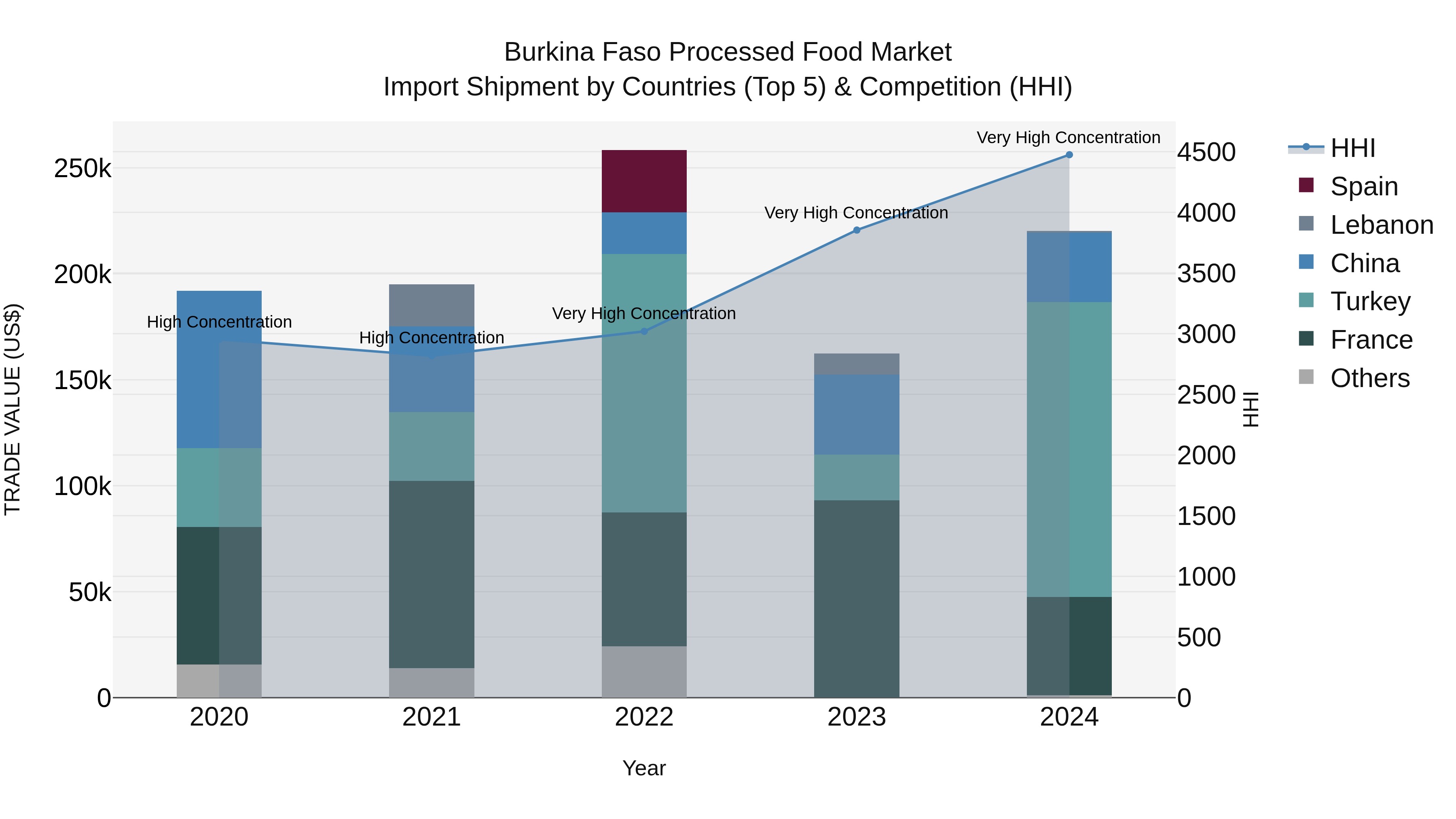
Burkina Faso`s processed food import market in 2024 continued to be dominated by top exporting countries such as Turkey, France, China, Poland, and Lebanon. The high concentration levels, as indicated by the Herfindahl-Hirschman Index (HHI), suggest a competitive market with significant presence from these key players. The compound annual growth rate (CAGR) from 2020 to 2024 stood at 3.48%, highlighting steady expansion. Notably, the impressive growth rate of 35.58% from 2023 to 2024 indicates a surge in demand for imported processed foods in Burkina Faso, presenting opportunities for market players to capitalize on this trend.
Processed Food Market: Burkina Faso vs Top 5 Major Economies in 2027 (Africa)
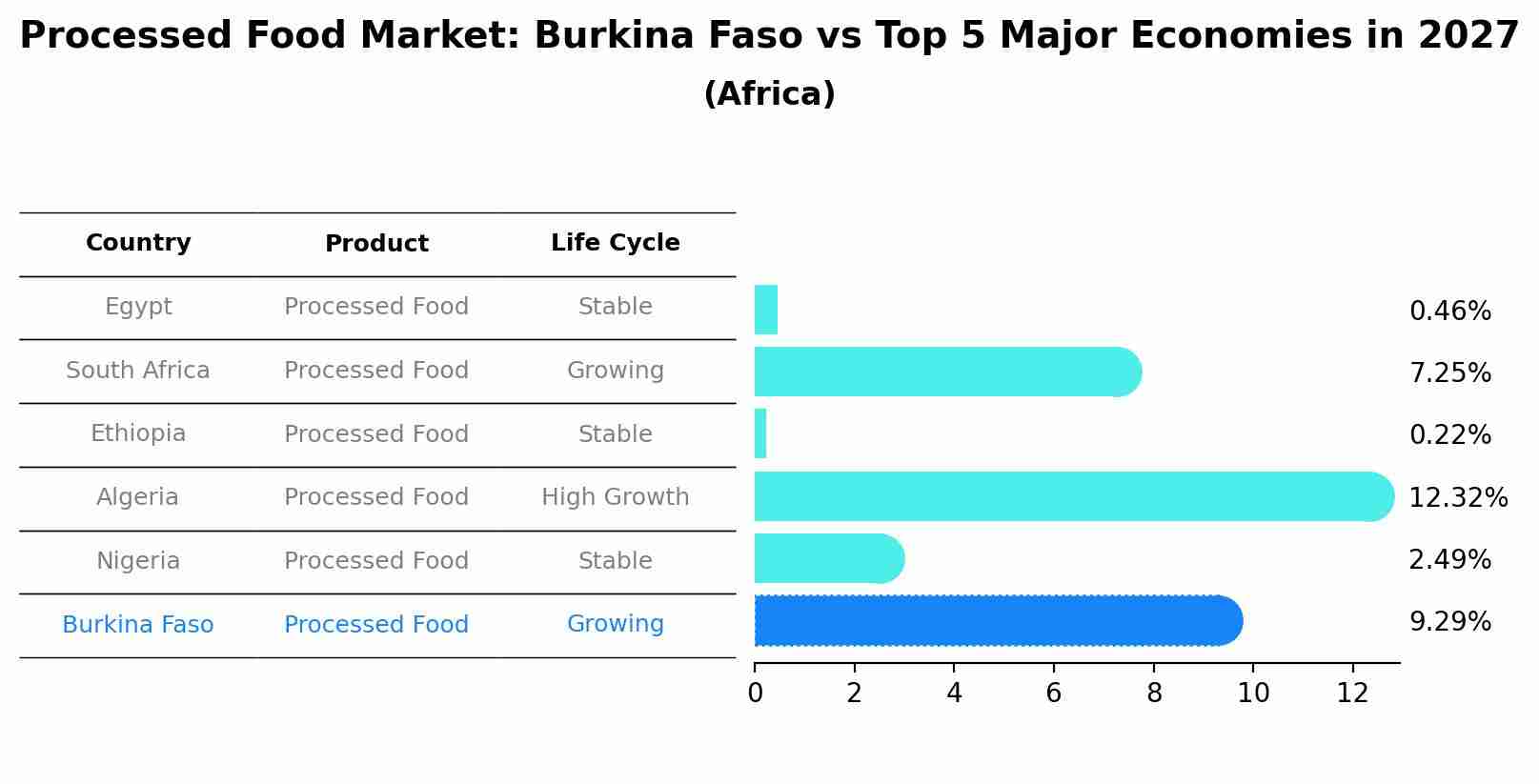
Burkina Faso's Processed Food market is anticipated to experience a growing growth rate of 9.29% by 2027, reflecting trends observed in the largest economy Egypt, followed by South Africa, Ethiopia, Algeria and Nigeria.
Burkina Faso Processed Food Market Overview
The processed food market in Burkina Faso includes a wide range of food products that have been manufactured through various processing techniques to extend shelf life and improve convenience. This market encompasses items such as canned goods, frozen foods, and ready-to-eat meals. The growth of the processed food market is driven by changing consumer lifestyles, urbanization, and the rising demand for convenient and long-lasting food options.
Drivers of the market
The processed food market in Burkina Faso is driven by the growing demand for convenient and ready-to-eat food products. Processed foods offer convenience, longer shelf life, and variety. The rise in urbanization, busy lifestyles, and the demand for diverse food options contribute to the growth of the processed food market.
Challenges of the market
The processed food market in Burkina Faso faces challenges due to high production costs and limited local processing infrastructure. Processed food products are expensive to produce because of the lack of local processing facilities and high raw material costs. The high import costs for processing equipment and packaging further limit market growth and accessibility.
Government Policy of the market
Government policies in Burkina Fasos processed food market support advancements in the food and beverage sectors. The government offers incentives for the production and consumption of processed foods, which are crucial for meeting local food demands and improving food security. Policies aim to enhance local manufacturing capabilities and support innovation in food processing technologies.
Key Highlights of the Report:
- Burkina Faso Processed Food Market Outlook
- Market Size of Burkina Faso Processed Food Market, 2024
- Forecast of Burkina Faso Processed Food Market, 2031
- Historical Data and Forecast of Burkina Faso Processed Food Revenues & Volume for the Period 2021-2031
- Burkina Faso Processed Food Market Trend Evolution
- Burkina Faso Processed Food Market Drivers and Challenges
- Burkina Faso Processed Food Price Trends
- Burkina Faso Processed Food Porter`s Five Forces
- Burkina Faso Processed Food Industry Life Cycle
- Historical Data and Forecast of Burkina Faso Processed Food Market Revenues & Volume By Process for the Period 2021-2031
- Historical Data and Forecast of Burkina Faso Processed Food Market Revenues & Volume By Minimally for the Period 2021-2031
- Historical Data and Forecast of Burkina Faso Processed Food Market Revenues & Volume By Highly for the Period 2021-2031
- Historical Data and Forecast of Burkina Faso Processed Food Market Revenues & Volume By Product type for the Period 2021-2031
- Historical Data and Forecast of Burkina Faso Processed Food Market Revenues & Volume By Plant based for the Period 2021-2031
- Historical Data and Forecast of Burkina Faso Processed Food Market Revenues & Volume By Fruits for the Period 2021-2031
- Historical Data and Forecast of Burkina Faso Processed Food Market Revenues & Volume By Vegetables for the Period 2021-2031
- Historical Data and Forecast of Burkina Faso Processed Food Market Revenues & Volume By Legumes for the Period 2021-2031
- Historical Data and Forecast of Burkina Faso Processed Food Market Revenues & Volume By Extracted foods for the Period 2021-2031
- Historical Data and Forecast of Burkina Faso Processed Food Market Revenues & Volume By Others for the Period 2021-2031
- Historical Data and Forecast of Burkina Faso Processed Food Market Revenues & Volume By Animal based for the Period 2021-2031
- Historical Data and Forecast of Burkina Faso Processed Food Market Revenues & Volume By Milk for the Period 2021-2031
- Historical Data and Forecast of Burkina Faso Processed Food Market Revenues & Volume By Application for the Period 2021-2031
- Historical Data and Forecast of Burkina Faso Processed Food Market Revenues & Volume By Baked foods for the Period 2021-2031
- Historical Data and Forecast of Burkina Faso Processed Food Market Revenues & Volume By Baby food for the Period 2021-2031
- Historical Data and Forecast of Burkina Faso Processed Food Market Revenues & Volume By Breakfast Cereal for the Period 2021-2031
- Historical Data and Forecast of Burkina Faso Processed Food Market Revenues & Volume By Biscuits for the Period 2021-2031
- Historical Data and Forecast of Burkina Faso Processed Food Market Revenues & Volume By Cheese for the Period 2021-2031
- Historical Data and Forecast of Burkina Faso Processed Food Market Revenues & Volume By Chocolate confectionary for the Period 2021-2031
- Historical Data and Forecast of Burkina Faso Processed Food Market Revenues & Volume By Ice creams for the Period 2021-2031
- Historical Data and Forecast of Burkina Faso Processed Food Market Revenues & Volume By Instant Noodles for the Period 2021-2031
- Burkina Faso Processed Food Import Export Trade Statistics
- Market Opportunity Assessment By Process
- Market Opportunity Assessment By Product type
- Market Opportunity Assessment By Application
- Burkina Faso Processed Food Top Companies Market Share
- Burkina Faso Processed Food Competitive Benchmarking By Technical and Operational Parameters
- Burkina Faso Processed Food Company Profiles
- Burkina Faso Processed Food Key Strategic Recommendations






































