Burkina Faso Trolley Market Top 5 Importing Countries and Market Competition (HHI) Analysis
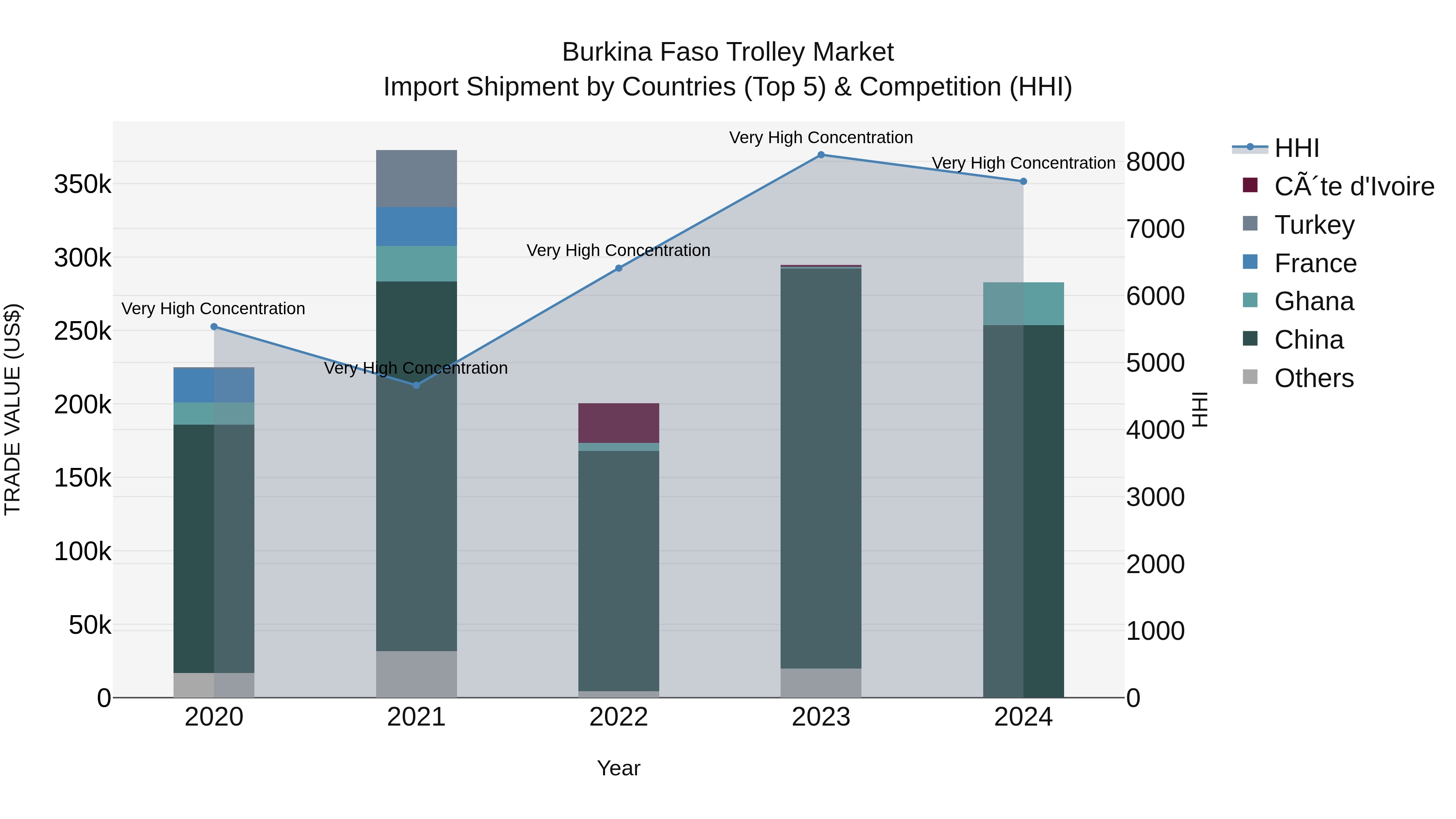
Burkina Faso continues to rely on trolley imports, with top exporting countries in 2024 being China, Ghana, USA, Andorra, and Côte d`Ivoire. The high Herfindahl-Hirschman Index (HHI) indicates significant market concentration. The Compound Annual Growth Rate (CAGR) from 2020 to 2024 stands at a healthy 5.89%, despite a slight decline in growth rate from 2023 to 2024. This data suggests a stable demand for trolleys in Burkina Faso, with potential opportunities for market expansion and diversification in the future.
Burkina Faso Trolley Market Overview
The trolley market in Burkina Faso involves various types of trolleys used in transportation and logistics, including hand trolleys and platform trolleys. The market is driven by increasing industrial activities and the need for efficient material handling solutions. Challenges include the need for durable and cost-effective trolleys and competition from global suppliers.
Drivers of the market
The Burkina Faso trolley market benefits from the growth of retail, hospitality, and logistics sectors. Trolleys are widely used for transporting goods and materials, making them essential in various industries. The increasing demand for efficient material handling solutions and advancements in trolley design drive market growth.
Challenges of the market
The trolley market in Burkina Faso encounters challenges related to limited local manufacturing capabilities and reliance on imports. There are issues with the availability and cost of raw materials, which affect the production and affordability of trolleys. Additionally, there is a lack of advanced design and technology in locally produced trolleys.
Government Policy of the market
In Burkina Faso, the trolley market is guided by regulations that ensure safety and durability in trolley manufacturing. The government provides support for local producers and encourages the adoption of high-quality standards and innovative designs to improve the functionality and safety of trolleys used in various industries.
Key Highlights of the Report:
- Burkina Faso Trolley Market Outlook
- Market Size of Burkina Faso Trolley Market, 2024
- Forecast of Burkina Faso Trolley Market, 2031
- Historical Data and Forecast of Burkina Faso Trolley Revenues & Volume for the Period 2021-2031
- Burkina Faso Trolley Market Trend Evolution
- Burkina Faso Trolley Market Drivers and Challenges
- Burkina Faso Trolley Price Trends
- Burkina Faso Trolley Porter`s Five Forces
- Burkina Faso Trolley Industry Life Cycle
- Historical Data and Forecast of Burkina Faso Trolley Market Revenues & Volume By Product for the Period 2021-2031
- Historical Data and Forecast of Burkina Faso Trolley Market Revenues & Volume By Manual for the Period 2021-2031
- Historical Data and Forecast of Burkina Faso Trolley Market Revenues & Volume By Electric for the Period 2021-2031
- Historical Data and Forecast of Burkina Faso Trolley Market Revenues & Volume By Application for the Period 2021-2031
- Historical Data and Forecast of Burkina Faso Trolley Market Revenues & Volume By Commercial for the Period 2021-2031
- Historical Data and Forecast of Burkina Faso Trolley Market Revenues & Volume By Non-commercial for the Period 2021-2031
- Historical Data and Forecast of Burkina Faso Trolley Market Revenues & Volume By Distribution for the Period 2021-2031
- Historical Data and Forecast of Burkina Faso Trolley Market Revenues & Volume By Offline for the Period 2021-2031
- Historical Data and Forecast of Burkina Faso Trolley Market Revenues & Volume By Online for the Period 2021-2031
- Burkina Faso Trolley Import Export Trade Statistics
- Market Opportunity Assessment By Product
- Market Opportunity Assessment By Application
- Market Opportunity Assessment By Distribution
- Burkina Faso Trolley Top Companies Market Share
- Burkina Faso Trolley Competitive Benchmarking By Technical and Operational Parameters
- Burkina Faso Trolley Company Profiles
- Burkina Faso Trolley Key Strategic Recommendations






































