Burkina Faso Whiskey Market Top 5 Importing Countries and Market Competition (HHI) Analysis
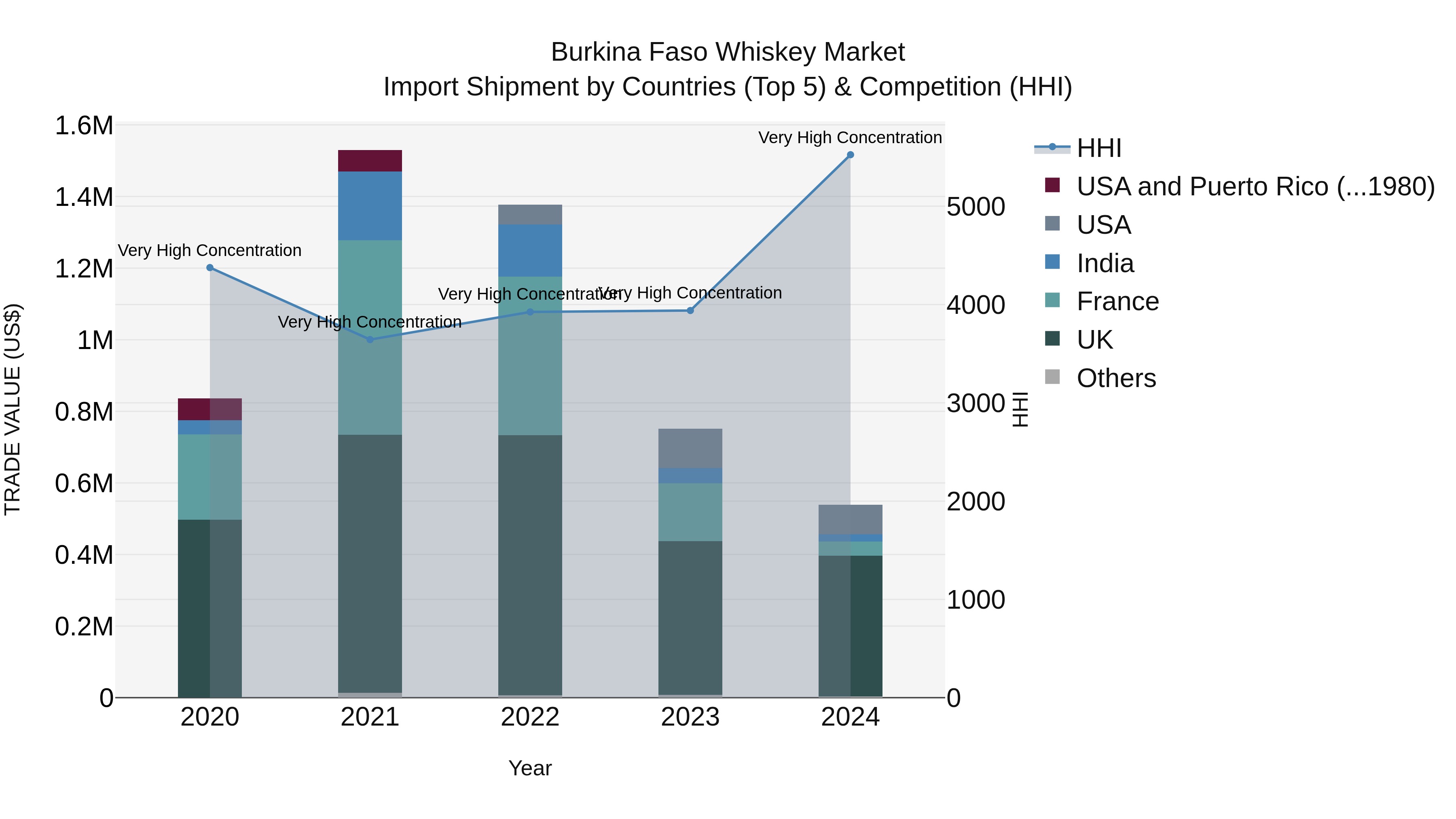
Burkina Faso`s whiskey import market in 2024 continues to be dominated by key exporters such as the UK, USA, France, India, and Ghana. Despite a high concentration with a significant Herfindahl-Hirschman Index (HHI), the market has experienced a negative compound annual growth rate (CAGR) of -10.41% from 2020-2024. The growth rate further declined in 2024 by -28.28%, indicating a challenging environment for whiskey imports in Burkina Faso. Monitoring shifts in consumer preferences and market dynamics will be crucial for stakeholders in the industry.
Burkina Faso Whiskey Market Overview
The whiskey market in Burkina Faso is characterized by a growing interest in premium and imported brands, driven by an increasing middle class and a rise in disposable incomes. The market is influenced by both local and international trends, with consumers becoming more discerning about quality and brand. Despite this growth, the market faces challenges such as limited local production and high import duties, which affect pricing and availability.
Drivers of the market
The whiskey market in Burkina Faso is primarily driven by a growing middle class with increasing disposable incomes. This demographic shift leads to greater spending on premium alcoholic beverages, including whiskey. Additionally, urbanization and changing lifestyle trends contribute to higher consumption rates. The rise in social events and celebrations where whiskey is preferred further fuels market growth. The increasing presence of international brands and their marketing efforts also play a significant role in driving the market.
Challenges of the market
The whiskey market in Burkina Faso faces several significant challenges. Firstly, the market is constrained by limited local production capabilities, with most whiskey being imported. This reliance on imports results in higher prices and vulnerability to supply chain disruptions. Additionally, there is a lack of widespread consumer awareness and education about whiskey, which affects demand. The market also contends with regulatory hurdles and import tariffs that can impact pricing and availability. Lastly, the informal sector`s presence and counterfeiting issues further complicate market dynamics.
Government Policy of the market
The whiskey market in Burkina Faso is shaped by government policies aimed at regulating alcohol production and consumption. The government enforces strict regulations on the importation and distribution of alcoholic beverages, including whiskey, to ensure quality standards and consumer safety. Licensing requirements for producers and distributors are rigorous, and adherence to health and safety standards is mandatory. Additionally, the government imposes taxes and tariffs on imported whiskey to control market competition and generate revenue. The promotion and advertising of whiskey are also regulated to prevent excessive consumption and protect public health.
Key Highlights of the Report:
- Burkina Faso Whiskey Market Outlook
- Market Size of Burkina Faso Whiskey Market, 2024
- Forecast of Burkina Faso Whiskey Market, 2031
- Historical Data and Forecast of Burkina Faso Whiskey Revenues & Volume for the Period 2021-2031
- Burkina Faso Whiskey Market Trend Evolution
- Burkina Faso Whiskey Market Drivers and Challenges
- Burkina Faso Whiskey Price Trends
- Burkina Faso Whiskey Porter`s Five Forces
- Burkina Faso Whiskey Industry Life Cycle
- Historical Data and Forecast of Burkina Faso Whiskey Market Revenues & Volume By Product Type for the Period 2021-2031
- Historical Data and Forecast of Burkina Faso Whiskey Market Revenues & Volume By American Whisky for the Period 2021-2031
- Historical Data and Forecast of Burkina Faso Whiskey Market Revenues & Volume By Irish Whisky for the Period 2021-2031
- Historical Data and Forecast of Burkina Faso Whiskey Market Revenues & Volume By Scotch Whisky for the Period 2021-2031
- Historical Data and Forecast of Burkina Faso Whiskey Market Revenues & Volume By Canadian Whisky for the Period 2021-2031
- Historical Data and Forecast of Burkina Faso Whiskey Market Revenues & Volume By Others for the Period 2021-2031
- Historical Data and Forecast of Burkina Faso Whiskey Market Revenues & Volume By Distribution Channel for the Period 2021-2031
- Historical Data and Forecast of Burkina Faso Whiskey Market Revenues & Volume By On-trade for the Period 2021-2031
- Historical Data and Forecast of Burkina Faso Whiskey Market Revenues & Volume By Off-trade for the Period 2021-2031
- Burkina Faso Whiskey Import Export Trade Statistics
- Market Opportunity Assessment By Product Type
- Market Opportunity Assessment By Distribution Channel
- Burkina Faso Whiskey Top Companies Market Share
- Burkina Faso Whiskey Competitive Benchmarking By Technical and Operational Parameters
- Burkina Faso Whiskey Company Profiles
- Burkina Faso Whiskey Key Strategic Recommendations






































