Cambodia Armored Vehicle Market Size, Share & Growth Rate
The Cambodia Armored Vehicle Market was estimated at USD 166 Million in 2025 and is projected to reach USD 221 Million by 2032, growing at a CAGR of 4.2% from 2026 to 2032. This growth trajectory is primarily fueled by escalating security concerns and the necessity for military modernization. The increasing focus on border security and counter-terrorism efforts further stimulates demand for versatile armored vehicles across various sectors, including military, law enforcement, and private security.
Cambodia Armored Vehicle Market Year-wise Growth Rate and Key Drivers
This graph highlights how the Cambodia Armored Vehicle Market has steadily grown over the years, supported by major growth factors.
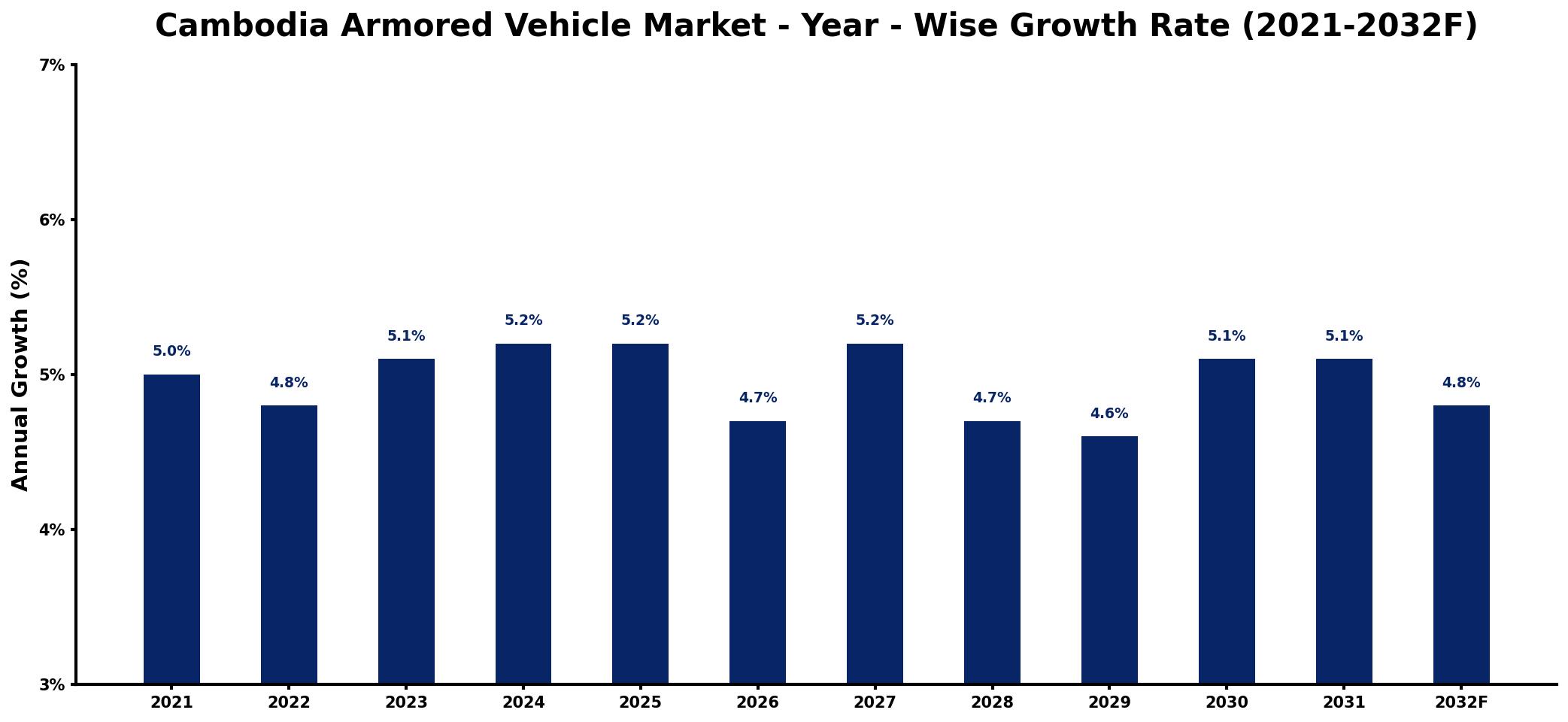
The table below presents the year‑wise growth rates along with the key drivers influencing the market
| Year | Growth Rate | Major Drivers |
| 2021 | 5.0% | Rising demand for security solutions |
| 2022 | 4.8% | Increased government defense spending |
| 2023 | 5.1% | Expansion of private security firms |
| 2024 | 5.2% | Growing interest in protective technologies |
| 2025 | 5.2% | Heightened regional geopolitical tensions |
| 2026 | 4.7% | Evolving urban security needs |
| 2027 | 5.2% | Investment in national infrastructure projects |
| 2028 | 4.7% | Strengthened law enforcement capabilities |
| 2029 | 4.6% | Emergence of new security threats |
| 2030 | 5.1% | Advancements in defense technologies |
| 2031 | 5.1% | Partnerships in international defense cooperation |
| 2032 | 4.8% | Focus on disaster response solutions |
Note: Market size estimations and growth projections presented in this report are based on 6Wresearch's proprietary forecasting methodology, utilizing the latest available industry data, government publications, and primary research inputs.
Cambodia Armored Vehicle Market Synopsis
The Cambodia Armored Vehicle Market is evolving in response to a complex security landscape characterized by regional geopolitical challenges and rising internal threats. The demand is increasingly shifting towards lightweight, maneuverable vehicles and advanced technologies that enhance operational effectiveness in diverse terrains.
Notably, the preference for mine-resistant ambush-protected (MRAP) vehicles reflects a strategic focus on troop safety against improvised explosive devices (IEDs). As Cambodia's defense capabilities continue to strengthen, the market is likely to adapt further, aligning with the unique security requirements of the nation.
Cambodia Armored Vehicle Market Key Takeaways
- Steady market growth driven by modernization and security needs.
- Light armored vehicles dominate demand from military and law enforcement sectors.
- Technological advancements are crucial for enhancing combat capabilities.
- Government policies regulate the importation and usage of armored vehicles.
- Investment opportunities abound in production and technology integration.
Evaluation of Restraints in Cambodia Armored Vehicle Market
The Cambodia Armored Vehicle Market faces several significant constraints that may inhibit its full potential. One of the primary challenges is the limited defense budget allocation, which restricts the ability of military and law enforcement agencies to invest in advanced armored systems. High import tariffs also pose barriers to accessing the latest technologies and vehicles, making it difficult for domestic players to compete with international manufacturers. Furthermore, a lack of skilled workforce for maintenance and operation compounds these challenges, necessitating strategic partnerships and investments in training and development.
Cambodia Armored Vehicle Market Trends
The current trends in the Cambodia Armored Vehicle Market reveal a distinct shift towards the adoption of lightweight, highly maneuverable vehicles tailored to navigate the countrys varied landscapes. Additionally, there is a growing inclination towards incorporating advanced features such as integrated communication systems and surveillance technologies, which enhance situational awareness for military and law enforcement operations. The emergence of multi-mission capable armored vehicles is also notable, allowing security forces to effectively address multiple challenges from border security to internal disturbances.
Cambodia Armored Vehicle Market Opportunities
The Cambodia Armored Vehicle Market presents attractive investment opportunities as the nation seeks to bolster its defense infrastructure. Potential areas for investment include the local manufacturing and assembly of armored vehicles to reduce reliance on imports, along with the integration of cutting-edge technologies for enhanced security operations. Furthermore, the ongoing modernization of the military and law enforcement agencies creates a demand for specialized vehicles equipped for peacekeeping missions and border surveillance, positioning investors to capitalize on this evolving landscape.
Government Initiatives in the Cambodia Armored Vehicle Market
The Cambodian government has instituted several policies to regulate the importation and usage of armored vehicles to ensure national security. Permits are required for entities wishing to bring armored vehicles into the country, and there are specific restrictions on their operation in certain areas to safeguard public safety. These regulatory frameworks aim to prevent misuse and facilitate the responsible deployment of armored vehicles across various sectors.
Future Insights of the Cambodia Armored Vehicle Market
Looking ahead to 2026-2032, the Cambodia Armored Vehicle Market is set for robust growth driven by increased defense expenditures and a commitment to modernizing military capabilities. The region's evolving security challenges will likely propel demand for advanced armored vehicles designed for both military and law enforcement applications. Moreover, global industry players are expected to explore opportunities within Cambodia, leading to the introduction of innovative technologies tailored to meet the unique requirements of the Cambodian defense sector.
Cambodia Armored Vehicle Market Latest Developments (2025 - 2026)
Recent developments in the Cambodia Armored Vehicle Market indicate a growing trend towards strategic partnerships aimed at enhancing local production capabilities. Additionally, there has been a noticeable increase in government initiatives focused on upgrading existing military infrastructure. These initiatives are likely to pave the way for enhanced procurement processes and technology acquisitions, fostering an environment conducive to sustained market growth.
Cambodia Armored Vehicle Market - Key Attractiveness of the Report
- 10 Years of Market Numbers
- Historical Data Starting from 2022 to 2025
- Base Year: 2025
- Forecast Data until 2032
- Key Performance Indicators Impacting the Market
- Major Upcoming Developments and Projects
Key Highlights of the Report:
- Cambodia Armored Vehicle Market Outlook
- Market Size of Cambodia Armored Vehicle Market, 2025
- Forecast of Cambodia Armored Vehicle Market, 2032
- Historical Data and Forecast of Cambodia Armored Vehicle Revenues & Volume for the Period 2022-2032F
- Cambodia Armored Vehicle Market Trend Evolution
- Cambodia Armored Vehicle Market Drivers and Challenges
- Cambodia Armored Vehicle Price Trends
- Cambodia Armored Vehicle Porter's Five Forces
- Cambodia Armored Vehicle Industry Life Cycle
- Historical Data and Forecast of Cambodia Armored Vehicle Market Revenues & Volume By Platform for the Period 2022-2032F
- Historical Data and Forecast of Cambodia Armored Vehicle Market Revenues & Volume By Combat Vehicles for the Period 2022-2032F
- Historical Data and Forecast of Cambodia Armored Vehicle Market Revenues & Volume By Combat Support Vehicles for the Period 2022-2032F
- Historical Data and Forecast of Cambodia Armored Vehicle Market Revenues & Volume By Unmanned Armored Ground Vehicles for the Period 2022-2032F
- Historical Data and Forecast of Cambodia Armored Vehicle Market Revenues & Volume By Mobility for the Period 2022-2032F
- Historical Data and Forecast of Cambodia Armored Vehicle Market Revenues & Volume By Wheeled for the Period 2022-2032F
- Historical Data and Forecast of Cambodia Armored Vehicle Market Revenues & Volume By Tracked for the Period 2022-2032F
- Historical Data and Forecast of Cambodia Armored Vehicle Market Revenues & Volume By System for the Period 2022-2032F
- Historical Data and Forecast of Cambodia Armored Vehicle Market Revenues & Volume By Engine for the Period 2022-2032F
- Historical Data and Forecast of Cambodia Armored Vehicle Market Revenues & Volume By Drive System for the Period 2022-2032F
- Historical Data and Forecast of Cambodia Armored Vehicle Market Revenues & Volume By Ballistic Armor for the Period 2022-2032F
- Historical Data and Forecast of Cambodia Armored Vehicle Market Revenues & Volume By Turret Drives for the Period 2022-2032F
- Historical Data and Forecast of Cambodia Armored Vehicle Market Revenues & Volume By Ammunition Handling System for the Period 2022-2032F
- Historical Data and Forecast of Cambodia Armored Vehicle Market Revenues & Volume By Fire Control Systems (FCS) for the Period 2022-2032F
- Historical Data and Forecast of Cambodia Armored Vehicle Market Revenues & Volume By Armaments for the Period 2022-2032F
- Historical Data and Forecast of Cambodia Armored Vehicle Market Revenues & Volume By Countermeasure System for the Period 2022-2032F
- Cambodia Armored Vehicle Import Export Trade Statistics
- Market Opportunity Assessment By Platform
- Market Opportunity Assessment By Mobility
- Market Opportunity Assessment By System
- Cambodia Armored Vehicle Top Companies Market Share
- Cambodia Armored Vehicle Competitive Benchmarking By Technical and Operational Parameters
- Cambodia Armored Vehicle Company Profiles
- Cambodia Armored Vehicle Key Strategic Recommendations






































