Cambodia Bakery Market: Import Trend Analysis
Cambodia import trend for the bakery market showed a 7.86% growth rate from 2023 to 2024, with a compound annual growth rate (CAGR) of 14.15% from 2020 to 2024. This significant increase in imports can be attributed to a shift in consumer preferences towards convenience foods and increased disposable income, driving demand for bakery products in the market.
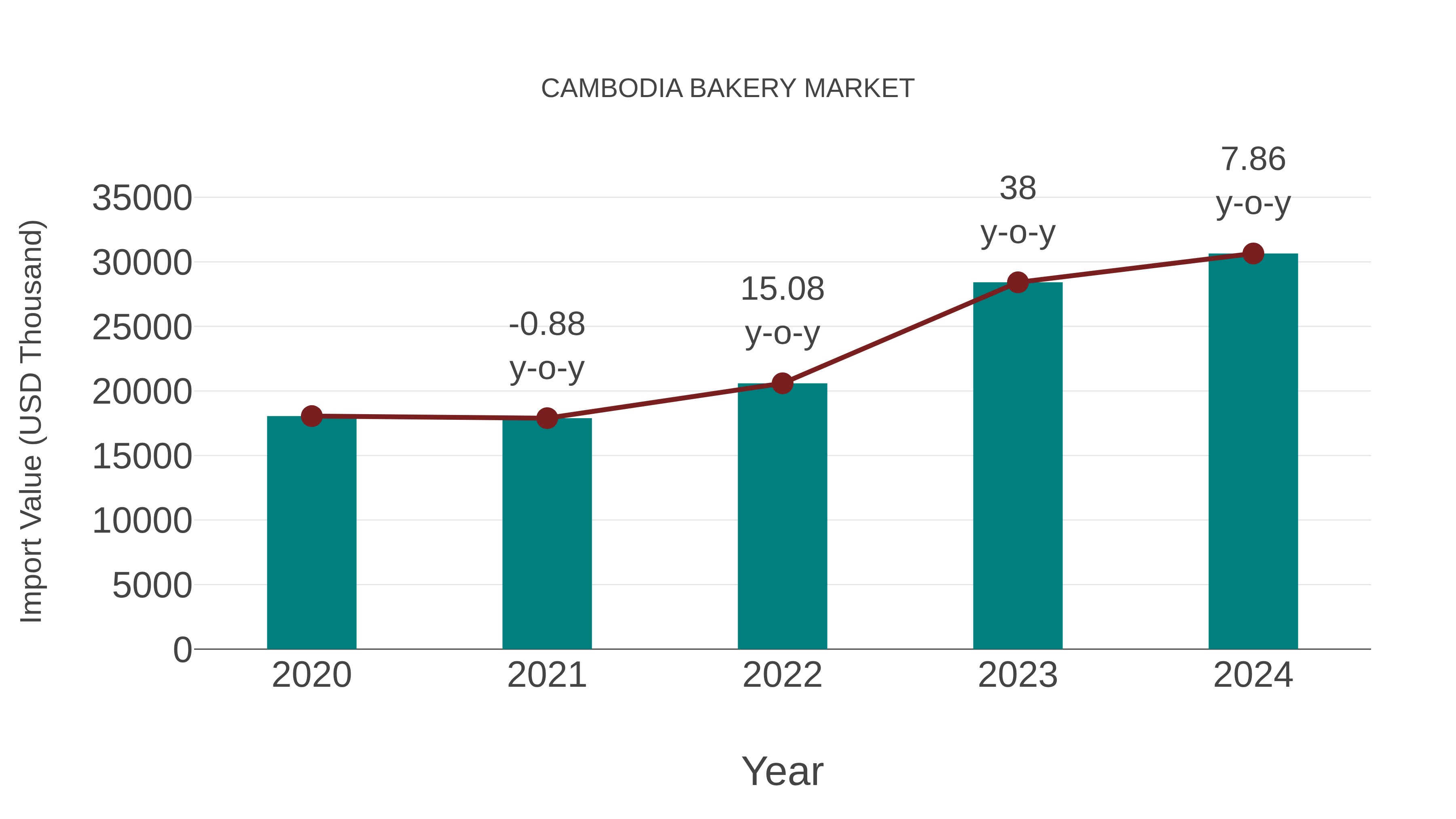
Cambodia Bakery Market Growth Rate
According to 6Wresearch internal database and industry insights, the Cambodia Bakery Market is projected to grow at a compound annual growth rate (CAGR) of 7.1% during the forecast period (2026-2032).
Topics Covered in the Cambodia Bakery Market Report
The Cambodia Bakery Market report thoroughly covers the market By Product Type, By Distribution Channel. The market report provides an unbiased and detailed analysis of ongoing market trends, opportunities/high growth areas, and market drivers, which help stakeholders devise and align their market strategies according to the current and future market dynamics.
Cambodia Bakery Market Highlights
| Report Name | Cambodia Bakery Market |
| Forecast Period | 2026–2032 |
| CAGR | 7.1% |
| Growing Sector | Hypermarkets/Supermarkets |
Cambodia Bakery Market Synopsis
Cambodia Bakery Market is expected to experience steady growth, owing to changing dietary habits of consumers, especially in urban cities, and the increasing requirement for convenient food products. Furthermore, modern retail outlet presence is also rising in Cambodia, which is likely to boost the growth of the bakery market in the country. At present, the market is witnessing a trend shift in terms of baked food, such as bread, cakes, and biscuits, in the daily diet of consumers, especially among the younger generation and working professionals.
In addition, the expansion of international bakery chains, the development of café culture in major cities like Phnom Penh, and the rising tourism sector are contributing to greater product availability and variety. Furthermore, improvements in food processing infrastructure and distribution networks are strengthening the overall growth prospects of the bakery industry in Cambodia.
Evaluation of Growth Drivers in Cambodia Bakery Market
Below mentioned are some prominent drivers and their influence on the market dynamics:
| Drivers | Primary Segments Affected | Why it Matters (Evidence) |
| Rising Urbanization and Lifestyle Changes | Bread, Cakes & Pastries | Urban consumers increasingly prefer convenient packaged bakery foods for daily consumption. |
| Expansion of Modern Retail Chains | Biscuits, Bread | Supermarkets and convenience stores provide wider shelf space for packaged bakery products. |
| Growth in Tourism and Hospitality Sector | Cakes & Pastries, Morning Goods | Hotels and cafés increase demand for premium bakery products. |
| Increasing Disposable Income | All Product Types, Supermarkets | Higher spending power encourages consumption of branded bakery goods. |
| Emergence of Local Bakery Brands | Bread & Biscuits, Specialty Stores | Local bakeries introduce innovative flavors and fresh bakery items, expanding market reach. |
Cambodia Bakery Market is expected to grow at the CAGR of 7.1% during the forecast period of 2026-2032. The most important factors that are expected to drive the Cambodia Bakery Market in the coming years are the rising demand for baked products such as different types of bread, cakes, and biscuits, which have now become a part of the regular diet of Cambodian people.
Besides, the ever-increasing tourism industry in Cambodia has also contributed to the demand for bakery products and bakery establishments. In addition, with the changing lifestyle of people and the busy work schedule, there is an ever-increasing demand for food that can be quickly consumed on the go, which is further strengthening the market for packaged baked goods.
Evaluation of Restraints in Cambodia Bakery Market
Below mentioned are some major restraints and their influence on the market dynamics:
| Restraints | Primary Segments Affected | What This Means (Evidence) |
| Limited Cold Chain Infrastructure | Cakes & Pastries, Specialty Stores | Lack of proper storage systems restricts distribution of fresh bakery products. |
| High Import Dependency for Ingredients | Bread, Cakes | Imported wheat and baking ingredients increase production costs. |
| Price Sensitivity Among Consumers | Biscuits, Bread | Many consumers prefer low-priced alternatives, limiting premium product adoption. |
| Limited Bakery Processing Technology | Morning Goods, Others | Smaller bakeries struggle to scale production due to limited modern equipment. |
| Competition from Traditional Snacks | All Product Types | Local street foods compete with packaged bakery products in daily consumption. |
Cambodia Bakery Market Challenges
Despite the positive growth projections, the Cambodia Bakery Market growth continues to face several challenges that affect the overall market share. Low technology adoption and poorly developed infrastructure act as key constraints for the production and distribution of bakery products in the country, resulting in higher production costs that are ultimately reflected in the retail prices charged to consumers.
Cambodia Bakery Market Trends
Some of the major trends prevailing in the Cambodia Bakery Market are as follows:
- Café and Bakery Chains Expansion: International and regional bakery café chains are expanding their operations in urban areas, thereby increasing the availability of premium quality cakes, pastries, and other bakery products.
- Increase in Demand for Packaged Snack Food: The customers are slowly adapting to packaged snack food as it offers them a long shelf life and also provides them with the facility of having it on the go.
- Product Innovation with Local Flavors: The bakeries are introducing their products with local flavors so that they can be sold in the local market as per the local tastes and preferences.
- Rising Popularity of Artisan and Premium Quality Bakery Products: The customers are showing interest in high-quality handcrafted products of bakeries.
Investment Opportunities in the Cambodia Bakery Market
The major investment opportunities in Cambodia Bakery Market are:
- Establishment of Modern Bakery Manufacturing Units – Investment in modern and automated manufacturing units of baked goods will help in efficient production and supply of packaged baked goods throughout the country.
- Development of Cold Chain Logistics – Investment in cold chain logistics will improve the quality of baked goods.
- Expansion of Bakery Café Franchises – International brands of bakery cafes will benefit from the increased demand for baked goods in urban areas of Cambodia.
- Innovation in Health-Focused Bakery Products – The development of healthy baked goods such as whole grain and low sugar will provide new market opportunities.
Top 5 Leading Players in the Cambodia Bakery Market
Prominent companies operating in the Cambodia Bakery Market include:
Government Regulations Introduced in the Cambodia Bakery Market
According to Cambodian Government Data, the government has established various regulations that directly affect the Cambodia Bakery Industry. The authorities are giving emphasis to food safety standards and hygiene protocols to protect the consumers. Although these regulations might increase the cost of operation, they will enhance client confidence and global market access. Additionally, the government is also providing incentives for businesses to adopt modern and sustainable practices.
Future Insights of the Cambodia Bakery Market
The future of the Bakery Market in Cambodia will become brighter through automation and improving increasingly into diversification of consumer preferences. The requirement of healthy and innovative bakery production will continue to grow because of that even more urbanization and inclination toward convenience. The whole market is expected to be increasingly competitive and promote innovation and sustainable practices for the long-run scenario that will take form for the Cambodian bakery industry.
Market Segmentation Analysis
The report offers a comprehensive study of the subsequent market segments and their leading categories:
1. Yamazaki Baking Co., Ltd.
| Company Name | Yamazaki Baking Co., Ltd. |
|---|---|
| Established Year | 1948 |
| Headquarters | Tokyo, Japan |
| Official Website | Click Here |
Yamazaki Baking is one of the leading bakery manufacturers in Asia, producing a wide range of bread, pastries, and packaged baked goods. The company supplies both domestic and international markets while supporting retail distribution networks that strengthen bakery product availability across developing Asian food markets.
2. Gardenia Bakeries (KL) Sdn Bhd
| Company Name | Gardenia Bakeries (KL) Sdn Bhd |
|---|---|
| Established Year | 1969 |
| Headquarters | Kuala Lumpur, Malaysia |
| Official Website | Click Here |
Gardenia Bakeries specializes in packaged bread and bakery products widely recognized for consistent quality and innovative flavors. The company plays a significant role in expanding the availability of modern bakery items across Southeast Asian retail outlets and supermarket distribution networks.
3. Mondelez International
| Company Name | Mondelez International |
|---|---|
| Established Year | 2012 |
| Headquarters | Chicago, United States |
| Official Website | Click Here |
Mondelez International produces a broad range of biscuits and snack bakery products distributed through retail and convenience channels worldwide. The company supports the growth of the packaged bakery snack segment across emerging food markets in Asia.
4. Nestlé S.A.
| Company Name | Nestlé S.A. |
|---|---|
| Established Year | 1866 |
| Headquarters | Vevey, Switzerland |
| Official Website | Click Here |
Nestlé offers a variety of packaged food products including bakery snacks and breakfast items. The company focuses on product innovation, efficient food processing, and strong distribution systems that expand the availability of convenient packaged foods in developing markets.
5. Britannia Industries Limited
| Company Name | Britannia Industries Limited |
|---|---|
| Established Year | 1892 |
| Headquarters | Bengaluru, India |
| Official Website | Click Here |
Britannia Industries produces biscuits, cakes, and other bakery snack foods widely distributed through retail channels. The company plays a significant role in expanding affordable packaged bakery products and strengthening the snack food market across emerging consumer economies.
Bread to Dominate the Market- By Product Type
According to Harsh, Senior Research Analyst, 6Wresearch, Bread is expected to dominate the Cambodia Bakery Market Share owing to its position as a staple bakery product widely consumed by households for breakfast and quick meals. The increasing adoption of westernized food habits among urban populations and the availability of packaged bread through supermarkets and convenience stores have significantly strengthened its market presence. Bread products also offer affordability and versatility, making them suitable for both home consumption and food service industries.
Key Attractiveness of the Report
- 10 Years of Market Numbers.
- Historical Data Starting from 2022 to 2025.
- Base Year: 2025.
- Forecast Data until 2032.
- Key Performance Indicators Impacting the Market.
- Major Upcoming Developments and Projects.
Key Highlights of the Report:
- Cambodia Bakery Market Outlook
- Market Size of Cambodia Bakery Market, 2025
- Forecast of Cambodia Bakery Market, 2032
- Historical Data and Forecast of Cambodia Bakery Revenues & Volume for the Period 2022-2032F
- Cambodia Bakery Market Trend Evolution
- Cambodia Bakery Market Drivers and Challenges
- Cambodia Bakery Price Trends
- Cambodia Bakery Porter's Five Forces
- Cambodia Bakery Industry Life Cycle
- Historical Data and Forecast of Cambodia Bakery Market Revenues & Volume By Product Type for the Period 2022-2032F
- Historical Data and Forecast of Cambodia Bakery Market Revenues & Volume By Cakes and Pastries for the Period 2022-2032F
- Historical Data and Forecast of Cambodia Bakery Market Revenues & Volume By Biscuits for the Period 2022-2032F
- Historical Data and Forecast of Cambodia Bakery Market Revenues & Volume By Bread for the Period 2022-2032F
- Historical Data and Forecast of Cambodia Bakery Market Revenues & Volume By Morning Goods for the Period 2022-2032F
- Historical Data and Forecast of Cambodia Bakery Market Revenues & Volume By Other for the Period 2022-2032F
- Historical Data and Forecast of Cambodia Bakery Market Revenues & Volume By Distribution Channel for the Period 2022-2032F
- Historical Data and Forecast of Cambodia Bakery Market Revenues & Volume By Hypermarkets/Supermarkets for the Period 2022-2032F
- Historical Data and Forecast of Cambodia Bakery Market Revenues & Volume By Convenience Stores for the Period 2022-2032F
- Historical Data and Forecast of Cambodia Bakery Market Revenues & Volume By Speciality Stores for the Period 2022-2032F
- Historical Data and Forecast of Cambodia Bakery Market Revenues & Volume By Online Retailing for the Period 2022-2032F
- Historical Data and Forecast of Cambodia Bakery Market Revenues & Volume By Other for the Period 2022-2032F
- Cambodia Bakery Import Export Trade Statistics
- Market Opportunity Assessment By Product Type
- Market Opportunity Assessment By Distribution Channel
- Cambodia Bakery Top Companies Market Share
- Cambodia Bakery Competitive Benchmarking By Technical and Operational Parameters
- Cambodia Bakery Company Profiles
- Cambodia Bakery Key Strategic Recommendations
Market Covered
The report offers a comprehensive study of the subsequent market segments:
By Product type
- Cakes And Pastries
- Biscuits
- Bread
- Morning Goods
- Other
By Distribution Channel
- Hypermarkets/Supermarkets
- Convenience Stores
- Speciality Stores
- Online Retailing
- Other






































