Cambodia Business Intelligence Market Size & Growth Rate (2026-2032)
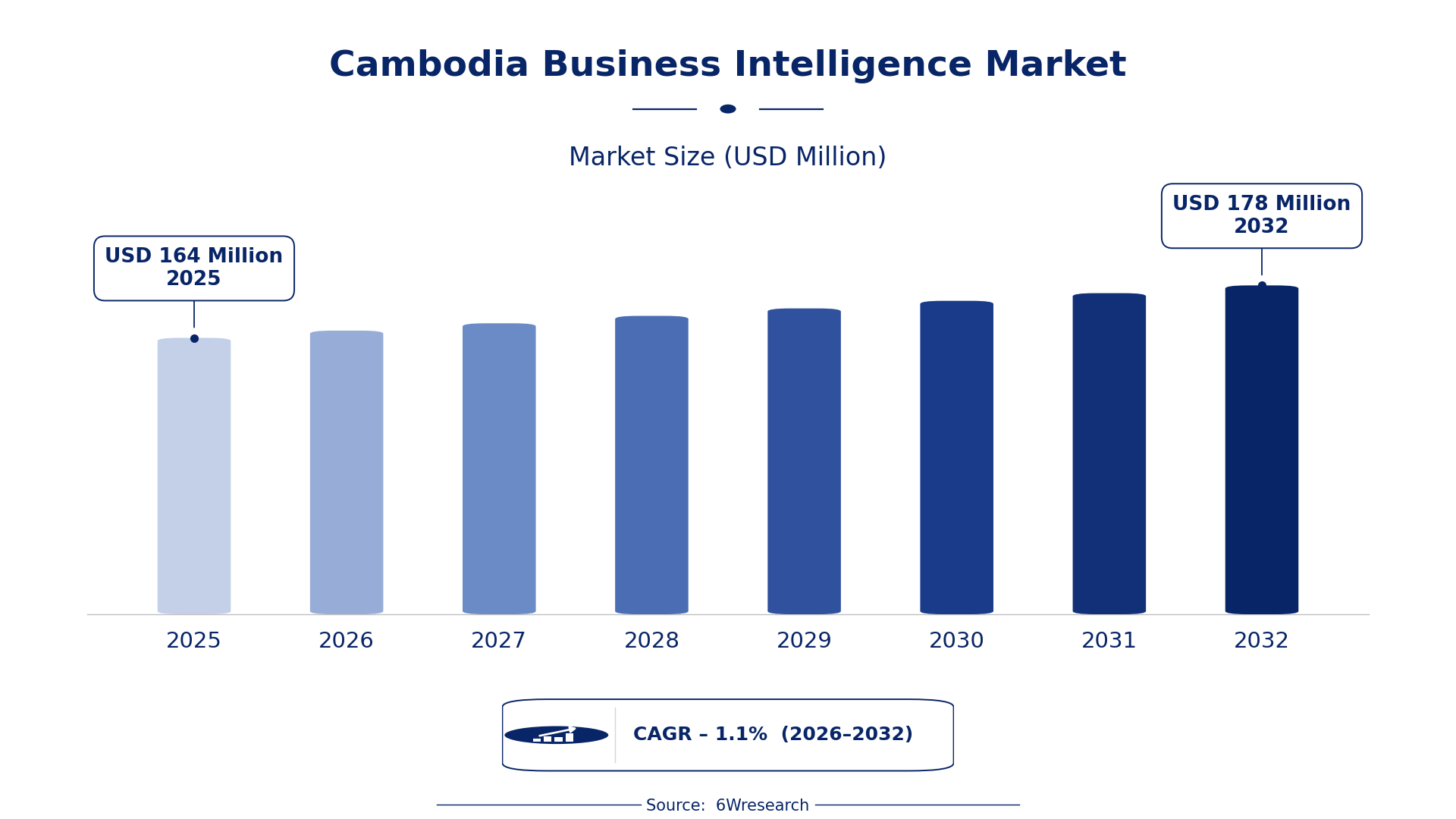
The Cambodia Business Intelligence Market was estimated at USD 164 Million in 2025 and is projected to reach USD 178 Million by 2032, growing at a CAGR of 1.1% from 2026 to 2032.
Cambodia Business Intelligence Market Synopsis
As Cambodian businesses increasingly recognize the value of data-driven insights, the demand for business intelligence solutions is rising. Industries like finance, retail, and telecommunications are particularly eager to adopt tools that provide real-time analytics and competitive intelligence.
This market is characterized by a blend of local and international vendors offering cloud-based solutions, appealing to the needs of small and medium-sized enterprises. As the economy grows, so does the appetite for advanced analytics and predictive tools that can enhance operational efficiency.
Cambodia Business Intelligence Market Year-wise Growth Rate and Key Drivers
This graph illustrates the annual growth rates of the Cambodia Business Intelligence Market from 2021 to 2032, highlighting a steady upward trajectory and projected expansion over the forecast period.
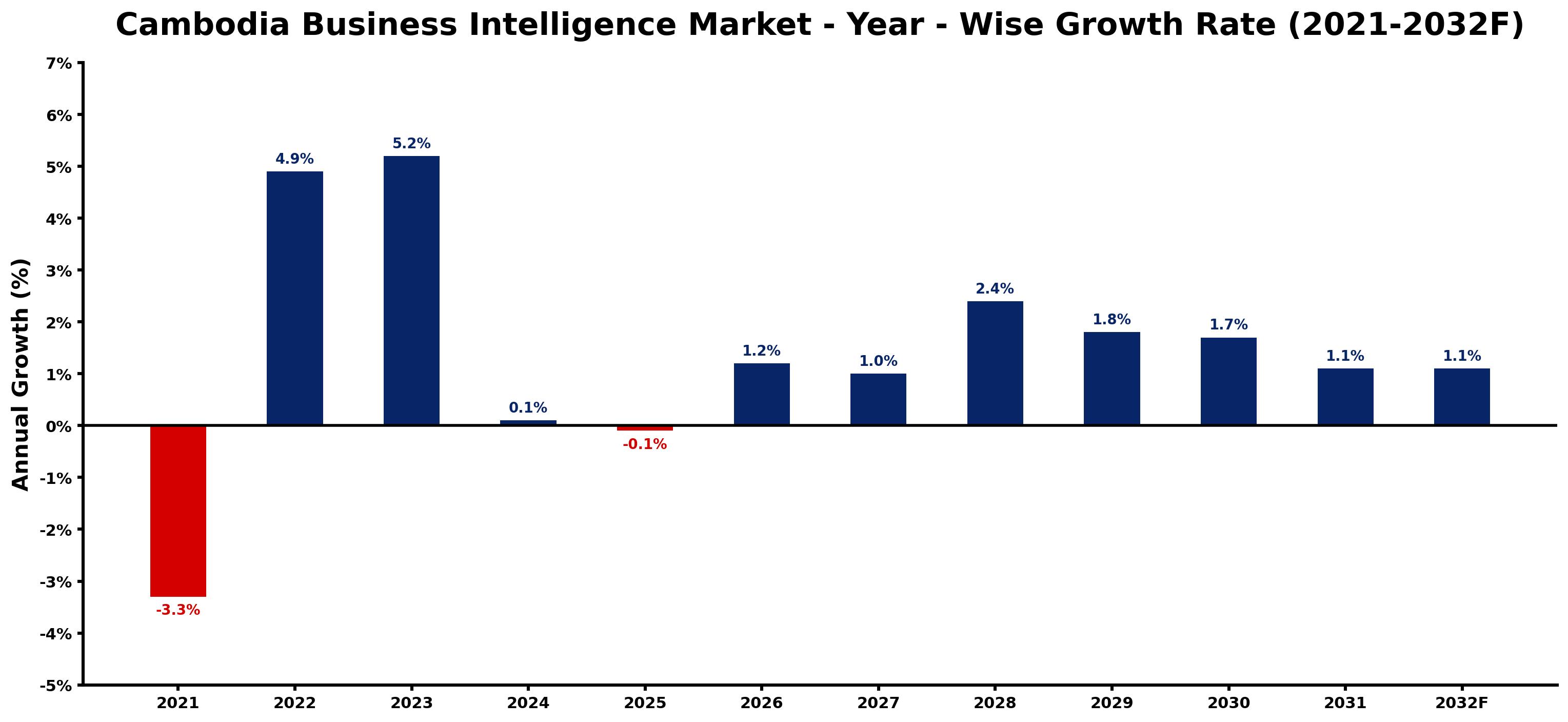
The table below presents the year‑wise growth rates along with the key drivers influencing the market
| Year | Growth Rate | Major Drivers |
| 2021 | -3.3% | COVID-19 lockdowns reduced demand for business intelligence tools. |
| 2022 | 4.9% | Rise in e-commerce driving analytics demand. |
| 2023 | 5.2% | Government promoting digital transformation initiatives. |
| 2024 | 0.1% | Increased foreign investment in tech startups. |
| 2025 | -0.1% | Limited internet infrastructure hampers data analytics growth. |
| 2026 | 1.2% | Growth of local SMEs adopting data analytics. |
| 2027 | 1.0% | Bamboo Island tech park fostering innovation. |
| 2028 | 2.4% | Enhanced internet connectivity boosting data accessibility. |
| 2029 | 1.8% | National data privacy regulations spurring analytics needs. |
| 2030 | 1.7% | Local universities expanding business analytics programs. |
| 2031 | 1.1% | Cambodia's tourism recovery necessitating market insights. |
| 2032 | 1.1% | Real estate sector leveraging data for decision making. |
Note: Market size estimations and growth projections presented in this report are based on 6Wresearch's proprietary forecasting methodology, utilizing the latest available industry data, government publications, and primary research inputs.
Cambodia Business Intelligence Market Key Takeaways
Below are some of the specific key takeaways from the market, including:
- Growing demand for cloud-based BI solutions tailored for SMEs.
- Increased investment in advanced analytics and AI capabilities.
- Real-time analytics becoming crucial for faster decision-making.
- Focus on data security and regulatory compliance shaping purchasing decisions.
- Opportunities for training and education in data analytics emerging rapidly.
Evaluation of Restraints in Cambodia Business Intelligence Market
Despite promising growth, the Cambodia Business Intelligence Market faces significant challenges. Limited data availability and quality hinder comprehensive analysis, leaving many businesses without the insights they need. The shortage of skilled professionals in data analysis restricts effective interpretation of data, further complicating decision-making processes. on top of that, the country's infrastructure struggles to support advanced analytics tools, leading to inefficiencies. Additionally, navigating the regulatory environment poses obstacles for companies trying to collect and analyze data effectively.
Cambodia Business Intelligence Market Trends
Currently, there is a noticeable shift toward advanced analytics tools in the Cambodia Business Intelligence Market. Businesses are increasingly investing in cloud solutions that allow for scalability and accessibility. The integration of artificial intelligence and machine learning is becoming prevalent, enabling organizations to derive deeper insights from their data. There is also a heightened emphasis on real-time analytics, which is essential for rapid decision-making in a competitive environment. Data security and compliance are critical as businesses seek solutions that meet regulatory requirements.
Cambodia Business Intelligence Market Opportunities
The growth of the Cambodia Business Intelligence Market presents numerous investment opportunities, especially given the rising trend of digital transformation. As e-commerce and digital marketing expand, the demand for effective business intelligence solutions continues to increase. Investing in software development, data analytics platforms, and consultancy services can yield substantial returns. Additionally, establishing training programs aimed at nurturing skilled professionals in business intelligence will be crucial for meeting the needs of this burgeoning market.
Government Initiatives in the Cambodia Business Intelligence Market
The Cambodian government is actively fostering the growth of the Business Intelligence market through a series of targeted policies and initiatives. By promoting an investment-friendly environment, the government aims to enhance the regulatory framework, streamline licensing processes, and improve infrastructure, all of which are vital for developing the Business Intelligence sector. These initiatives are designed to create a skilled workforce, ensuring that the growing demand for data professionals is met.
- A national digital infrastructure upgrade programme recently completed to enhance connectivity and data access.
- Current initiatives focused on improving training and education programs in collaboration with universities.
- A planned public-private partnership expected to facilitate the development of regulatory standards for data privacy and security by 2028.
- Ongoing tax incentives designed to attract foreign investment in technology and data sectors.
- Upcoming workshops and seminars aimed at educating businesses on data analytics tools and best practices.
Future Insights of the Cambodia Business Intelligence Market
Looking ahead to 2026-2032, the Cambodia Business Intelligence Market is set for notable expansion. As digital transformation accelerates, businesses will increasingly prioritize data-driven decision-making. The burgeoning e-commerce sector and a growing emphasis on operational efficiency will drive demand for innovative BI solutions. Government initiatives aimed at promoting a digital economy will further bolster market growth, paving the way for both local and international vendors to thrive in this dynamic environment.
Cambodia Business Intelligence Market Latest Developments
In the past year, the Cambodia Business Intelligence Market has seen several noteworthy developments. Companies are actively launching new tools and services to meet the increasing demand for data analytics. The landscape is changing as businesses adapt to the necessity of real-time insights and competitive intelligence.
- A major technology vendor introduced a new cloud-based BI platform in early 2025, enhancing data visualization capabilities for local businesses.
- An ongoing initiative began in mid-2025, focusing on the integration of AI in business analytics tools to improve data insights.
- A recent partnership between a local tech firm and an international analytics provider aims to expand BI services across the country, with rollout expected by late 2026.
- In Q2 2025, a leading consultancy launched a series of workshops to train businesses on effective data utilization strategies.
- Upcoming in 2026 is a government-led project to improve data privacy regulations that will directly impact BI solutions and practices.
Cambodia Business Intelligence Market - Key Attractiveness of the Report
- 10 Years of Market Numbers
- Historical Data Starting from 2022 to 2025
- Base Year: 2025
- Forecast Data until 2032
- Key Performance Indicators Impacting the Market
- Major Upcoming Developments and Projects
Key Highlights of the Report:
- Cambodia Business Intelligence Market Outlook
- Market Size of Cambodia Business Intelligence Market, 2025
- Forecast of Cambodia Business Intelligence Market, 2032
- Historical Data and Forecast of Cambodia Business Intelligence Revenues & Volume for the Period 2022-2032F
- Cambodia Business Intelligence Market Trend Evolution
- Cambodia Business Intelligence Market Drivers and Challenges
- Cambodia Business Intelligence Price Trends
- Cambodia Business Intelligence Porter's Five Forces
- Cambodia Business Intelligence Industry Life Cycle
- Historical Data and Forecast of Cambodia Business Intelligence Market Revenues & Volume By Component for the Period 2022-2032F
- Historical Data and Forecast of Cambodia Business Intelligence Market Revenues & Volume By Solutions for the Period 2022-2032F
- Historical Data and Forecast of Cambodia Business Intelligence Market Revenues & Volume By Services for the Period 2022-2032F
- Historical Data and Forecast of Cambodia Business Intelligence Market Revenues & Volume By Business Function for the Period 2022-2032F
- Historical Data and Forecast of Cambodia Business Intelligence Market Revenues & Volume By Human Resource for the Period 2022-2032F
- Historical Data and Forecast of Cambodia Business Intelligence Market Revenues & Volume By Finance for the Period 2022-2032F
- Historical Data and Forecast of Cambodia Business Intelligence Market Revenues & Volume By Operations for the Period 2022-2032F
- Historical Data and Forecast of Cambodia Business Intelligence Market Revenues & Volume By Sales and Marketing for the Period 2022-2032F
- Historical Data and Forecast of Cambodia Business Intelligence Market Revenues & Volume By Deployment Mode for the Period 2022-2032F
- Historical Data and Forecast of Cambodia Business Intelligence Market Revenues & Volume By On-premises for the Period 2022-2032F
- Historical Data and Forecast of Cambodia Business Intelligence Market Revenues & Volume By Cloud for the Period 2022-2032F
- Historical Data and Forecast of Cambodia Business Intelligence Market Revenues & Volume By Organization Size for the Period 2022-2032F
- Historical Data and Forecast of Cambodia Business Intelligence Market Revenues & Volume By SMEs for the Period 2022-2032F
- Historical Data and Forecast of Cambodia Business Intelligence Market Revenues & Volume By Large Enterprises for the Period 2022-2032F
- Historical Data and Forecast of Cambodia Business Intelligence Market Revenues & Volume By Vertical for the Period 2022-2032F
- Historical Data and Forecast of Cambodia Business Intelligence Market Revenues & Volume By Retail for the Period 2022-2032F
- Historical Data and Forecast of Cambodia Business Intelligence Market Revenues & Volume By Manufacturing for the Period 2022-2032F
- Historical Data and Forecast of Cambodia Business Intelligence Market Revenues & Volume By Government and Public Services for the Period 2022-2032F
- Historical Data and Forecast of Cambodia Business Intelligence Market Revenues & Volume By Media and Entertainment for the Period 2022-2032F
- Historical Data and Forecast of Cambodia Business Intelligence Market Revenues & Volume By Transportation and Logistics for the Period 2022-2032F
- Historical Data and Forecast of Cambodia Business Intelligence Market Revenues & Volume By BFSI for the Period 2022-2032F
- Historical Data and Forecast of Cambodia Business Intelligence Market Revenues & Volume By Telecom and IT for the Period 2022-2032F
- Historical Data and Forecast of Cambodia Business Intelligence Market Revenues & Volume By Healthcare and Life Sciences for the Period 2022-2032F
- Cambodia Business Intelligence Import Export Trade Statistics
- Market Opportunity Assessment By Component
- Market Opportunity Assessment By Business Function
- Market Opportunity Assessment By Deployment Mode
- Market Opportunity Assessment By Organization Size
- Market Opportunity Assessment By Vertical
- Cambodia Business Intelligence Top Companies Market Share
- Cambodia Business Intelligence Competitive Benchmarking By Technical and Operational Parameters
- Cambodia Business Intelligence Company Profiles
- Cambodia Business Intelligence Key Strategic Recommendations






































