Cambodia Fruit Powder Market Size, Share & Growth Rate
The Cambodia Fruit Powder Market was estimated at USD 351 Million in 2025 and is projected to reach USD 489 Million by 2032, growing at a CAGR of 4.9% from 2026 to 2032. This growth trajectory is primarily driven by the rising consumer awareness surrounding health benefits of fruit powders, as well as the increasing demand for natural and organic products. Additionally, the ongoing expansion of the food and beverage industry in Cambodia is enhancing the incorporation of fruit powders in various applications, further boosting market growth.
Cambodia Fruit Powder Market Year-wise Growth Rate and Key Drivers
This graph highlights how the Cambodia Fruit Powder Market has steadily grown over the years, supported by major growth factors.
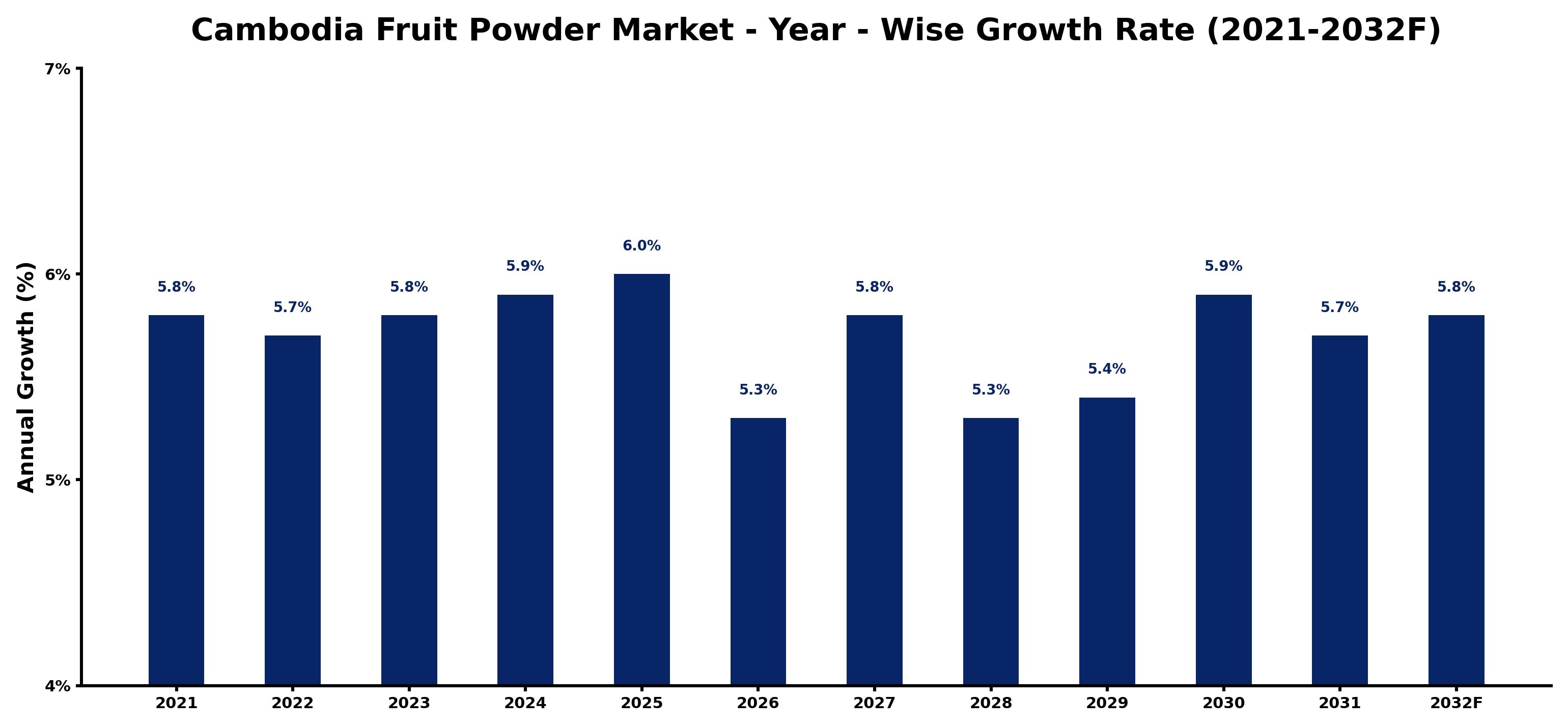
The table below presents the year‑wise growth rates along with the key drivers influencing the market
| Year | Growth Rate | Major Drivers |
| 2021 | 5.8% | New processing facilities enhance fruit powder production efficiency |
| 2022 | 5.7% | Accelerated demand for health products boosted fruit powder production |
| 2023 | 5.8% | Modern processing facilities boost fruit powder production capacity and efficiency |
| 2024 | 5.9% | Domestic fruit processing plants invest in advanced dehydration technology |
| 2025 | 6.0% | Technology integration in processing boosts Cambodia's fruit powder yield |
| 2026 | 5.3% | Accelerated domestic fruit powder production meets export market demand |
| 2027 | 5.8% | Local processing facilities scaled up production capacity for fruit powders |
| 2028 | 5.3% | Fruit powder manufacturers adopt advanced dehydration technology for efficiency |
| 2029 | 5.4% | Factory upgrades enhanced fruit processing efficiency and output levels |
| 2030 | 5.9% | New fruit processing facilities boost Cambodia's export capabilities |
| 2031 | 5.7% | New fruit drying technologies boosted Cambodia's powder production efficiency |
| 2032 | 5.8% | Export driven demand boosts fruit powder production facility upgrades |
Note - Market size estimations and growth projections presented in this report are based on 6Wresearch's advanced forecasting approach, validated with industry datasets as of June 2026.
Cambodia Fruit Powder Market Synopsis
The demand for fruit powders in Cambodia is gaining momentum, particularly for popular variants such as mango and dragon fruit, which are being integrated into diverse products ranging from snacks to nutritional supplements. This surge in interest is largely due to changing consumer preferences towards healthier food alternatives.
On the supply side, Cambodia's agricultural sector is evolving, with investments aimed at improving processing technology and quality standards. This has the potential to ensure a reliable supply chain for fruit powder production, addressing some of the market's existing challenges.
Cambodia Fruit Powder Market Key Takeaways
- The market is experiencing a robust growth phase, driven by health-conscious consumer behavior.
- Investment opportunities are ripe due to Cambodia's expanding agriculture and food sectors.
- Government policies are fostering innovation and infrastructure improvements within the industry.
- Challenges such as supply chain inefficiencies and quality control are being tackled through modernization efforts.
- Increasing product innovation is essential for meeting evolving consumer preferences.
Evaluation of Restraints in Cambodia Fruit Powder Market
Despite the promising growth prospects, several factors are impeding the Cambodia Fruit Powder Market. Inconsistent supply chain infrastructure remains a notable concern, often leading to interruptions in the availability of quality raw materials for fruit powder production. Additionally, limited access to advanced processing technology can hinder efficiency and product quality. These challenges necessitate a coordinated effort towards enhancing logistics and technology adoption to bolster the market's competitiveness.
Cambodia Fruit Powder Market Trends
Current trends indicate a shift towards natural and organic food products, with fruit powders being perceived as convenient nutrient-rich alternatives. There's a significant movement towards health-oriented products, including functional foods and beverages that leverage the nutritional benefits of fruit powders. As the food and beverage landscape in Cambodia continues to evolve, consumers are increasingly drawn to products that emphasize sustainability and traceability in sourcing.
Cambodia Fruit Powder Market Opportunities
Investors should closely examine the burgeoning demand for clean-label fruit powders, particularly as consumer preference shifts towards transparency in food sourcing. With a growing focus on health and convenience, the market is ripe for innovations in product formulations. Additionally, establishing collaborations with local farmers and technology providers can enhance sourcing capabilities while ensuring quality and sustainability in production.
Government Initiatives in the Cambodia Fruit Powder Market
The Cambodian government is actively supporting the fruit powder sector through various initiatives aimed at agricultural innovation and enhancing processing capabilities. By promoting technology adoption, the government aims to improve efficiency in fruit production and processing. Infrastructure development is also a priority, aimed at facilitating smoother distribution channels for fruit powder products. These efforts, alongside streamlined trade regulations, are designed to create a more favorable environment for market growth.
Future Insights of the Cambodia Fruit Powder Market
Looking forward to 2026-2032, the Cambodia Fruit Powder Market is set to experience significant transformation driven by growing health awareness and rising disposable incomes. The increasing preference for functional foods and the integration of fruit powders into diverse applications will likely fuel market expansion. As the industry evolves, we can expect enhanced product innovation and a diversification of offerings that cater to the health-oriented consumer segment.
Cambodia Fruit Powder Market Latest Developments (May 2025 - June 2026)
Recently, the market has seen a notable uptick in investments directed toward improving processing facilities, aimed at ensuring higher quality outputs. Additionally, new partnerships are being formed between local farmers and food manufacturers to enhance supply chain efficiency. Moreover, growing consumer campaigns focused on health and wellness are increasing awareness and demand for fruit powders, influencing market dynamics positively.
Cambodia Fruit Powder Market - Key Attractiveness of the Report
- 10 Years of Market Numbers
- Historical Data Starting from 2022 to 2025
- Base Year: 2025
- Forecast Data until 2032
- Key Performance Indicators Impacting the Market
- Major Upcoming Developments and Projects
Key Highlights of the Report:
- Cambodia Fruit Powder Market Outlook
- Market Size of Cambodia Fruit Powder Market, 2025
- Forecast of Cambodia Fruit Powder Market, 2032
- Historical Data and Forecast of Cambodia Fruit Powder Revenues & Volume for the Period 2022-2032F
- Cambodia Fruit Powder Market Trend Evolution
- Cambodia Fruit Powder Market Drivers and Challenges
- Cambodia Fruit Powder Price Trends
- Cambodia Fruit Powder Porter's Five Forces
- Cambodia Fruit Powder Industry Life Cycle
- Historical Data and Forecast of Cambodia Fruit Powder Market Revenues & Volume By Type for the Period 2022-2032F
- Historical Data and Forecast of Cambodia Fruit Powder Market Revenues & Volume By Banana for the Period 2022-2032F
- Historical Data and Forecast of Cambodia Fruit Powder Market Revenues & Volume By Grapes for the Period 2022-2032F
- Historical Data and Forecast of Cambodia Fruit Powder Market Revenues & Volume By Blueberry for the Period 2022-2032F
- Historical Data and Forecast of Cambodia Fruit Powder Market Revenues & Volume By Mango for the Period 2022-2032F
- Historical Data and Forecast of Cambodia Fruit Powder Market Revenues & Volume By others for the Period 2022-2032F
- Historical Data and Forecast of Cambodia Fruit Powder Market Revenues & Volume By Application for the Period 2022-2032F
- Historical Data and Forecast of Cambodia Fruit Powder Market Revenues & Volume By Bakery & Confectionery for the Period 2022-2032F
- Historical Data and Forecast of Cambodia Fruit Powder Market Revenues & Volume By Dairy & Frozen Desserts for the Period 2022-2032F
- Historical Data and Forecast of Cambodia Fruit Powder Market Revenues & Volume By Beverages for the Period 2022-2032F
- Historical Data and Forecast of Cambodia Fruit Powder Market Revenues & Volume By Food Supplements for the Period 2022-2032F
- Historical Data and Forecast of Cambodia Fruit Powder Market Revenues & Volume By others for the Period 2022-2032F
- Cambodia Fruit Powder Import Export Trade Statistics
- Market Opportunity Assessment By Type
- Market Opportunity Assessment By Application
- Cambodia Fruit Powder Top Companies Market Share
- Cambodia Fruit Powder Competitive Benchmarking By Technical and Operational Parameters
- Cambodia Fruit Powder Company Profiles
- Cambodia Fruit Powder Key Strategic Recommendations






































